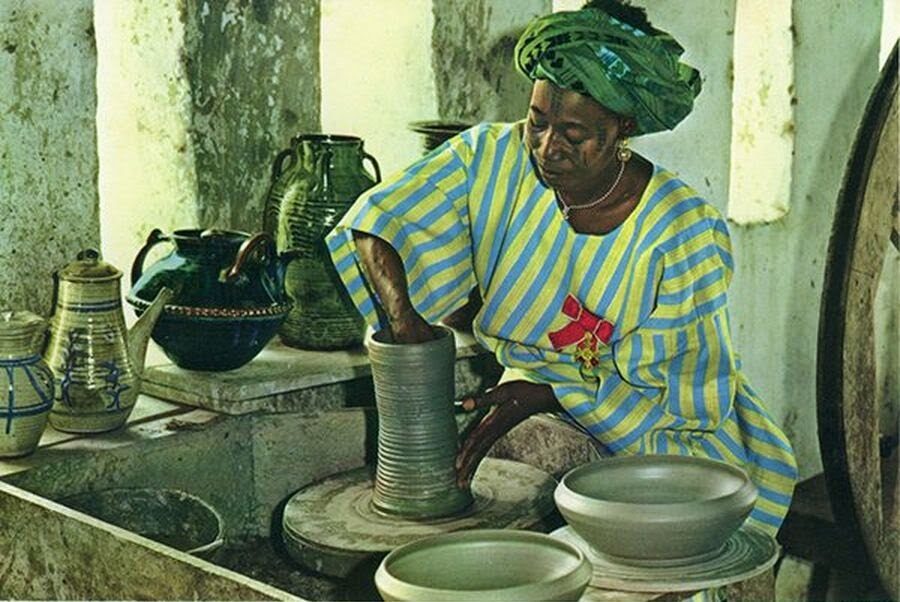
Ladi Kwali’s story is one of those quiet Nigerian legends that never grow old. Born in 1925 in a small Gwari community in Kwali, she learned pottery the same way many girls around her did—by watching the women of her family shape clay into everyday household vessels. But from the beginning, her work carried something extra. Her pots were bigger, cleaner, more expressive. People travelled from nearby villages just to buy “Kwali pots.”
Her life changed in the 1950s when Michael Cardew, a British studio potter appointed by the colonial government, saw one of her pieces in a local palace. He immediately went looking for the woman behind the work. When Ladi arrived at the Abuja Pottery Training Centre, she didn’t come as a beginner—she came as a master. What she found there was not a replacement of her tradition, but a new space to stretch it. She learned glazing, experimented with firing, and began blending Gwari designs with modern studio techniques. The result? Pottery that was unmistakably Nigerian, yet polished enough to command global respect.
By the 1960s, her works were already touring exhibitions in London, Germany, and the U.S. Her pots—rounded, earthy, and decorated with her familiar lizards, snakes, and birds—became symbols of a Nigeria that could hold its own anywhere in the world. Some of these pieces still sit in major museums today.
Back home, her impact was even bigger. She became a teacher at the pottery centre, gently passing on her skills to a new generation. Many of her students say she never rushed, never raised her voice—she simply guided their hands until the clay responded. When the Abuja pottery centre was renamed in her honour, it felt only natural. When she appeared on the N20 note, it was a national nod to a woman who had shaped more than just pottery—she had shaped pride.
Ladi Kwali’s legacy is not loud, but it is lasting. She showed that traditional craft is not “old-fashioned”—it is identity. She proved that art made from simple clay can travel farther than its maker ever imagined. And she left behind a reminder that some of Nigeria’s greatest stories come from everyday people doing extraordinary work with their hands.
We’ve got the edge. Get real-time reports, breaking scoops, and exclusive angles delivered straight to your phone. Don’t settle for stale news. Join LEADERSHIP NEWS on WhatsApp for 24/7 updates →
Join Our WhatsApp Channel