
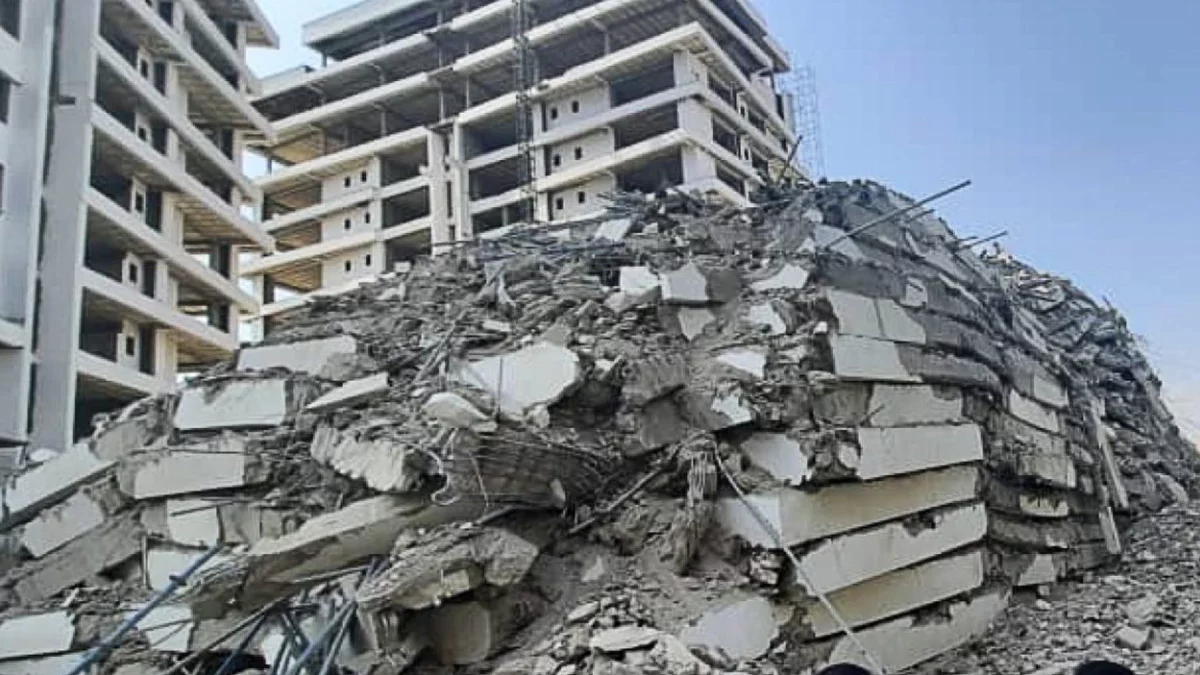
Following the collapse of a school building at Yemco Schools, 11, Adu Street, Aguda, Ogba, in Ojodu Local Council Development Area, Lagos, on Monday, March 9, 2026, the Building Collapse Prevention Guild (BCPG) has called for the installation of early warning systems in buildings in the country.
The Guild, in a statement signed by BCPG Ojodu cell coordinator, Prince Abiodun Adegoke, a surveyor; general secretary, Dom Ibeh, an architect and public relations officer, Femi Ishola, a builder, said the latest collapse underscored the critical need for proactive early warning systems in Nigerian buildings.
“Fortunately, the pupils and staff were evacuated in time, demonstrating how timely alerts could prevent loss of life. Buildings often exhibit tell-tale signs of impending failure before collapse. Common indicators include concrete spalling, visible cracks in walls or columns, bulging surfaces, unusual vibrations, and deflection of floors or beams. Observing these early signs provides a crucial window for intervention.
“The collapse of the four-storey Yemco school building at Ogba, Ojodu , four days to the 6th anniversary of a similar collapse of a five-storey Ohen school building at 63, Massey Street, Ita- Faaji, Lagos Island, on Wednesday, March 13, 2019, heightened the importance of Early Warning Systems.
“According to the feedback from the BCPG Lagos Island Cell, pre – building collapse cracks, spalling of concrete and the accompanying sounds were noticed in the Ohen school building at Ita-Faaji on that fateful day. Unfortunately, the building collapsed before the pupils and other occupants could be evacuated, leading to the death of about 20 pupils, while many sustained injuries.’’
The Guild emphasised that the narrow escape of the evacuated pupils and staff of Yemco Schools from the building collapse has initiated a call for the installation of early warning systems in buildings.
‘’Modern building collapse detection systems now take early warning to the next level. IoT-enabled sensors embedded in structural members continuously monitor stress, movement, and deflection. As soon as the building exceeds safe thresholds, when beams bend, columns deflect, or vibrations rise, alarms are triggered, alerting occupants and building managers to evacuate and take immediate action.”
“They said while structural engineers interpret sensor data, all building professionals, including town planners, architects, engineers, builders, surveyors, quantity surveyors, estate surveyors and valuers, and facility managers, play a role in ensuring early signs are noticed and acted upon.
“High-occupancy buildings such as schools, hospitals, and multi-storey residential complexes should be prioritised for these systems. The school building collapse at Aguda, Ogba, demonstrates a simple but vital lesson: detecting tell-tale signs and equipping buildings with Early Warning Systems to save lives.”
“They urge building owners, managers, and regulators to adopt smart monitoring devices in all high-risk buildings, enabling real-time alerts, timely evacuation, and a safer urban environment across Nigeria.
“The policy of continual structural integrity tests on buildings, especially the old ones, should be well implemented.
“This latest school building collapse should serve as a wake-up call to the Lagos State government to act quickly on the distressed three-storey school building (s) at Mainland Senior High School, Onayade Street, Fadeyi, Yaba. BCPG Yaba Cell officially drew the attention of the
We’ve got the edge. Get real-time reports, breaking scoops, and exclusive angles delivered straight to your phone. Don’t settle for stale news. Join LEADERSHIP NEWS on WhatsApp for 24/7 updates →
Join Our WhatsApp Channel