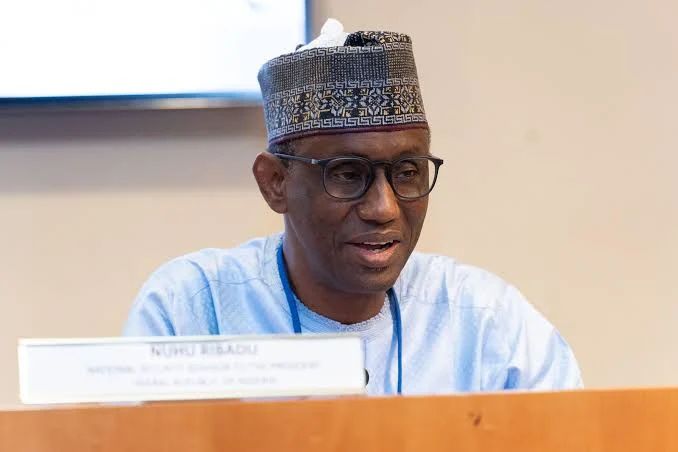
The National Security Adviser Mallam Nuhu Ribadu has said Lakurawa terrorists were exploiting porous borderlines and ungoverned forest reserves to introduce advanced combat tactics into the North-West theatre, blurring the line between criminal enterprise and transnational insurgency.
This is just as the NSA unveiled a five point crisis response framework to curtail banditry and other criminal elements in Sokoto State.
He said, “The security challenges confronting rural Sokoto have crossed a critical operational threshold. This is because what began years ago as opportunistic cattle rustling, rural robbery, and disjointed highway extortion has hardened into organised, territorial warfare. Today, heavily armed syndicates seek to impose illegal levies on farming communities, dictate agricultural planting and harvesting calendars, and restrict rural transit. This poses a direct, intolerable challenge to this great nation’s sovereignty.
“We are witnessing a dangerous convergence along our 120-kilometre frontier with the Republic of Niger. The emergence and entrenchment of Lakurawa, formally designated by the Federal Government as a terrorist organisation, signals the operational intermingling of profit-driven bandit cartels with the ideological, logistical, and tactical networks of the broader Sahelian jihadist ecosystem. By exploiting porous borderlines and ungoverned forest reserves, these elements introduce advanced combat tactics into the North-West theatre, blurring the line between criminal enterprise and transnational insurgency”.
Ribadu represented by the Director Legal at the Office of the National Security Adviser Zakari Mijinyawa said 350 abductions were recorded across 21 of our 23 Local Government Areas Sokoto State between July 2024 to June 2025.
“Epicentres such as Sabon Birni, Isa, Tangaza, Goronyo, Rabah, and Gudu have borne an unacceptable human cost. More than 580,000 compatriots across Katsina, Sokoto, and Zamfara have been displaced from their ancestral homes – most of them women and children”.
He said the the Office of the National Security Adviser (ONSA) in order to permanently dismantle this cycle, has transitioned a national response from fragmented, episodic campaigns to an institutionalised, whole-of-government and whole-of-society architecture codified under the National Crisis Management Doctrine (NCMD).
He explained that the NCMD bridges historic inter-agency boundaries by standardising command hierarchies across three functional tiers: Strategic (Gold Command) at the executive and policy level, Operational (Silver Command) within the multi-agency Joint Operations Centre (JOC), and Tactical (Bronze Command) among field units and first responders
For Sokoto State, he said operationalising the NCMD requires implementing a synchronised, five-phase crisis response framework of Reclaiming Ungoverned Spaces and Border Domination;Establishing a Unified Common Operating Picture (COP)
We’ve got the edge. Get real-time reports, breaking scoops, and exclusive angles delivered straight to your phone. Don’t settle for stale news. Join LEADERSHIP NEWS on WhatsApp for 24/7 updates →
Join Our WhatsApp Channel