In the closing pages of The History of the Peloponnesian War, Thucydides reflects on how conflict strips societies to their core. Under stress, he observed, people reveal who they truly are. Strength and weakness, prudence and vanity, courage and hesitation all surface with startling clarity. Leadership, he argued, is never tested by routine times. It is measured only when events spiral, when rules lose their certainty, and when people look to someone, anyone, who can interpret the storm around them.
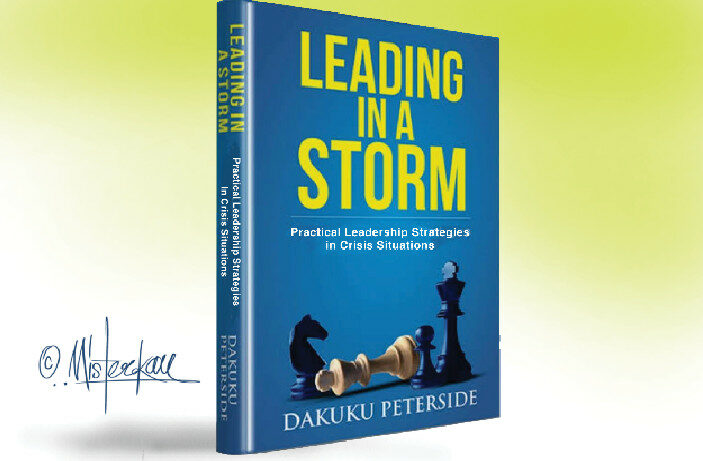
Dakuku Peterside’s Leading in a Storm: Practical Leadership Strategies in Crisis Situations is written with this ancient truth in mind. Although grounded in contemporary research, the book is fundamentally about the timeless human struggle to lead when the world tilts. In this respect, it carries the intellectual DNA of Nancy Koehn’s Forged in Crisis, Ronald Heifetz’s Leadership on the Line, and Doris Kearns Goodwin’s Leadership in Turbulent Times. Each of these authors insists that crises do not create leaders, but reveal the preparation, clarity, discipline, and emotional stamina that leaders either possess or lack. Peterside enters this long scholarly conversation with a distinctly structured and empirically grounded framework that translates those insights for modern institutions.
The Anatomy of Crisis
Peterside begins by examining what a crisis actually is. He describes it not as an event but as a condition. Crises destabilise familiar patterns, compress timelines, distort information, and heighten emotions. They force leaders to make consequential decisions with incomplete data while the public demands certainty. This dynamic reflects Heifetz’s concept of adaptive pressure. People under duress look to leaders for protection, guidance, and meaning. Leaders, in turn, must separate what requires immediate action from what requires collective learning.
Peterside argues that crises expose the fragility or robustness of institutions. A structure that appears solid in normal times can disintegrate rapidly when demands multiply. This reinforces a point Goodwin makes in her analysis of Lincoln and Franklin Roosevelt. Institutions are not self-correcting. They need leaders who can recognise when inherited systems are inadequate and must be rebuilt in real time.
Competencies That Become Lifelines
Rather than treating leadership as charisma or innate talent, Peterside identifies a network of competencies that function together as a stabilising system. He does not present them as isolated skills but as parts of an integrated cycle that strengthens leaders under pressure.
The first is contextual intelligence. Leaders must understand their environment with depth and precision. This involves analysing political, social, economic, and psychological variables, then synthesising them into a coherent assessment. Peterside notes that leaders are often overwhelmed not by the crisis itself but by their failure to grasp its contours early enough. Contextual intelligence reduces guesswork and grounds decisions in reality.
Calm confidence follows logically. It is not the absence of fear but the management of it. Leaders who remain composed help others regulate their anxiety. Here Peterside’s narrative aligns with Koehn’s striking portrayal of Ernest Shackleton, who kept his crew’s morale intact through two years of Antarctic uncertainty. Peterside reinforces that calmness can be contagious and that panic at the top radiates downward with destructive speed.
Sense-making is the next competency. Crises generate contradictory information. Leaders must create coherence, identify cause and effect, and distinguish between speculation and actionable facts. This is particularly important in the age of digital misinformation, when crises often evolve faster than institutions can react. Peterside argues that sense-making is both analytical and relational. It requires listening, questioning, and building collective understanding.
Strategic decision-making emerges once meaning has been clarified. Leaders must choose among imperfect options. Peterside emphasises that timeliness is as important as correctness. A delayed decision in a crisis can be more damaging than a partially informed one. He also stresses the ethical dimensions of decision-making, noting that expediency must not override integrity.
Communication is another cornerstone. Poor communication, Peterside warns, magnifies confusion and erodes trust. Clear communication steadies the public, aligns teams, and gives direction. Goodwin’s treatment of Franklin Roosevelt illustrates this perfectly. Roosevelt transformed radio into a tool for national reassurance by explaining the Depression in plain language and offering concrete actions.
Adaptability is equally critical. Crises do not unfold in straight lines. Leaders must revise strategies as new information arrives. Peterside draws from historical cases where rigidity worsened crises and where calculated flexibility saved lives.
Coordination is another essential component. Crises involve multiple institutions, each with distinct priorities and capacities. Leaders must bridge these boundaries, distribute responsibilities, and align efforts. Peterside argues that coordination requires clarity of purpose, shared information systems, and mutual trust.
He adds emotional resilience to the framework. Crisis leadership is mentally draining. Leaders must endure long periods of uncertainty, public scrutiny, and moral pressure. Emotional resilience prevents burnout and preserves clarity.
Finally, Peterside highlights ethical judgment and continuous learning. A crisis does not absolve leaders of responsibility. Their choices carry moral weight and long-term consequences. After the storm, leaders must extract lessons, strengthen institutions, and prepare for the next disruption.
Echoes of History
What makes Peterside’s book notable is the way it resonates with the leadership trajectories documented by Koehn and Goodwin. Koehn’s case studies show that crisis leadership emerges from disciplined preparation, personal reflection, and the willingness to confront reality without illusions. Goodwin illustrates how presidents like Lincoln, Theodore Roosevelt, and Lyndon Johnson developed their leadership identities through hardship long before they occupied high office.
Heifetz goes even further by arguing that leadership is fundamentally a learning process. Leaders must help people adapt to changing realities, endure losses, and develop new capacities. Peterside’s model reflects this adaptive spirit. His competencies are not heroic traits but learnable habits.
The World That Requires Such Leadership
The twenty-first century has become a theatre of continuous turbulence. Economies are interconnected, information flows instantly, and public expectations for rapid action have intensified. Peterside argues that leaders must therefore evolve. Linear thinking is inadequate in systems defined by complexity. Technical expertise alone cannot solve problems that are deeply social, political, and emotional.
He reinforces this point with compelling contemporary examples. The Ebola response in West Africa demonstrates the value of clear coordination. The Chilean mining rescue illustrates the interplay between psychological resilience and strategic decision-making. Nigeria’s own challenges in public health, security, and governance reveal what happens when institutions confront crises without the necessary competencies.
The book’s strength lies in its methodology. Peterside integrates case studies, comparative leadership analysis, behavioural insights, and real-world observations. His approach is neither abstract nor sentimental. It is grounded in how leaders actually behave when conditions deteriorate.
A Contribution for Our Times
Leading in a Storm is a significant addition to leadership scholarship because it offers both conceptual clarity and practical guidance. It bridges historical insight with contemporary complexity. It respects the giants of leadership theory but translates their insights into actionable pathways for current practitioners. It is a book written for leaders who must make sense of a world that feels perpetually on edge.
For Nigerian readers and African institutions, Peterside’s work is especially timely. Our region faces overlapping crises that require leaders who can think systemically, communicate effectively, and act with integrity. Peterside does not romanticise leadership. He presents it as disciplined labour grounded in competence, reflection, and moral judgment.
We’ve got the edge. Get real-time reports, breaking scoops, and exclusive angles delivered straight to your phone. Don’t settle for stale news. Join LEADERSHIP NEWS on WhatsApp for 24/7 updates →
Join Our WhatsApp Channel