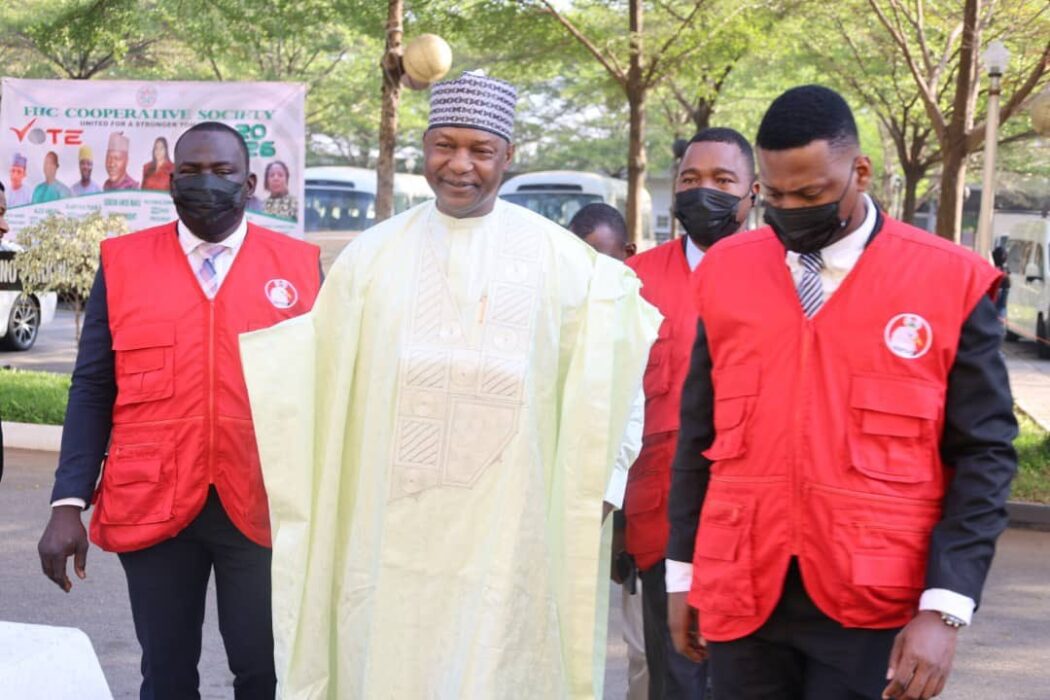
On 4th February, 2026, the Chief Judge of the Federal High Court (FHC), Justice John Tsoho, reassigned the money laundering trial and the civil forfeiture suit involving Abubakar Malami, the former Minister of Justice and former Attorney-General of the Federation (AGF) to Justice Obiora Egwuatu of the Federal High Court, Abuja.
The reassignment affects both the criminal charge bordering on alleged money laundering and the civil suit seeking the forfeiture of 57 properties linked to him. The former Minister and his son are also facing a separate five-count charge bordering on alleged terrorism, filed by the Department of State Services (DSS) before Justice Joyce Abdulmalik.
His arraignment alongside his son, is not just another high-profile court appearance. It is a moment laden with consequence — for the justice system, for the credibility of state institutions, and for the fragile trust between the Nigerian state and its citizens.
The office of the Attorney-General of the Federation is not an ordinary political appointment. It is the nerve centre of Nigeria’s legal order — the custodian of prosecutorial discretion, the supervisor of justice administration, and the institutional conscience of the state. When a former occupant of that office is subjected to criminal prosecution, the issue at stake transcends individual guilt or innocence. What is being tested is whether Nigeria has matured to a point where power truly expires when office ends.
It is important to state here that arraignment of an individual does not automatically translate to conviction. Also, an allegation is not proof. The rule of law requires that every accused person, regardless of past influence or public perception, is entitled to due process, fair hearing, and the presumption of innocence. Any attempt to prosecute this case in the court of public opinion will only weaken the very justice the country claims to pursue.
At the same time, Nigerians have reason to be attentive. For decades, the country has struggled with the perception — and often the reality — that the powerful are immune from consequences, that accountability is selective, and that institutions bend under the weight of political influence. This is why the Malami’s case matters. It places the Nigerian state and its judicial system under a microscope.
The Economic and Financial Crimes Commission(EFCC) and the DSS, having initiated this prosecution, are themselves on trial in the court of public confidence. The two agencies must demonstrate that their actions are driven strictly by intelligence, evidence, and national interest — not politics, vendetta, or post-power realignments. Anything short of professional rigor will reinforce cynicism and damage institutional credibility.
Equally, the judiciary carries a heavy responsibility. This case must not be hurried, politicised, or quietly abandoned. Nigerians have seen too many high-profile prosecutions collapse under the weight of poor investigation, weak evidence, or procedural abuse. Such outcomes do more harm than inaction; they deepen public distrust and confirm the belief that accountability is performative rather than real.
The stakes are especially high because of the nature of the allegations, especially the terrorism financing. This is not a routine charge. It strikes at the heart of national security in a country that has paid dearly — in lives, livelihoods, and stability — for years of insurgency and violent extremism. If such allegations are well-founded, they must be pursued with firmness and transparency. If they are not, the damage caused by reckless prosecution would be profound and unforgivable.
This moment also carries implications for those currently in public office. Nigeria’s governance culture has long been shaped by the assumption that power confers protection, and that yesterday’s authority guarantees tomorrow’s immunity. A properly handled prosecution — one that is fair, evidence-driven, and insulated from political manipulation — would send a powerful signal that public office is a responsibility, not a shield.
However, selective justice would send the opposite message. If this case proceeds while other equally weighty allegations against other powerful figures are ignored or buried, Nigerians will rightly interpret the process as factional or retaliatory. Accountability cannot be credible if it is inconsistent. Already there are allegations of political interference in the Malami trial.
We, therefore, call for restraint, discipline, and institutional integrity from all sides. The prosecution must resist the temptation of spectacle. The defence must engage the process through law, not influence. The media must report responsibly, avoiding sensationalism and premature conclusions. And political actors must keep their distance, allowing institutions to do their work.
Nigeria does not lack laws. What it has often lacked is the courage to apply them evenly and the patience to see justice through to its conclusion. This case offers an opportunity — rare and fragile — to begin correcting that deficit.
Handled well, it could mark a quiet but meaningful shift in Nigeria’s accountability culture. Mishandled, it will become yet another chapter in the long story of dashed expectations and institutional disappointment.
This is why this moment must not be mishandled.
We’ve got the edge. Get real-time reports, breaking scoops, and exclusive angles delivered straight to your phone. Don’t settle for stale news. Join LEADERSHIP NEWS on WhatsApp for 24/7 updates →
Join Our WhatsApp Channel