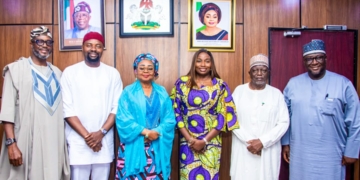
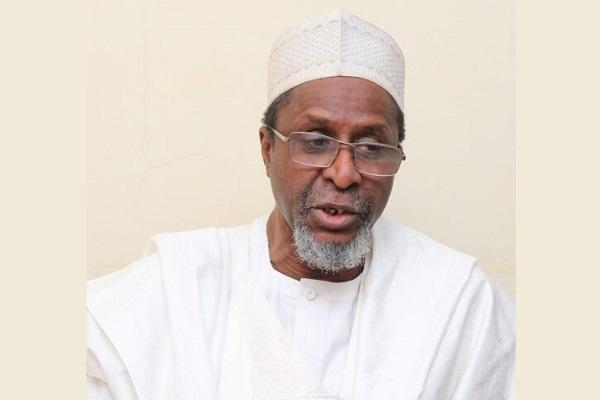
Nigeria’s worsening environmental crisis from deadly floods to creeping desertification will deepen unless the media steps up as a frontline driver of accountability and public action, the minister of Environment, Balarabe Abbas Lawal, has warned.
At a media engagement workshop in Abuja, the minister painted a stark picture of a country under growing ecological strain, where environmental degradation is no longer a distant concern but a daily threat to livelihoods, food security and public health.
He said Nigeria is grappling simultaneously with desert encroachment in the North, severe flooding and erosion in the South-East and South-South, and persistent oil pollution in the Niger Delta, challenges he described as “immediate realities” affecting millions and undermining national development.
Lawal stressed that while government interventions are scaling up, the response remains insufficient without sustained, issue-driven media coverage capable of translating complex environmental threats into public urgency and policy pressure.
“Climate change is not abstract. It is about the air we breathe, the food we eat, and the future we are already losing,” he said, urging journalists to move beyond episodic reporting to deeper, data-driven and solutions-focused storytelling.
The minister revealed that under the Renewed Hope Agenda of President Bola Ahmed Tinubu, the Federal Ministry of Environment has intensified restoration efforts, recording over 1.14 million hectares of rehabilitated land and the planting of more than 1.5 million trees in 2025 alone through programmes such as ACReSAL and the Great Green Wall initiative.
While describing these gains as significant, he acknowledged that environmental decline continues to outpace interventions, warning that without stronger public awareness and behavioural change, progress could be easily reversed.
He identified the media as a “strategic ally” in bridging the gap between policy and citizens, noting that environmental issues are still too often treated as secondary despite their direct impact on the economy, agriculture and health systems.
Lawal called for a shift toward investigative and accountability journalism that not only highlights environmental violations but also tracks government commitments and showcases innovative solutions across communities.
“The media is the megaphone of truth and the mirror of society. What you choose to amplify can influence policy, shape behaviour and determine whether we act in time or too late,” he said.
He assured journalists of improved access to environmental data, field operations and policy processes, pledging closer collaboration to strengthen public engagement and transparency in the sector.
The minister warned that the stakes could not be higher, as future generations risk inheriting a degraded environment marked by polluted rivers, disappearing forests and declining agricultural productivity.
He urged participants to treat the workshop as a turning point, where storytelling becomes a tool not just for reporting events but for driving national response to an unfolding environmental emergency.
“Stories told today will shape the Nigeria we leave behind,” Lawal said, calling for a united front to secure a cleaner, greener and more resilient future.
We’ve got the edge. Get real-time reports, breaking scoops, and exclusive angles delivered straight to your phone. Don’t settle for stale news. Join LEADERSHIP NEWS on WhatsApp for 24/7 updates →
Join Our WhatsApp Channel