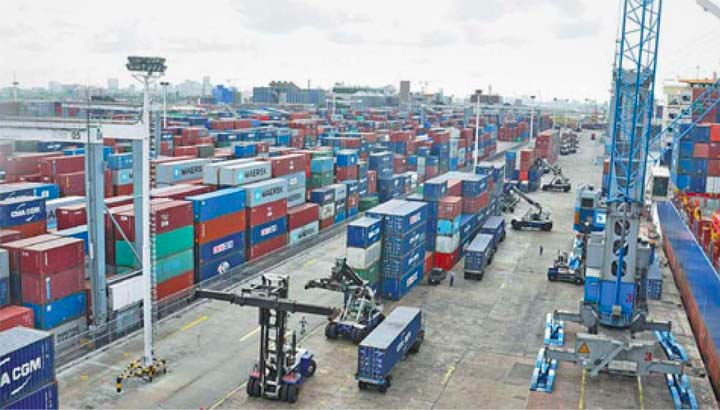
Maritime stakeholders have expressed divergent views over the continued relevance of bonded terminals in Lagos, with some industry players calling for their gradual wind down, even as operators warn that investments valued at over N5 trillion are under serious threat due to poor utilisation.
The debate comes amid renewed traffic build-up along the Apapa and Tin Can port corridors and growing concerns that many bonded terminal operators may be forced out of business if the current operational trend persists.
While operators insist that bonded terminals remain internationally recognised extensions of seaports and critical tools for cargo evacuation and port decongestion, some freight forwarders argue that the facilities have outlived their usefulness and should either be restructured or phased out.
The controversy follows the recent decision by the National Association of Government Approved Freight Forwarders (NAGAFF) to commence a nationwide inspection and assessment of licensed Customs-bonded warehouses and terminals over concerns bordering on operational inefficiencies, inadequate infrastructure and poor service delivery.
Speaking on the state of the sector, the general secretary of the Association of Bonded Terminal Operators of Nigeria (ABTON), Haruna Omolajomo, raised concerns over what he described as the near-collapse of bonded terminal operations despite investments exceeding N5 trillion.
According to him, more than 40 bonded terminals in Lagos alone possess infrastructure capable of handling approximately 84,000 Twenty-foot Equivalent Units (TEUs), but are currently operating at less than five per cent of their installed capacities.
“Today, I don’t think there are up to 500 containers spread across these terminals. Most are operating below five per cent capacity, and huge investments are lying idle,” he lamented.
Omolajomo recalled that bonded terminals were established in 2001 after the Federal Government sought private sector support to tackle severe port congestion that had resulted in substantial cargo diversion to neighbouring countries.
He explained that operators invested heavily in developing modern facilities after being encouraged by the federal government and the Nigeria Customs Service to transform bonded warehouses into full-fledged bonded terminals.
According to him, the first 10 bonded terminals handled over 484,000 TEUs within their first three years of operation, significantly reducing congestion at the ports and facilitating smoother cargo delivery.
“The success recorded by bonded terminals was one of the factors that inspired the government’s port concession programme,” he stated.
Omolajomo attributed the sector’s current challenges to the increasing dominance of foreign operators across the logistics value chain, noting that indigenous investors face severe financing constraints compared to their foreign counterparts.
He disclosed that several bonded terminal operators have already shut down operations, while others are struggling to remain afloat amid mounting financial pressures.
Also speaking, another bonded terminal operator, Kenneth Ofurum, maintained that bonded terminals remain necessary, particularly as congestion gradually returns to Lagos port corridors.
“Our roads are getting back to the old days. The roads are clogged and the ports are becoming full again,” he said.
According to Ofurum, the poor utilisation of bonded terminals is not due to lack of necessity, but rather operational practices that discourage cargo transfers from the ports.
He alleged that some operators benefit from prolonged cargo dwell time and demurrage charges, thereby reducing incentives to move containers to bonded terminals.
“Most of the bonded terminals are not fully utilised. Yet people are still applying for new licences, which shows that there is still a strong need for them,” he argued.
He called on the federal government to introduce stronger regulatory measures to ensure effective utilisation of bonded terminals whenever congestion begins to build up at the seaports.
However, the national public relations officer of the Association of Registered Freight Forwarders of Nigeria (AREFFN), Taiwo Fatomilola, presented a contrary view, arguing that many bonded terminals have become unnecessary and should be gradually wound down.
Describing the facilities as largely ineffective, Fatomilola alleged that some bonded terminals create opportunities for revenue leakages and inadequate cargo supervision.
According to him, concerns over duty assessments, cargo transfers and regulatory compliance have continued to raise questions about the value they add to the logistics chain.
He dismissed claims that the current traffic situation around Lagos ports is linked to the under-utilisation of bonded terminals.
“The traffic in the port corridor is not enough excuse for bonded terminals to be patronised. The congestion is largely man-made and caused by operational inefficiencies,” he said.
We’ve got the edge. Get real-time reports, breaking scoops, and exclusive angles delivered straight to your phone. Don’t settle for stale news. Join LEADERSHIP NEWS on WhatsApp for 24/7 updates →
Join Our WhatsApp Channel