There’s this local adage that a worm that is a little too long might be a snake. The saying is a traditional euphemism used to denote a seemingly harmless situation that might actually be fraught with danger.
It reminds one of the security challenge which started as a worm in Nigeria’s northeast region, but has become a hydra-headed snake with a nearly two-decade lifespan and counting.
More prominent than the actual victims of terror and crime in bleeding towns and communities, however, are the bleeding headlines across front pages, in the airwaves, and on social media – glorifying the time-honoured but sensational and default custom that ‘what bleeds must lead’.
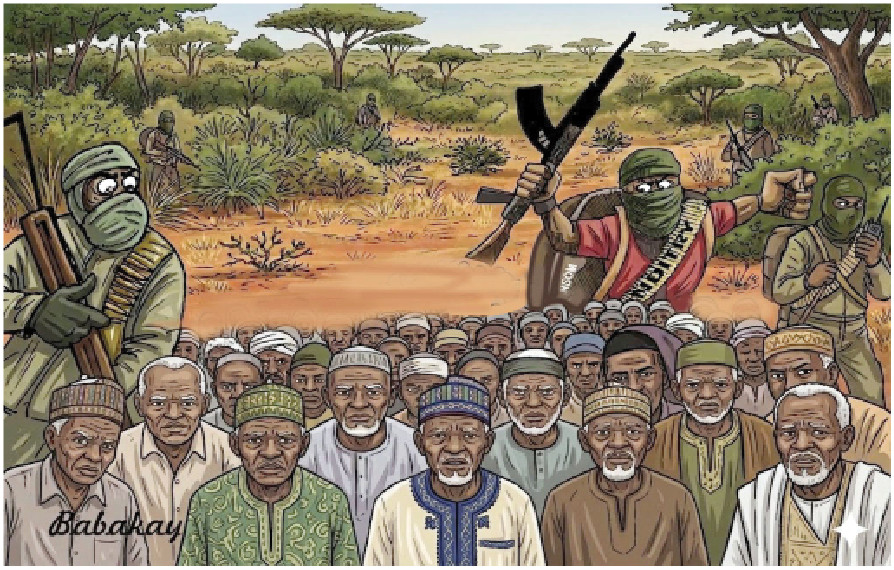
For the better part of the last two decades, Boko Haram and its various franchises and other adaptations of crime have dominated the media space, setting a dangerous agenda that now has the entire country gripped by fear.
An intending visitor to Nigeria is likely to have this eerie foreboding that there may be bandits waiting on the runway or lurking at every corner in and around the airport. Until it is confirmed otherwise, the news flow suggests that as soon as the plane taxies to a stop, every passenger would simply be herded away as a hostage with a price tag.
Watching, listening to, or reading the headlines paints a mental image of war and chaos, of a country sectioned and controlled by kidnap kingpins and insurgents, much the same way rival warring factions now control Sudan or used to control Somalia. A mental impression of total anarchy has been imposed on the country, breeding pessimism, gloominess, but worst of all, reinforcing locally divisive and internationally discriminatory stereotypes.
Far from the forests and dark alleys where bandits and insurgents operate, there’s more banditry and crime in the headlines. The depression arising from such imposed national trauma has become viral – an infestation that causes the rest of the world to look at the country and its citizens as inmates to be quarantined.
Apart from the news flow, bloggers and social media entrepreneurs have turned insecurity into an article of trade – investing in the sensation and reaping from the traffic.
The bigger tragedy is that mainstream media is incredulously lifting and parroting headlines and content from blogs and influencers and directly injecting this poisonous content into the bloodstream of the wider society.
Don’t get it twisted. Are there security problems in Nigeria? More than enough! Is this an attempt to downplay the severity? Far from it! Should the media look away from the crisis? A definite ‘No’!
What then is the middle ground? Common sense dictates that developing societies should live by or practise the ethos of developmental journalism.
Reporting insecurity in the media has tended towards amplifying the audacity of the criminals while negating the national duty of rallying society and providing agency to the effort to defeat the menace.
Our bleeding headlines, riders, captions, and videos ignore the fact that in the midst of the bloody streets and deadly forests, the majority of Nigerians are still running their businesses, hosting parties, travelling, attending to their jobs and schedules on a fairly regular basis.
But there have also been far-reaching consequences arising from the agenda set by the media.
A good example is the Nigerian passport, which has become a liability for those who are privileged to carry one. It is no longer a guarantee of diplomatic respect and courtesy for the holder than it is a badge of suspicion and apprehension that triggers harassment as well as demands for further explanations.
Now back to the nearly forgotten question of Developmental Journalism – a pragmatic theory which contends that the core responsibility of the media is to maintain public safety and enhance national stability; that it should actively serve as an instrument for national development, peacebuilding, and social cohesion.
This directly implies that the media should prioritise the social consequences of a story over its shock value. Such consequences should generally override the commercial pressure to generate clicks or sell copies.
As a constructive partner in nation-building, certain media practices such as giving front-page prominence, graphic details, and dramatic framing to criminal acts constitute what the military refers to as a ‘force multiplier’ for insurgent groups. It publicises the terror these groups wish to instill for free and helps such non-state actors create psychological tensions even in regions not affected by violence. This is Nigeria’s biggest challenge at the moment.
The rush to break news often legitimizes criminals as political actors or aggrieved parties instead of as criminals, thereby emboldening them with a false sense of justification and entitlement.
The default habit of framing conflicts in ethno-religious binaries to the exclusion of social and economic causal relationships not only negates the theory of development journalism, but it also amplifies tribal and religious fault lines, escalating the cycle of conflicts and reprisals as is currently evident in Plateau State.
It has become very clear that the biggest force multiplier for conflict is social media, which operates completely outside of conventions and rules. Misleading or false reports, apart from spreading fear, often give security agencies a false start or cost the state time and money chasing false leads rather than fighting actual crime.
The bottom line is that Nigeria is in a hole, and the media keeps digging.
The solution is for the industry to self-regulate and for leading bodies like the Editors’ Guild, the Press Council, and others to recalibrate the gatekeeping concept as a national and patriotic duty that looks beyond headlines, trends, and commerce.
We have had more than enough time to learn that when the headlines bleed, the country and its citizens also become anaemic.
.Julius Ogar writes from Utako, Abuja
We’ve got the edge. Get real-time reports, breaking scoops, and exclusive angles delivered straight to your phone. Don’t settle for stale news. Join LEADERSHIP NEWS on WhatsApp for 24/7 updates →
Join Our WhatsApp Channel