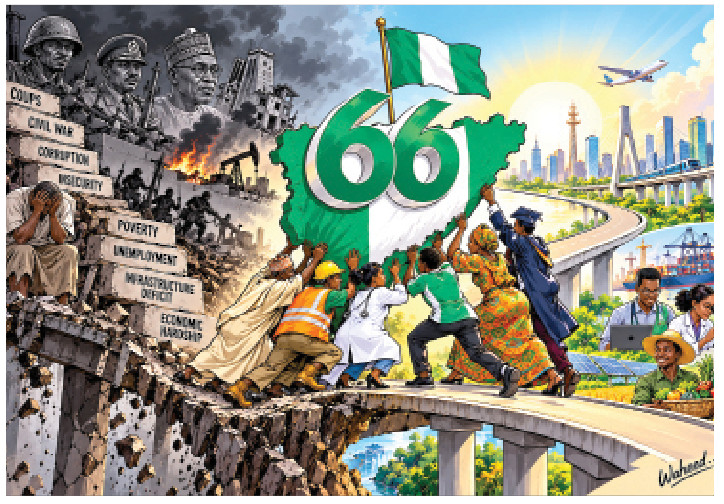
Six decades and six years after the Union Jack was lowered and Nigeria’s green-and-white flag was hoisted, Africa’s most populous nation is a metaphor for a multi-faceted needlepoint knit of crippling despair and unyielding optimism. Nigeria’s story has never been a straightforward journey to progress. Several curves have tested the nation’s soul, but the resilience of the Nigerian spirit has steered the ship of state away from ultimate destruction. After 66 years of political freedom, Nigeria has continued to draw energy from the self-renewing moral fibre of citizens who have always expressed hope for a bright future amid the lamentation of present hardship. Nigeria’s declining hope is written in the ink of missed opportunities, worsened by corruption and systemic failures.
At independence, Nigeria naturally became Africa’s leader because of its natural resources, including oil reserves. However, its foundational years as an independent nation were marred by political instability; the end of the Biafran War, led by Lt. Col. Odumegwu Ojukwu in January 1970, offered an opportunity to unite the country towards a common purpose. If independence in 1960 lit a flame of hope for Nigerians, the civil war brought bloodshed that left a deep scar, hardening patriotic citizens’ commitment to the Nigerian project.
Military Era
The years of military rule proved both progressive and retrogressive, as the nation saw infrastructural development and institutional building. After the civil war’s destruction, General Yakubu Gowon embarked on what he called the three Rs (Reconciliation, Rehabilitation and Reconstruction) to ease the South-East’s pain, boost infrastructure development, and address war-related challenges. High international crude oil prices provided the funds to realise some of these dreams. Gowon’s postponement of handing over power to civilians led to a 1975 coup that enthroned a triumvirate: General Murtala Muhammed as Head of State, General Olusegun Obasanjo as Chief of Staff, and General Theophilus Yakubu Danjuma as Chief of Army Staff.
Major General Muhammadu Buhari’s emergence as Head of State in the dying hours of December 1983 ended the Second Republic. It ushered in nearly 16 years of unbroken military rule under Generals Ibrahim Badamasi Babangida, Sani Abacha, and Abdulsalami Abubakar. The military is credited with keeping the nation united and building infrastructure for national development. In line with global demands for democracy, the quest for ballot government remained unassailable, as Nigerians demonstrated unwavering support for popular rule. The nullification of the June 12 presidential poll and the swift transition to civilian administration, which led to the inauguration of this unbroken democracy, testify to a resilient nation devoted to the enthronement of democracy.
Despite years of efforts to free the country from heavy reliance on a volatile mono-product oil economy, crude oil remains the source of Nigeria’s economic strength. More than 66 years after political freedom, the economy grapples with global market shocks and domestic mismanagement. Not only do inflation, currency depreciation, and high unemployment push millions into the bottomless pit of poverty, but insistent threats of insurgency, banditry, and other activities of criminal groups have overstretched the security forces, leading some security experts to question the very viability of the Nigerian project.
Anti-Corruption War
Despite threats from non-state actors to the corporate survival of the Nigerian State, both past and present administrations, since the dawn of this unbroken democracy, have never wavered in ensuring Nigeria’s survival. Recognising corruption as the albatross around the country’s neck, former President Olusegun Obasanjo established measures to combat the monster of corruption. Though citizens placed great confidence in the Economic and Financial Crimes Commission (EFCC) and the Independent Corrupt Practices and Other Related Offences Commission (ICPC), critics argue that these anti-graft agencies were established to serve as a political witch-hunt.
Nigeria’s battle against corruption seems endless, with some even accusing these anti-graft bodies of corrupt dealings. The EFCC Chairman, Ola Olukoyede, recently dismissed over 40 EFCC operatives over corruption. Olukoyede’s sacking of his agency’s operatives lends credence to the claim that rotten eggs in the EFCC collude with and abet corrupt fat cats under investigation. The snag is not whether corruption exists in the House created to fight corruption. The tragedy is that, after the Olukayode-led leadership, the fight against those colluding with corrupt actors will either continue or stop. The greatest tragedy afflicting Nigeria is using power to achieve personal and ethnic ends by empowering family and cronies, thereby compromising governance and national development.
Looking at Nigeria through the lens of its structural decay, and how it has survived years of rot, is incredible in terms of its resilience. Some global bodies have predicted Nigeria’s disintegration in 2015. The country proved these gloomy predictions wrong. Nigeria’s rising hope comes not from the corridors of political power but from citizens’ entrepreneurial ingenuity, especially at the grassroots level, rewriting the rules of endless possibility. Some of these resilient citizens reject the late Dele Giwa’s claim of Nigeria being “God’s creation in the impossibility.”
Rising Hope
Nigeria is now a nation of massive global consequence, undiminished in the comity of nations. Renewed hope for the country’s resurgence largely comes from its youth, who have refused to be defined by their environment’s limitations. These new innovators have become leaders in the global tech ecosystem, the creative industry, and premier startup hubs across the African continent. Despite infrastructure deficits, young entrepreneurs from Nigeria are building fintech, agritech, and health tech solutions, turning their nation into a global venture capital hub while solving real-world African problems.
Nearly three score and ten years after gaining political freedom, Nigeria is neither a failed country nor has it achieved what it set out to do at independence. Its dualities are stark, reflecting a Nigeria confronted by infrastructural deficits, even as world-class digital infrastructure is being engineered. Statistics from global bodies suggest the economy is recovering. However, at the microeconomic level, families still struggle with the hardships caused by the necessary economic reforms introduced by the President Bola Tinubu-led administration. Amid these hardships, driven by the withdrawal of the fuel subsidy, hard-working traders in Kano have shown resilience that has given oxygen to the economy. Nigeria’s lesson at 66 is that a nation’s greatest asset is not solely natural resources, but the stubborn, firm spirits of its citizens.
We’ve got the edge. Get real-time reports, breaking scoops, and exclusive angles delivered straight to your phone. Don’t settle for stale news. Join LEADERSHIP NEWS on WhatsApp for 24/7 updates →
Join Our WhatsApp Channel