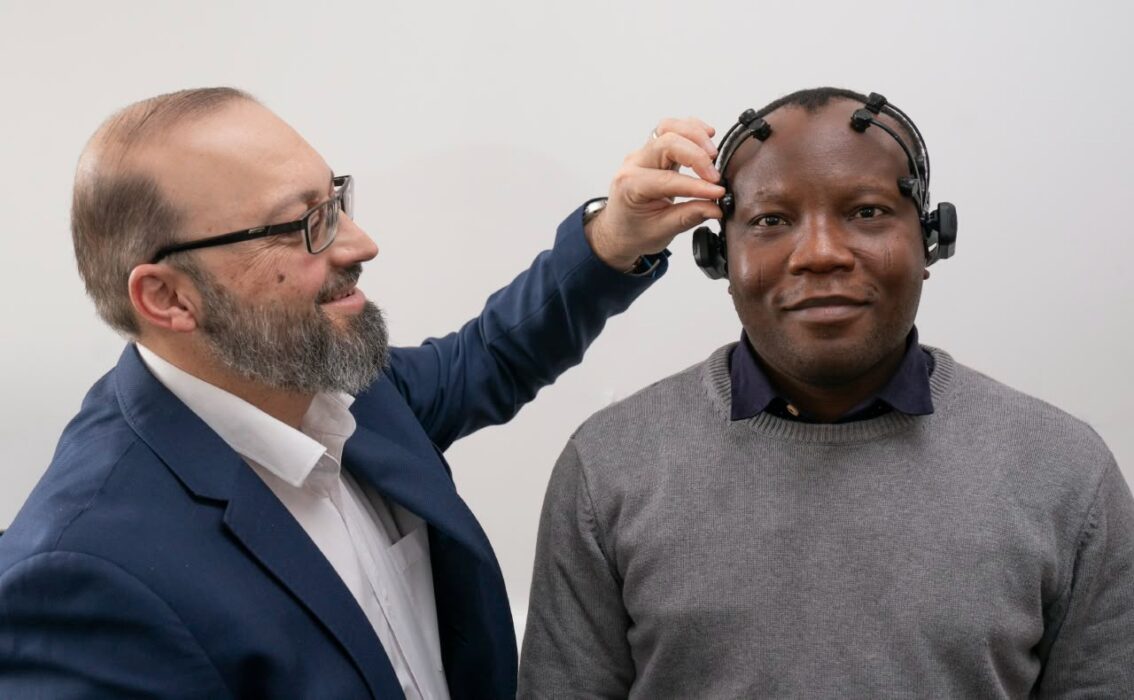
A Nigerian postgraduate researcher, Peter Akor, has won both the Judges’ Choice and People’s Choice awards at the 2026 Vitae Three Minute Thesis Competition in the United Kingdom.
Akor, a researcher at Glasgow Caledonian University’s School of Science and Engineering, emerged overall winner of the national competition after beating finalists from the University of Oxford, King’s College London, the University of Surrey, the University of Reading and the University of Westminster.
His double victory marked the first time Glasgow Caledonian University has won the national 3MT final.
According to Akor, he is only the second researcher in the history of the Vitae competition to win both the Judges’ Choice and People’s Choice awards in the same final.
The results were announced by Vitae following the national final, while the People’s Choice Award was determined through a public vote.
Akor’s presentation, titled “The Minutes That Matter: Transforming Epileptic Seizure Care from Reaction to Prediction”, focused on how technology and data could be used to predict epileptic seizures before they occur.
The research explores the potential of technology to improve the safety, treatment and quality of life of people living with epilepsy.
A native of Owukpa in Benue State, Akor secured his place in the national final after winning the Judges’ Choice Award at Glasgow Caledonian University’s annual 3MT final in June.
The Three Minute Thesis competition challenges postgraduate researchers to explain the significance of their research to a non-specialist audience using a single presentation slide and no more than three minutes.
The 2026 national final featured six researchers from universities across the UK.
As the Judges’ Choice winner, Akor received a £1,000 grant sponsored by UK Research and Innovation, mentorship from The Brilliant Club and an engraved trophy.
He also received a £250 UKRI-sponsored grant, mentorship and another engraved trophy after winning the People’s Choice Award.
The grants are intended to support public engagement or professional development activities.
Akor said he planned to use the funding to organise two public engagement events, one in the UK and another in Nigeria, subject to approval.
He said the proposed events would bring together researchers, medical professionals, artificial intelligence enthusiasts, patients and carers to discuss how AI and research could help people living with neurological disorders.
Akor began his academic career at Joseph Sarwuan Tarka University, Makurdi, where he graduated with First Class Honours in Electrical/Electronics Engineering in 2012 and was named the Best Graduating Student in the College of Engineering.
He later joined the institution as a Graduate Assistant and rose to the rank of Lecturer, spending about nine years in academia before relocating to the UK to pursue his PhD at Glasgow Caledonian University.
Meanwhile, Rachel Bernasconi of the University of Surrey won the Editor’s Choice Award, selected by The Conversation UK.
Akor’s latest achievement builds on his earlier success at Glasgow Caledonian University, where his research on seizure prediction earned him the university’s Judges’ Choice Award and secured his place in the national competition.
We’ve got the edge. Get real-time reports, breaking scoops, and exclusive angles delivered straight to your phone. Don’t settle for stale news. Join LEADERSHIP NEWS on WhatsApp for 24/7 updates →
Join Our WhatsApp Channel