Senator Victor Umeh, representing Anambra Central, has criticised the Federal Government’s borrowing policy, saying Nigeria is over-borrowing while Nigerians bear the brunt of the country’s rising debt profile.
Umeh said the government had poorly managed the country’s resources, questioning the impact of repeated borrowing on the living conditions of citizens.
“We are over-borrowing in simple terms. Whether you do a GDP borrowing ratio and all that, the important thing is how are we faring in the circumstance as a country? Citizens are groaning, we are suffering. Even the rich also cry now in Nigeria,” he said.
The senator spoke on Politics Today, a current affairs programme on Channels Television, on Tuesday, while reacting to President Bola Tinubu’s request to the National Assembly to approve a fresh external borrowing plan.
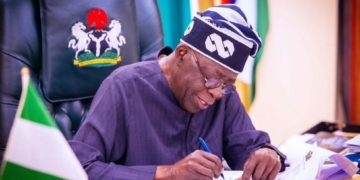
LEADERSHIP reports that Tinubu had asked the National Assembly to approve the processing of external loans worth $20.5 billion ($20,517,755,901) and €1.045 billion (€1,045,083,643) under the 2026–2027 Supplementary External Borrowing Plan.
The proposed loans are expected to finance critical projects across various sectors, including infrastructure, agriculture, healthcare, education, water supply, security and employment generation, as well as financial management reforms.
The president’s request was conveyed in a letter read by the Senate President, Godswill Akpabio, during plenary on Tuesday.
In the letter, Tinubu said the proposed borrowing was necessary to support his administration’s reform agenda.
However, Umeh questioned the effectiveness of the government’s borrowing strategy, arguing that borrowing should translate into tangible improvements in the lives of Nigerians.
According to him, the continued hardship experienced by citizens suggests that government policies and interventions are not producing the desired results.
“If we are doing something, we are experimenting with something and it’s not improving the quality of life of the citizens, it means that what they are doing is not responding,” he said.
He likened the situation to the treatment of a patient whose condition fails to improve, arguing that such a situation indicates that the treatment is ineffective.
“The treatment you are giving to a patient that is not getting better shows that it’s not responsive,” he added.
The lawmaker also questioned the government’s fiscal responsibility, alleging that public resources had been poorly managed despite successive borrowing initiatives.
“So what they are doing is that I believe the resources of the country have been poorly managed and the fiscal responsibility on the part of government is questionable,” Umeh said.
He argued that the justification for borrowing should be measured by the benefits the funds deliver to the economy and the people.
“If you are borrowing money to deliver some ends, those ends, when delivered, will improve the quality of life in the system. So it’s not about borrowing,” he said.
Umeh further expressed concern about Nigeria’s mounting debt burden, stressing the need for accountability over how borrowed funds had been spent.
“People have 166 trillion naira in debt, it’s not 166,000 naira. And if you have borrowed it, where have you put the money?” he queried.
The senator said the government should prioritise policies and projects capable of easing the economic pressures confronting Nigerians rather than continuing to accumulate debt without clear improvements in living standards.
He also questioned why the country had continued to struggle with domestic petroleum supply and rising fuel costs despite years of borrowing.
“I have been talking about government doing things that will help relieve the country from the cliffhanger the country has been passing through,” he said.
Umeh challenged the government to consider the amount borrowed over the years against the resources required to address critical economic challenges, including domestic petroleum refining.
“If you can borrow 21 billion dollars, 22 billion dollars, 20 billion dollars, how much will you need to build a refinery? This is the question. All these monies have been borrowed in the past,” he said.
He noted that rising petroleum product prices continued to place pressure on Nigerians, arguing that government interventions should produce measurable relief.
“Today, the issue of petroleum products rising is hanging on the neck of Nigerian people,” he said.
Umeh warned that borrowing without a corresponding improvement in the welfare of citizens would amount to an ineffective response to the country’s economic challenges.
“So if you are doing anything and it is not reducing the pain in the system, then it means that the sickness has become malignant,” he added.
We’ve got the edge. Get real-time reports, breaking scoops, and exclusive angles delivered straight to your phone. Don’t settle for stale news. Join LEADERSHIP NEWS on WhatsApp for 24/7 updates →
Join Our WhatsApp Channel