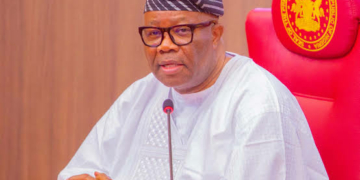
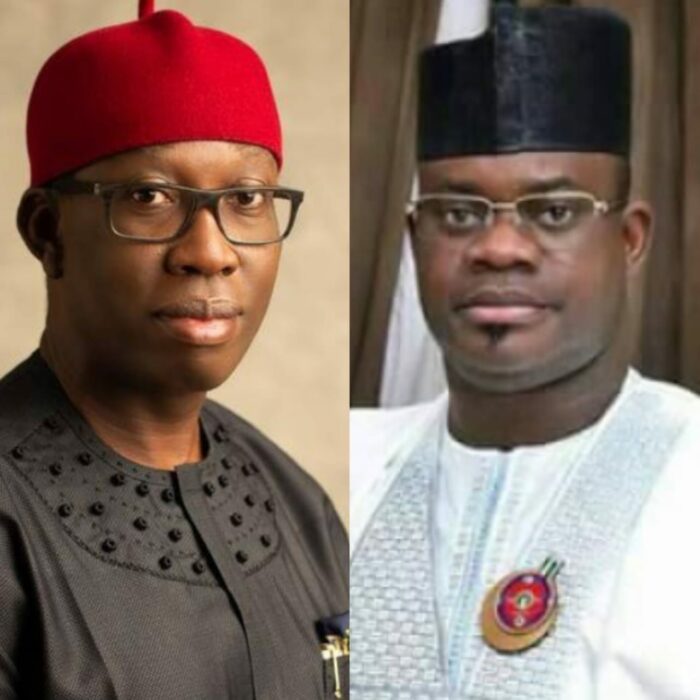
The decision by the ruling All Progressives Congress (APC) to clear former Delta State governor, Ifeanyi Okowa, and former Kogi State governor, Yahaya Bello, to contest its senatorial primaries has sparked outrage among many Nigerians, who described the development as a dangerous endorsement of corruption.
Both politicians, who emerged victorious in their respective APC senatorial primaries, are currently facing separate corruption and money laundering prosecutions instituted by the Economic and Financial Crimes Commission (EFCC).
The development has triggered widespread criticism from political analysts, civil society actors and ordinary Nigerians, many of whom questioned the moral authority of a government that claims to be fighting corruption while allegedly rewarding politicians facing serious criminal allegations.
Okowa, who governed Delta State between 2015 and 2023, is under EFCC investigation over alleged financial misconduct running into trillions of naira.
The anti-graft agency arrested the former governor in November 2024 over allegations bordering on the diversion of public funds, abuse of office and acquisition of massive assets through state resources.
Among the allegations against him is the alleged inability to account for about ₦1.3 trillion in 13 percent oil derivation funds received by Delta State during his tenure.
The EFCC is also probing allegations that about ₦40 billion was used to acquire an eight percent equity stake in UTM Floating Liquefied Natural Gas, alongside claims that state funds were diverted into luxury property acquisitions in Abuja and Asaba.
Shortly after his arrest, Okowa defected from the Peoples Democratic Party (PDP) to the APC, a move that fueled public speculation that the corruption probe against him may eventually be abandoned.
Although the EFCC has repeatedly insisted that political defection does not confer immunity from prosecution, critics argue that the pace of the investigation has significantly slowed since his alignment with the ruling party.
Bello, on the other hand, is facing multiple corruption and money laundering charges involving over ₦190 billion.
The EFCC is prosecuting the former Kogi governor in separate cases before the Federal High Court and the FCT High Court over alleged diversion of public funds, criminal breach of trust and property fraud.
In one of the cases, Bello is accused of diverting ₦80.2 billion from Kogi State coffers to acquire luxury properties in Nigeria and Dubai through proxies and bureau-de-change operators.
The anti-graft agency also alleged that the former governor withdrew large sums of dollars from state accounts to pay his children’s school fees in advance.
Despite the weight of the allegations, Bello was cleared by the APC to contest and eventually win the party’s senatorial primary for Kogi Central, positioning him to challenge the incumbent senator, Natasha Akpoti-Uduaghan.
The former governor has consistently denied all allegations against him, insisting that the charges are politically motivated.
His legal battle with the EFCC has generated national attention in recent months, especially following repeated standoffs between operatives of the commission and his supporters during attempts to arrest and arraign him.
Reacting to the development, political scientist, Professor Abdullah Abubakar, described the emergence of Okowa and Bello as evidence that corruption has become deeply entrenched in Nigeria’s political culture.
“The victories of Okowa and Bello confirm what many Nigerians already believe , that corruption has become institutionalised,” he said.
“Imagine politicians standing trial for monumental corruption being rewarded with tickets to represent the same people whose resources they allegedly looted. It sends a terrible message about
accountability and governance.”
A civil servant, Biodun Agunbiade, in an interview with LEADERSHIP in Abuja, also expressed disappointment over Okowa’s emergence in Delta North.
“When I heard that Okowa defeated Senator Ned Nwoko, I was shocked. Nigerians are watching politicians accused of looting public funds being celebrated instead of being isolated from public office,” he said.
For many Nigerians, the controversy has once again reopened debates over whether individuals facing criminal prosecution for corruption should be allowed to contest elections pending the determination of their cases in court.
An activist, Desmond Atake, who spoke with our correspondent, said the development reflected a collapse of ethical standards in the country’s political system.
“Nigeria under the current administration has lost its moral compass,” he said.
“Politicians facing corruption allegations ought to be politically ostracised, not rewarded with senatorial tickets.”
Wilson Okonkwo, a data analyst, described the APC’s decision as “official legitimisation of corruption,” while political commentator Ahmed Walata argued that Nigeria’s anti-corruption institutions have failed to deter public officials accused of looting state resources.
He questioned why some politically exposed persons continue to enjoy enormous political influence despite facing serious criminal allegations.
“The EFCC should explain to Nigerians why individuals with corruption cases hanging over them are still being allowed to freely participate in politics and seek elective office,” he said.
The controversy surrounding the APC primaries has continued to fuel public debate over the credibility of Nigeria’s anti-corruption war and the integrity of the country’s political process ahead of the 2027 general elections.
We’ve got the edge. Get real-time reports, breaking scoops, and exclusive angles delivered straight to your phone. Don’t settle for stale news. Join LEADERSHIP NEWS on WhatsApp for 24/7 updates →
Join Our WhatsApp Channel