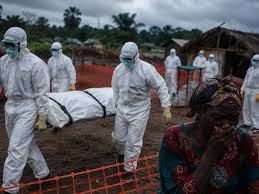
The World Health Organisation (WHO) has warned that the risk posed by the ongoing Ebola outbreak in the Democratic Republic of Congo (DRC) remains high at national and regional levels, while the global risk is still considered low.
The UN health agency said investigations into the origin of the outbreak are ongoing, but preliminary findings suggest the virus may have been circulating in eastern DRC for several months before detection.
Speaking at a press briefing at WHO headquarters in Geneva, director-general Tedros Adhanom Ghebreyesus, said 51 confirmed Ebola cases have so far been recorded in the eastern provinces of Ituri and North Kivu.
He cautioned, however, that the actual number of infections could be significantly higher.
“WHO assesses the risk of the epidemic as high at the national and regional levels, and low at the global level,” Tedros said.
He disclosed that neighbouring Uganda has confirmed two Ebola cases in the capital, Kampala, including one death, while a United States national infected in the DRC has been transferred to Germany for treatment.
Tedros warned that nearly 600 suspected cases and 139 suspected deaths had also been recorded, raising fears of wider transmission.
“Beyond the confirmed cases, there are almost 600 suspected cases and 139 suspected deaths,” he said.
“We expect those numbers to keep increasing, given the amount of time the virus was circulating before the outbreak was detected.”
Despite the growing concern, WHO said the outbreak does not currently meet the threshold for a pandemic emergency.
Tedros had earlier declared the outbreak a Public Health Emergency of International Concern (PHEIC), the second-highest alert level under international health regulations, prompting affected countries to activate emergency response measures.
However, the WHO emergency committee, which met on Tuesday, concluded that while the situation is serious, it does not constitute a pandemic-level emergency.
“The current situation and criteria for a public health emergency of international concern have been met, and we agree that the current situation does not satisfy the criteria for a pandemic emergency,” committee chair Lucille Blumberg said.
WHO technical officer on viral haemorrhagic fevers, Anais Legand, said investigations were ongoing to determine how long the virus had been circulating undetected in eastern DRC.
“Given the scale, we are thinking that it has started probably a couple of months ago, but investigations are ongoing,” she said.
She added that response efforts are focused on breaking transmission through contact tracing, isolation, and treatment of suspected and confirmed cases.
Meanwhile, concerns have emerged over the speed of WHO’s response, with US Secretary of State Marco Rubio suggesting the agency was “a little late” in identifying the outbreak.
The criticism comes amid renewed tensions between Washington and WHO following US President Donald Trump’s move to initiate a withdrawal from the organisation over disputes linked to its COVID-19 response.
Responding, Tedros defended the agency’s actions, saying the criticism reflected a misunderstanding of international health regulations.
“Maybe what the secretary said could be from lack of understanding of how IHR work, and the responsibilities of WHO and other entities,” he said, stressing that WHO’s role is to support countries rather than replace national outbreak response systems.
We’ve got the edge. Get real-time reports, breaking scoops, and exclusive angles delivered straight to your phone. Don’t settle for stale news. Join LEADERSHIP NEWS on WhatsApp for 24/7 updates →
Join Our WhatsApp Channel