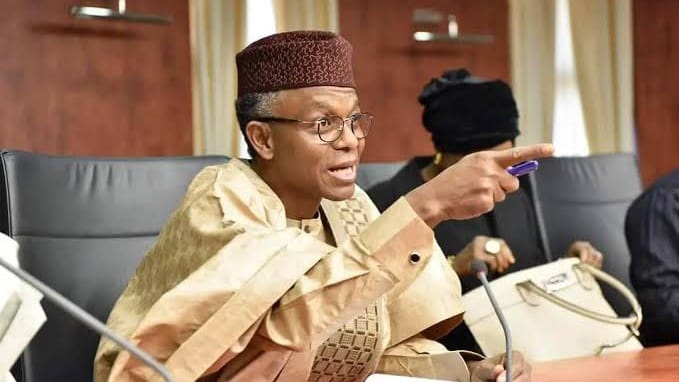
Embatlled former Kaduna State governor, Nasir El-Rufai, has argued that Nigeria’s persistent economic underperformance was rooted not in a lack of talent or capital, but in the misallocation of its brightest minds.
El-Rufai diaclosed this as he continued to face legal battles and detention over alleged graft.
In a lengthy post shared on his verified Facebook page on Wednesday morning, April 1, El-Rufai described Nigeria as “a paradox,” noting that despite possessing “extraordinary human capital—energetic, inventive, resilient,” the country continued to record weak productivity, shallow growth, and limited prosperity.
“Nigeria’s growth problem is not primarily a shortage of talent, capital, or ideas. It is a problem of where our best talent goes—and why,” he stated.
The former governor framed his argument as a political economy issue, stressing that individuals respond rationally to incentives within the system.
“People do not wake up intending to harm their country. They respond rationally to incentives,” he said, adding that the key question should not be about corruption, but rather: “What activities does our system reward most handsomely?”
According to him, when economies reward innovation and entrepreneurship, growth accelerates, but when rent-seeking activities dominate, development stagnates.
Citing key economic indicators, El-Rufai noted that while Nigeria recorded about 4.1% GDP growth in 2024, it remained insufficient for a rapidly growing population. He added that GDP per capita remained low, while informal employment accounts for about 93% of the labour force.
He further highlighted Nigeria’s low tax-to-GDP ratio, estimated at 8.2%, describing it as a sign of weak fiscal capacity and overreliance on discretionary revenue collection.
“These numbers are not abstract. They describe an economy where scale is risky, visibility attracts predation, and long-term investment struggles to compete with short-term access,” he said.
El-Rufai warned that rent-seeking not only diverts resources but also discourages productive investment and innovation.
“When the brightest minds are pulled away from production, the quality of entrepreneurship falls, technological progress slows, and the economy’s long-run growth rate declines,” he argued.
He also pointed to structural constraints such as poor power supply, inefficient ports, and low formal employment as factors that make building businesses more difficult than extracting value.
The former governor proposed a reform agenda centred on reversing incentives in the economy.
“Make value creation more rewarding than value capture,” he said, outlining measures such as reducing discretionary government powers, improving regulatory transparency, strengthening property rights, and promoting business scalability.
He added that measurable progress within two years—such as improved power supply, faster port operations, increased wage employment, and higher tax revenue—would signal a shift toward a more productive economy.
LEADERSHIP reports that El-Rufai was scheduled to appear in court this Wednesday in Kaduna for hearing on his bail application.
Recall that a Federal High Court sitting in Kaduna on Tuesday adjourned ruling on his bail application till Wednesday. His counsel, Mr. Ukpong Abang, SAN, confirmed the development, stating: “The hearing of the bail application has been adjourned till tomorrow.”
El-Rufai, who has spent over a month in detention, was seen being escorted from the court premises by operatives of the Independent Corrupt Practices and Other Related Offences Commission (ICPC).
The anti-graft agency had earlier granted him temporary release on compassionate grounds last week following the death of his mother, Hajiya Ummah El-Rufai, in Cairo, Egypt.
In a related development, a separate Federal High Court in Abuja has fixed June 17 to hear his N1 billion fundamental rights enforcement suit against the ICPC.
He is also facing trial before a Kaduna State High Court alongside one Amadu Sule on charges bordering on alleged abuse of office, fraud, intent to commit fraud, and conferring undue advantage.
Despite his legal challenges, El-Rufai maintained that Nigeria’s future depended on restructuring incentives within its economy.
“Nigeria does not lack talent. Nigeria must reallocate it,” he concluded.
As if the time of filing this report, the former governor had arrived court for his bail hearing in Kaduna.
We’ve got the edge. Get real-time reports, breaking scoops, and exclusive angles delivered straight to your phone. Don’t settle for stale news. Join LEADERSHIP NEWS on WhatsApp for 24/7 updates →
Join Our WhatsApp Channel