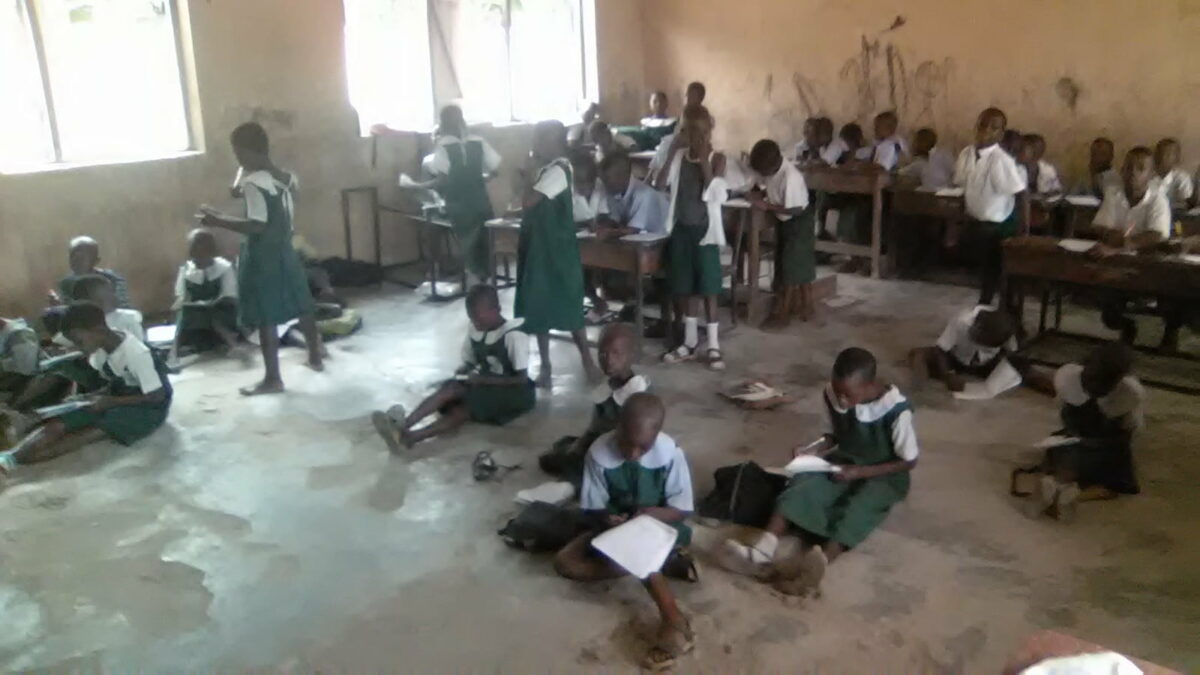
In a stark reminder of the uphill battle for quality education in Nigeria, students of Enekorogha Grammar School in Delta State sit on bare floors to attend classes and exams, a heartbreaking glimpse into schooling in many rural communities. FELIX IGBEKOYI writes that while this reflects the daily struggle of young minds determined to learn despite crumbling classrooms, stakeholders continue to plead for urgent action, as soaring costs and systemic neglect leave policy promises far from reality.
For years, successive governments in Delta State have boasted of investments and improved allocations for education, yet students at Enekorogha Grammar School are still forced to sit on bare floors to learn. Desks, chairs, and basic classroom infrastructure, and essentials in any school remain absent, leaving pupils to battle not just lessons, but the indignity of being denied a proper learning environment.
It is a bitter irony that while funds are released and budgets approved, those at the heart of the system, the children, continue to suffer.
Parents and community members are outraged, describing the situation as a betrayal. “Our children at Enekorogha Grammar School are being made to pay the price for mismanagement,” one mother fumed. Teachers, too, lament the impossible conditions, struggling to deliver lessons in spaces barely fit for learning.
The stark neglect exposes a disturbing truth in Delta State, the dreams of students are being suffocated while bureaucracy and soaring costs take precedence over the future of the next generation.
While students at Enekorogha Grammar School struggle on bare floors, with many likely facing lifelong back pains from hours of bending, some of the children of policymakers in the state enjoy a starkly different reality, attending expensive boarding schools or studying abroad, where comfort and quality education come at millions of naira.
The contrast is glaring, and the injustice is infuriating, those shaping education policy live in privilege, while those who depend on it suffer daily neglect.
Like Mr. Friday Edojah, Secretary of one of the Community Development Associations (CDAs) in Delta State, who is currently facing severe hardship. He manages an uncompleted building in Ughelli, where basic furniture such as beds and chairs are unavailable. Recently, his family was evicted from their rented two-bedroom apartment due to an inability to meet the rent obligations. Tragically, his children are also experiencing difficulties at school, facing similar hardships and lacking the necessary support for their education.
Edojah viewed this as an act of injustice based on his personal experiences. This may explain his anger and strong criticisms of the state government, which allows students to sit on bare floors to learn, and in some schools, even without classroom teachers. According to Edojah, such actions reflect arbitrariness, thoughtlessness, and mismanagement by the state government.
More and more problems like this are becoming a daily occurrence in schools across Delta State. Today, children as young as four are forced to sit and learn on bare floors riddled with holes and dust. Telltale signs indicate that the school, which was established 60 years ago, has long seen better days. Basic facilities and furniture are sorely lacking: fewer than 50 desks and chairs are available for over 200 pupils, leaving the bare floor as the only option for children desperate to learn.
With fewer than 50 usable desks in the entire school, only a few students get to sit on the squeaky, creaky furniture, but even then, they must watch out for protruding rusty nails and screws that can tear their uniforms and dig into their tender skin. Their less fortunate classmates are left to sit or even lie on the bare, dusty floors, struggling to take down the teacher’s notes in their exercise books.
Overhead, broken ceiling boards dangle precariously from the roof. Classrooms and even teachers’ staff rooms are without doors or windows, which means that valuables and books left behind at school often disappear and may never be recovered.
When the school closes, miscreants and hoodlums take over. They litter the premises and soil desks and floors with human waste. When the children return, especially after weekends or holiday breaks, they are confronted with mountains of faeces teeming with flies, strong odours, decaying leftover food, urine, and other filth. This hazardous mix exposes the children to a wide range of illnesses and diseases.
When concerns were raised about Jelu Primary School, Omadino, an oil-rich community in Warri South local government area, regarding the neglect of the school founded in 1940 by both community leaders and the government, the findings were shocking. The school has just one block of six classrooms, but during NDV’s visit, there were no windows, doors, chairs, chalkboards, or staff rooms.
It was learned that most members of the community send their children to government schools in neighboring Ughoton in Okpe local government area, showing little concern for what happens to their own school. Efforts to get the attention of community leaders and the government proved unsuccessful.
A source disclosed that some National Youth Service Corps (NYSC) members posted to the school took it upon themselves to contact non-governmental organisations for assistance. This effort brought the plight of Jelu Primary School to the attention of the Itsekiri Elite in the United Kingdom, who mobilised to help by raising funds for the renovation of the decrepit school.
LEADERSHIP Weekend gathered that the president of Ugbajor Itsekiri, Dr. Mogba Eyoiyibo, while donating chairs, benches, and windows to the school, called on the state government to declare a state of emergency for Jelu Primary School. Eyoiyibo, clearly frustrated at the complete neglect of the school by community leaders who even attempted, unsuccessfully, to hinder the donation, commended the teachers for persevering in such difficult conditions to regularly attend classes. He also appealed to the pupils to focus on their studies, praying that they would achieve greatness in life.
Isherhe Primary School and Adagwe Grammar School in Ughelli North local government area of Delta State are schools where pupils and students are forced to sit on bare floors to learn. Founded in 1980, Adagwe Grammar School, located in Eruemukohwarien, hosts hundreds of students from the Ekrokpe and Ekakpamre communities. Isherhe Primary School, founded in 1929, accommodates pupils from Oviri, Orho-Agbarho, and several other neighboring communities.
A classroom teacher who pleaded not to be named told our reporter that the odds are heavily stacked against pupils in the school. “It is not easy to learn; when you are teaching, some pupils are jumping here and there, and the heat at this time is really unbearable. It is a real challenge to the learning process,” he said. He described the school as a disgrace and a stark reflection of the failures of those who have governed the state over the years. “I am shocked,” he added, drawing attention to the condition of his former school, and appealed, “Sheriff should come to the aid of the school without delay.”
LEADERSHIP Weekend observed that during a visit to some of the schools affected that students are forced to learn in ridiculous environment while using their thighs as table as others sprawl on the floor for their daily lessons. Government officials had, while responding to the poor state of schools, affirmed the efforts of the state government to transform the physical infrastructure in schools in the state with a promise that the challenges of the school will be looked into soonest.
However, a visit to some schools proved that the promised transformation of physical infrastructures in schools in the state by the Delta government is yet to get to the school as things are going from bad to worse.
At some primary schools, the pupils were seen on the bare ground owing to the non-availability of furniture while others, who seemed lucky, were seen kneeling on the ground while using a makeshift table without a chair as their writing pad.
Though the Headmaster and Principal of the schools refused to comment on the level of infrastructural decay in the schools, the students lambasted Delta State government for being insensitive to their plight, with one of them lamenting, “Government refused taking care of our school because we are in a rural community.”
“Delta State government is not trying at all. We need chairs in our school. Our ceilings are not good. We don’t have boards to write on. We don’t have chairs to sit down to learn; we are pleading with the government to bring chairs. We receive our tutorials while standing or sitting by the windows.”
On his part, Senior Perfect of the school, name unknown said: “Since we have no chairs in our classes. We have to move to the empty laboratory and call in teachers to teach. Students find it difficult to cope with their studies because right from SSS 1 till now, we have not been taught a single practical. “I am appealing to the state government and the Commissioner for Education to please come to our help by providing us chairs and enabling learning environment.”
Speaking on efforts taken so far to draw the attention of government to the school, the Parent Teacher Association, PTA, chairman of the school, Prince Great Otabor, said: “We have written severally to the local and state governments all to no avail.
There was a time when a PTA meeting was called and, in that meeting, it was resolved that every parent should pay the sum of N2,500 in order to construct desks but the Principal refused, claiming that she needed to formally inform the state government first.
“After a while, she told parents that the state government had turned down the proposal of the N2, 500 levy, saying it was illegal to levy parents.
“She told us that government will do the needful by supplying desks to the school, but for the past years, nothing has been done and we have not heard from government.
Among the schools facing a severe shortage of teachers and poor learning environments are Oformor Primary School, Okparabe Secondary School, and Otovwodo Grammar School, all located in Ughelli South local government area of Delta State.
The communities have adopted various measures to raise funds to pay for the services of external teachers, but poor remuneration has forced many of them to leave. As a result, there are currently not enough teachers in the affected schools. At separate press conferences, community leaders, including the traditional ruler of Okparabe Kingdom, His Royal Majesty (HRM) Andrew Oghenevwodo, Osakpa III, Ovie of Okparabe Kingdom, and its president-general, Evangelist David Brighodemor, appealed to both the state and local government authorities to come to the rescue of the communities.
“Since two years ago, there have been no enough teachers in both primary and secondary schools to teach the pupils and students in Oformor Primary School and Okparabe Secondary School. The Okparabe community has tried their various ways to pay for the services of external teachers but because of poor remuneration, the external teachers left and now there are not enough teachers to teach the pupils and students. Okparabe Town Health Centre/Maternity is also facing the same challenge of lack of healthcare officers and other basic needs,” the monarch lamented.
Also, the president-general of the kingdom, Evang David Brighodemor, said Okparabe Kingdom needs social amenities and in pains, appealing to the federal and Delta state governments to come to their aid. He emphasized that primary and secondary school students in Okparabe town lack classrooms and furniture, stressing that the pupils and students sit on the floor during their classes.
In a similar development, president of Otovwodo Community, Engr. Ovigue Solomon Ugbarugba, also lamented the shortage of teachers. He highlighted the community’s contributions to the development of the area, citing a recent intervention at the Otovwodo Grammar School where they spent over ₦3.5 million this year alone.
“The principal of Otovwodo Grammar School wrote to the community about the shortage of teachers. In response, the community employed four graduate teachers: two English language teachers, one Christian Religious Study (CRS) teacher and one Geography teacher. We’ve been paying them from February last year to date, spending over ₦3.5 million,” he said.
They have cried out to the Delta State Governor, Hon Sheriff Oborevwori and Ughelli South council chairman, Hon Lucky Avwerome, to provide classroom teachers for both primary and secondary schools in Okparabe town.
An indigine. simply called Christy said the community are perplexed by the condition under which their children study, particularly considering that the community contributes to the state’s economy with revenue from crude oil extracted from oil wells located in the community.
Christy explained that there was nothing the leadership of the community could do about defecation in the classes, because of the porous security in the school. He blamed this on failure of government to provide security. “Teachers have reported the problem, but what can we do when there is no gate? The fence has fallen and intruders can even gain entry through the roof.”
Similarly, students of Enekorogha Grammar School, Burutu local government area of Delta, established in the early 1980s, sit on the bare floor to attend classes and write examinations.
According to Mr. Peter Ganagana, the chairman of the Community’s Education Committee, the state government has not constructed any buildings in the school. The only six-classroom block was erected by an individual, while other facilities were built solely by the community.
“While teachers lack basic necessities such as offices, chairs, and tables. Currently, the school has only a few classroom blocks and lacks essential items such as furniture, roofs, windows, doors, chairs, proper chalkboards, and a suitable staff room.
Ganagana further revealed that out of a student population exceeding 350, 80 per cent do not have adequate seats or desks for learning. “The few seats we have in the school were provided by the community and the ones donated by an old student of the school who visited some time ago. He generously donated 50 desks to the school, and these are the only seats in the school and it is not enough.
“It is pitiable that our children sit on the bare floor to learn daily, and even as they write this second term exam, beginning from JSS 1 to SS3, there is no desk for them to write. The school has just six teachers and the principal made it seven government teachers, and as you know, this is not enough to take all the subjects, so the community has to engage volunteer teachers that are given stipends monthly,” he said.
Ganagana said frustrated by the unsatisfactory conditions affecting both the students and their learning environment, the community wrote to the Post-Primary Education Board and the Ministry of Education. According to him, this prompted the board and ministry to send a delegation to the school to observe the situation firsthand.
He expressed disappointment that none of the commitments made to address the dreadful state of the school had been honoured. The school principal of one of the schools, who spoke under anonymity said several failed efforts have been made by the school authorities and the community leadership to get government’s attention. The school has remained only because of the community leaders’ efforts. The (last) renovation project was carried out in partnership with an oil company. The company wanted to carry out a project, but we said since nobody (government) is showing concern, let us convert the project to school renovation.”
Pupils of the school, who spoke about their fates, lamented the attitude of the state government but commended staff for their doggedness in spite of the challenging environment. An SSS3 student, Oghene Divine, lamented that she and other colleagues were preparing for WAEC under very difficult learning conditions.
“It is difficult for us to concentrate and learn,” one of the primary pupils told our reporter, “because two teachers are teaching at the same and they are teaching different classes and subjects. The teachers have to keep shouting for us to hear. Sometimes you don’t even know which of the lectures you are taking”
Due to dearth of the structures and facilities in the school, Science and Arts subjects students in the high school also share classes, with most of the former not having the luxury of using laboratories for practical.
Years back, schools like Sedeco schools (a misnomer) in Enerhen area of Uvwie Local Government was lucky, a soft drink company built a block of six very small rooms, which added to the two blocks of three classrooms the school kicked off with in 2007. The only other ‘structures’ are shades constructed by the PTA.
The primary school section has about 350 pupils, who share three classrooms. The situation is the same in the secondary school, with about twice more students. One of the rooms was used as staff room, while hundreds of pupils share three ‘classrooms’, which are separated by pieces of plywood to accommodate six classes: primaries one and two are cramped into a room, while three and four, and five and six share the other two rooms. Teachers, who cannot squeeze into the staff room, sit around the corridor and veranda, while preparing lesson notes.
Meanwhile, the executive chairman, Delta State Universal Basic Education Board (D-SUBEB), Hon. Samuel Mariere, who was contacted on the state of the schools, was furious, he said the board was investing in classrooms, teacher capacity, digital tools, and safety facilities to ensure that every Delta child has access to quality education.
He said journalists were only concerned about dilapidated schools while ignoring the work the government was doing in other schools. “There are other schools. Have you seen the work we are doing there? What about the communities that vandalize school properties? You people don’t report such cases for us. You should talk about that.”
“On teachers training, he congirmed 5,511 teachers trained under 10 professional development programmes, boosting lesson planning, classroom management and digital literacy,” he stated.
Further findings showed that where there is government school, private schools are expensive and inaccessible for the poor, they were forced to send their children and wards to public schools. A parent agreed that only children from indigent families attend private schools. “Government school charges little or nothing, (that is why) they (parents) still prefer to send their children here.
“Some schools do not have (external) examination centre because the schools don’t have laboratory, library and the schools do not have fence. The population is enough to get a centre, but now we have to write in other schools,” a student added.
A member of staff of the school, who spoke to our correspondent in confidence, said officials from the Ministry of Education have visited the school to see the deplorable condition under which pupils study. “We have written letters with photographs of the school to the Ministry of Education through our Chief Inspector of Education.”
But Mariere said government has plans to renovate schools. “Some communities want to get schools by all means. If we want to build now, Students will be relocated to another place before government will know what can be done to the place.”
Also, the commissioner for Works (Rural Roads) and Public Information, Mr. Charles Aniagwu, said the MORE Agenda is being implemented in a manner that impacts every part of the state, ensuring that all 25 local government areas, the 10 federal constituencies and the three senatorial districts benefit from government projects.
Aniagwu reaffirmed that Governor Sheriff Oborevwori’s administration remains committed to fairness.
The situation at Enekorogha Grammar School in the Burutu local government area of Delta state is both shocking and distressing. Students are forced to sit on the bare floor to attend classes and take examinations, while teachers lack basic necessities such as offices, chairs, and tables.
Despite these challenging circumstances, characterized by a severe lack of fundamental educational resources like desks and chairs, and inadequately maintained classrooms, the students remain enthusiastic about learning.
Established in the early 1980s, the school has experienced minimal government involvement and suffers from a shortage of qualified teachers. The secondary school students are taught under the most dehumanising environment. There is no basic amenity in the school: No pipe borne water, electricity or even toilet facilities. The closest thing to a toilet is a cubicle used exclusively by teachers, while pupils make do with a dump site located within the school premises as the toilets are no go area.
It Is surprising to see the state of Enekorogha Grammar School, especially considering the substantial monthly allocations received by the Delta State government. The school is marked by crumbling structures, a lack of desks for students, and a troubling environment, all of which contribute to an unsafe and unwelcoming atmosphere.
According to Mr. Peter Ganagana, the Chairman of the Community’s Education Committee, the state government has not constructed any buildings at the school. The only six-classroom block was erected by an individual, while other facilities were built solely by the community.
The level of neglect experienced by this school, established in the early 1980s, under various administrations in Delta State is astonishing. Currently, the school has only a few classroom blocks and lacks essential items such as furniture, roofs, windows, doors, chairs, proper chalkboards, and a suitable staff room. Ganagana further revealed that out of a student population exceeding 350, 80 per cent do not have adequate seats or desks for learning.
He said; “The few seats we have in the school where provided by the community and the ones donated by an old student of the school who visited sometime ago. He generously donated 50 desk to the school, and this are the only seats in the school and it is not enough. It is pitiable that our children sits on bare floor to learn daily, and even as they write this second term exam, beginning from JSS 1 to SS3, there are no desk for them to write.
“The school has just six teachers and the principal made it seven government teachers, and as you know, this is not enough to take all the subjects, so the community have to engage volunteers teachers that are given little stipends monthly.” He further disclosed that, frustrated by the shameful and unsatisfactory conditions affecting both the students and their learning environment, the community took the initiative to write to the Post Primary Education Board and the Ministry of Education.
According to him, this prompted the board and ministry to send a delegation to the school to observe the situation firsthand. However, he expressed disappointment that none of the commitments made to address the dreadful state of the school have been honored to this day. In spite of these difficulties, the student population continues to grow each year, as they remain determined and resilient in their pursuit of academic success. The community, for its part, has committed its resources and efforts to ensure that their children receive a quality education, even in the absence of government support and with limited resources.
Recognizing the challenges faced by the school, the community has actively sought to provide support in various ways, reaching out to local individuals for donations of textbooks, stationery, and other essential supplies aimed at enhancing students’ learning experiences.
One aspect that warms the heart of any visitor is the unwavering determination of the students. Despite the tough and unsettling conditions, they are committed to succeeding and maximizing the opportunities presented to them. Their resilience and dedication inspire everyone who visits the school and observes their commitment to learning and pursuing their aspirations
However, beyond the lack of furniture, many classrooms suffer from severely damaged ceilings, with roofing sheets having come loose, and the dilapidated floors where students sit for their lessons. The neglect of the school by the Delta State government is mind-blowing with just few blocks of classroom built by an individual and the community long ago without desks is disturbing.
Asked if the teachers are coming to school and the role of the principal in ensuring the students are given quality education, Peter said, the principal reside in Ughelli, but blamed the government for not doing their job diligently, but said the focus majorly is for the state government to come and do a total overhauling of the school.
“We are appealing to Governor Sheriff Oborevwori to come to our aid and do a thorough renovation of existing structures, build new structures and furnish all classes with basic learning materials. We also call on him to send more teachers to the school as the strength of the teachers both the six government teachers and the community volunteers teachers do not match the population of students in the school.
“Several efforts has been made by the community leaders and the school authority to get government attention but all seems to have failed as no positive response has come out of this.”The people and leadership of Enekorogha Community in Burutu Local Government Area are calling on the state government and the administration of Hon. Sheriff Oborevwori, to as a matter of urgency visit the school before the next term and begin a total renovation and provision of basic educational learning materials to enable the students learn comfortably like their other counterparts in other places and areas of the state.
Delta is one of the richest states in Nigeria, yet well-equipped and functional basic and secondary schools are still a mirage in parts of the state that earned a steady #423.85 billion monthly allocation from the Federation Account in November 2025.
Years back, the deplorable state of four schools in Udu and Uvwie local governments and the fate of thousands of children who attend them was terrible. The sight of the learning condition in some of Delta State’s rural primary and secondary schools broke the most hardened heart. It prompted the resuscitation and beautification of some schools during the Dr Emmanuel Uduaghan administration. But it seems the development have faded away in some schools, especially in the rural areas. Now, tender learners are subjected to the most excruciating and most deplorable conditions.
The state allocated billions of naira to the ministries of education in the 2025 budgets. Yet, the conditions of some schools in the state make mockery of any claim of commitment to education. Schools like Sedeco Basic School and Sedeco High School located in Enerhen Community of Uvwie Local Government Area, and Emadadja Primary and Adadja Secondary Schools in Udu LGA, all in Delta Central Senatorial District of the state, then were examples of rot, decay and lack of concern for the future of those who attend the schools.
However, the Umukwata community in Ukwuani Local Government Area of Delta State has expressed profound joy and appreciation as renovation works commence at Umukwata Secondary School, restoring hope to students, staff, and residents after years of neglect and deterioration.
The school, which had suffered significant dilapidation, now sports a “new look” following the approval of the renovation project by the Delta State Governor, Hon. Sheriff Oborevwori.
We’ve got the edge. Get real-time reports, breaking scoops, and exclusive angles delivered straight to your phone. Don’t settle for stale news. Join LEADERSHIP NEWS on WhatsApp for 24/7 updates →
Join Our WhatsApp Channel