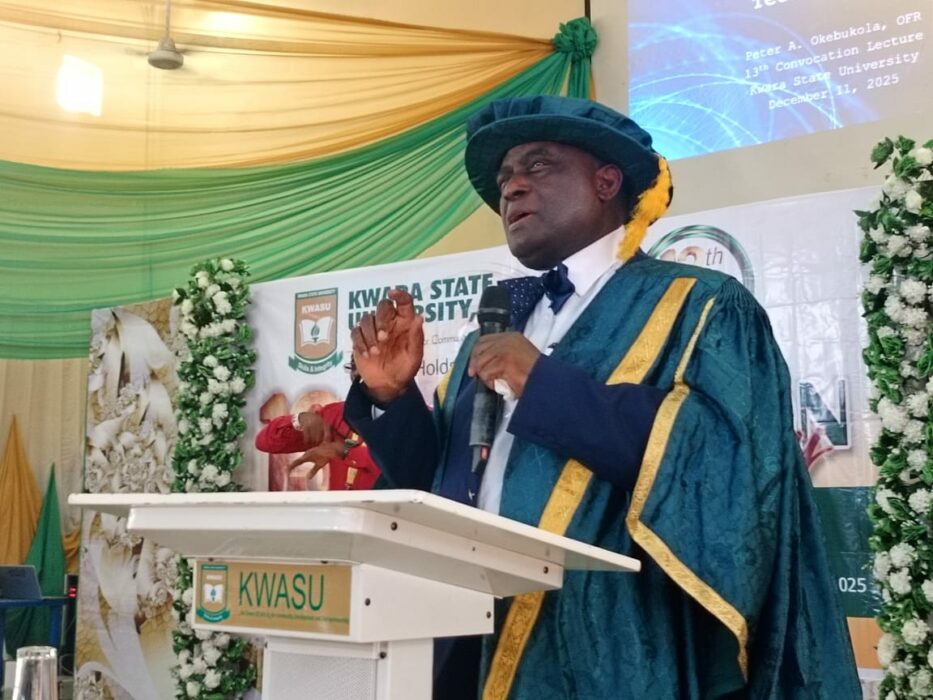
The former executive secretary of the National Universities Commission (NUC), Prof. Peter Okebukola, on Thursday, stressed the need for the government to establish tax incentives for private sector organisations that fund university researches or establish research chairs in emerging technology areas in the nation’s universities.
He also decried low funding in research and development in the nation’s universities.
Okebukola said this while delivering the 13th Convocation Lecture of the Kwara State University, Malete (KWASU) titled “Universities in the age of Quantum Thinking: Redefining Quality, Relevance and Innovation through Emerging Technologies”.
He lamented that Nigeria only invests 0.2 per cent of GDP in research, recommending a dramatic increase in research and development funding for both the state and federal universities in the country.
“Currently, Nigeria invests approximately 0.2 per cent of GDP in research, far below the African average of 0.5 per cent and well below the global leaders who invest 3 to 4 per cent.
“Building on the NUC’s 2025 partnership with France’s AFD on a 38 million euro ICT transformation project for Nigerian universities, government should actively seek additional international partnerships that bring both funding and expertise to our institutions.
“Government should mandate that a percentage of all technology procurement contracts include capacity building components that involve Nigerian universities, ensuring that we build local expertise rather than remaining perpetually dependent on foreign knowledge,” he said.
Okebukola also recommended that the government should address the brain drain challenge facing Nigerian universities by creating competitive research fellowship programmes that make it financially attractive for the nation’s best minds to build careers in Nigerian universities rather than emigrating.
“These fellowships should be specifically targeted at emerging technology areas where Nigeria seeks to build capacity,” he said.
On the theme of the convocation lecture, Okebukola said that quantum thinking simply means multi-dimensional thinking.
“Quantum thinking is not merely metaphorical flourish. It is a necessary cognitive framework for institutions operating in an era where nearly one billion jobs worldwide will undergo significant changes due to technology within the next decade. Traditional universities operated on Newtonian principles, where knowledge was compartmentalised into discrete disciplines, where cause and effect followed predictable paths and where outcomes could be calculated with reasonable certainty.
“However, today’s challenges demand quantum approaches, Climate change, artificial intelligence ethics, pandemic preparedness, and sustainable development are not problems confined to single disciplines or predictable in their manifestations. They require what we might call quantum superposition of expertise, where solutions emerge from the simultaneous consideration of multiple knowledge states.
“Consider how quantum computing teaches us to think in terms of quantum states, parallel processing, and probabilistic outcomes rather than deterministic solutions. This represents
more than technological advancement; it embodies a fundamental shift in how we approach problem-solving itself.
:Universities in the quantum age must cultivate this cognitive agility in their students and staff, moving beyond the tyranny of single-answer, single-pathway thinking to embrace the productive uncertainty that characterises our complex world,” he explained.
Earlier, the vice chancellor of KWASU, Prof. Shaykh-Luqman Jimoh, had said that the university prioritises transformative ideas and innovations that contribute to the development of society, adding that the university cherishes synergies that add value.
Prof. Jimoh also said that the university brings the gown in contact with the town as a way of forging connections that have potential of extending to mutually beneficial relationships.
We’ve got the edge. Get real-time reports, breaking scoops, and exclusive angles delivered straight to your phone. Don’t settle for stale news. Join LEADERSHIP NEWS on WhatsApp for 24/7 updates →
Join Our WhatsApp Channel