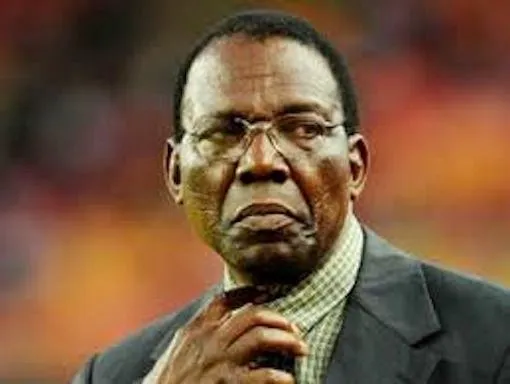
The death of Chief Adegboye Onigbinde at the age of 88 marks the passing of one of the last authentic voices in Nigerian football, a man who understood the game not as spectacle or commerce but as a discipline rooted in intellect and preparation.
For more than four decades, Onigbinde gave Nigerian football something it has consistently failed to reward: honest, indigenous expertise. In a country where the coaching of the national team has too often been outsourced to foreign hands or handed to politically connected figures, Onigbinde stood as proof that a Nigerian, armed with knowledge and conviction, could hold his own at the highest levels of the game.
Onigbinde’s credentials were never in doubt. He started from the trenches of club football in the 1960s, building Water Corporation FC of Ibadan into a continental quarter-finalist by 1977 and later steering Shooting Stars FC to the final of the African Champions Cup. His appointment as head coach of the Super Eagles in the early 1980s was a watershed moment, the first time an indigenous coach had been entrusted with the senior national team at that level.
And he delivered. At the 1984 Africa Cup of Nations in Cote d’Ivoire, Onigbinde assembled a squad heavy on young, untested players and guided them to a silver medal, losing the final 3–1 to Cameroon. It was a result that announced Nigeria as a serious football nation and Onigbinde as a coach of rare tactical depth.
But it was the 2002 FIFA World Cup in Korea and Japan that defined, and in many ways complicated, his legacy. Called up to replace the coaching crew of Shuaibu Amodu after a disappointing 2002 Africa Cup of Nations, Onigbinde had barely three months to assemble and prepare a squad for the biggest stage in world football. What he did with that time was audacious. He threw open the doors of the national camp to over 100 players, eventually whittling the number to a final 23 that shocked many observers.
Established names like Sunday Oliseh and Finidi George were dropped. In their place came young, largely unknown players alongside a few experienced heads like Taribo West and Ike Shorunmu, brought back to provide stability. He introduced a teenage Vincent Enyeama, who kept a clean sheet against England, and selected 17-year-old Femi Opabunmi fresh from the under-17 World Cup.
The results were mixed. Nigeria narrowly lost to Argentina and Sweden and drew with England, exiting the group stage without a win. The backlash was ferocious.
And the Nigeria Football Federation, as is its custom, moved on to the next coach without so much as a proper debrief. What was lost in the noise was the substance of what Onigbinde had attempted: a philosophical reset of Nigerian football, away from dependence on individual brilliance and towards systemic cohesion and tactical discipline.
That Onigbinde became the first indigenous coach to lead Nigeria at a World Cup, following Dutchman Clemens Westerhof in 1994 and Serbian Bora Milutinovic in 1998, was historic. But what should concern us more is that over two decades later, Nigeria has still not produced a sustainable pipeline of indigenous coaches capable of operating confidently at the elite level.
The country’s football administration continues to swing between expensive foreign appointments and reluctant stop-gap arrangements with local coaches, a pattern that speaks to a fundamental lack of serious investment in coaching education and development and a stubborn, almost reflexive refusal to trust homegrown expertise.
After his time with the Super Eagles, Onigbinde did not retreat into bitterness. He reinvented himself as a technical instructor for CAF and FIFA, spending years training coaches across Africa and the world. The NFF also utilised him as a technical director, a role he filled with characteristic diligence.
The tributes now pouring in from President Bola Tinubu, the NFF, and football stakeholders across the continent are fitting. The NFF’s General Secretary, Dr Mohammed Sanusi, described him as a man who “ate, drank, breathed, slept and lived football development.” President Tinubu commended his contributions to grassroots football and acknowledged his historic leadership.
These are words well spoken, and they are deserved. But words alone will not honour a man whose entire life was devoted to building a system that the country’s football authorities have consistently undermined through poor governance, relentless political interference, and chronic short-termism that has plagued the system for decades.
If Nigeria is serious about honouring Onigbinde’s memory, the path is clear. The NFF must invest in a structured coaching development programme that identifies and nurtures local talent from the grassroots. The era of treating indigenous coaches as second-class alternatives to foreign imports must end. Football academies must be built and funded not as political projects but as functional institutions.
And the culture of discarding coaches after every poor tournament a culture that consumed Onigbinde himself must give way to a patient, long-term vision for the development and growth of the game.
Onigbinde, born in Modakeke, Osun State, was many things: a high chief, a teacher, a football intellectual, and a man who dropped his baptismal name in 1960 because he believed his Yoruba identity, Adegboye, “a child born to reclaim a chieftaincy title” – better captured who he was. He was right about that. He spent his entire life reclaiming space for Nigerian coaching at every level of the game. The least the country can do now is ensure that the space he carved out does not close behind him.
We’ve got the edge. Get real-time reports, breaking scoops, and exclusive angles delivered straight to your phone. Don’t settle for stale news. Join LEADERSHIP NEWS on WhatsApp for 24/7 updates →
Join Our WhatsApp Channel