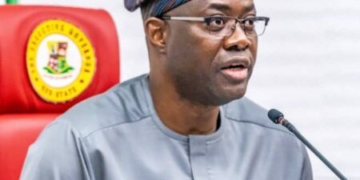

The minister of State for Agriculture and Food Security, Senator Aliyu Abdullahi on Tuesday said, limited capital releases had slowed programme execution and restricted the ministry’s capacity to scale support for farmers and production systems.
Abdullahi said this when he appeared before the Joint Senate and House of Representatives Committees on Agricultural Production, Services and Rural Development for budget defence.
He explained that personnel expenditure under the 2025 appropriation was largely implemented, but capital project execution has been significantly constrained by delayed releases.
According to the former senator about 30 per cent of the capital allocation representing roughly N18 billion is yet to be released to the ministry.
The minister added that only funds tied to constituency related projects had seen partial disbursement, with about N19.8 billion released so far.
He said despite prevailing financial constraints, Nigerian farmers had shown strong commitment to production, with government surveys indicating marginal increases in output.
Abdullahi noted, however, that sustaining those gains requires addressing the structural challenges confronting producers nationwide.
He said the agricultural sector is projected to receive a total allocation of N1 trillion in the 2026 fiscal year, of which the ministry is expected to get approximately N262 billion for capital expenditure and N19.18 billion for recurrent costs, including personnel and overheads.
The minister stressed that the most pressing concern confronting farmers remains the rising cost of inputs, driven by broader macroeconomic pressures beyond the ministry’s direct control.
He cited fertiliser production as a major example, noting that gas pricing policies significantly affect manufacturers’ ability to produce affordable fertiliser for Nigerian farmers. He added that taxation policies affecting agricultural chemicals and pesticides also increase production costs.
Abdullahi urged lawmakers to support interventions that would improve access to inputs, support domestic fertiliser production and reduce cost pressures across the agricultural value chain.
In his intervention, chairman of the House Committee on Agricultural Production and Services, Hon. Bello Ka’oje, warned that reduced funding for the agricultural sector could undermine Nigeria’s food security ambitions and weaken economic recovery efforts if urgent corrective measures are not taken.
The lawmaker expressed concern over what he described as a troubling contradiction in budgetary allocations to the agricultural sector.
He noted that while total planned national expenditure is projected to rise by 21 per cent to N58.47 trillion in 2026, the allocation to the Federal Ministry of Agriculture and Food Security has declined sharply from N2.22 trillion in 2025 to N1.45 trillion in the 2026 proposal.
Ka’oje warned that inadequate funding could deepen food insecurity, weaken productivity and derail broader economic recovery efforts.
For his part, chairman of the Senate Committee on Agriculture, Production and Rural Development, Senator Saliu Mustapha, asked the Federal Government to prioritise adequate funding and timely release of resources to the agricultural sector to safeguard food security and support economic growth.
Mustapha said low implementation of capital projects in the 2025 budget had constrained productivity in the sector, warning that insufficient funding could worsen food insecurity and undermine economic recovery.
We’ve got the edge. Get real-time reports, breaking scoops, and exclusive angles delivered straight to your phone. Don’t settle for stale news. Join LEADERSHIP NEWS on WhatsApp for 24/7 updates →
Join Our WhatsApp Channel