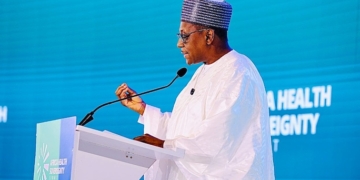
The health sector is one of the Tinubu administration’s axes of policy dynamos and triumphs. Reforms initiated to upskill manpower, strengthen structural integrity, upgrade infrastructure, provide essential equipment, and ensure efficiency in healthcare delivery are crystallising with evident outcomes.
In December 2023, President Bola Tinubu unveiled the Nigeria Health Sector Renewal Investment Initiative (NHSRII) – a programme steered by the Ministry of Health and Social Welfare under the Coordinating Minister of Health and Social Welfare, Dr Muhammad Ali Pate.
The Nigeria Health Sector Renewal Investment Initiative is a strategic blueprint — with a sector-wide tack for improving population health outcomes through the primary healthcare system, and enhancing reproductive, maternal, and child health services in the country.
Primary healthcare is as fundamental as the under-structure of an edifice in building a resilient and integrated healthcare system; hence, the Tinubu administration’s comprehensive revamp of infrastructure and equipment and re-training of frontline health workers.
Specifically, the administration set out to raise the number of functional Primary Healthcare Centres (PHCs) from 8,809 to over 17,000 by 2027 across the 36 states and the Federal Capital Territory (FCT), train 120,000 frontline health workers over 16 months, increase health personnel enrolment capacity of accredited nursing and midwifery institutions by two-fold to accommodate the demand created by new facilities, and establish a paid volunteer youth force of social accountability officers to monitor the functioning and financial integrity of these primary healthcare centres.
In addition, the administration sought to address the high cost of healthcare and enhance access to healthcare services by redesigning the Basic Health Care Provision Fund (BHCPF). The BHCPF is a foundational element of the sector-wide approach – with pooled and non-pooled financing to advance the primary health system nationwide.
So far, the policy intentions and actions are yielding winsome outcomes.
Reproductive, Maternal, Newborn, And Child Health Service Delivery
Under reproductive, maternal, newborn, and child health service delivery, the progressive outcomes are:
• Expanded Midwives Service Scheme (eMSS) redesigned across four major areas
• Quantification of commodities completed (Quantification is the process of estimating the quantities and costs of the products required for a specific health programme (or service) and determining when the products should be delivered to ensure an uninterrupted supply for the programme)
• Service delivery models for traditional birth attendant referral and midwifery outreach are being developed
• 730 skilled birth attendants to be deployed to 760 level 1 facilities (in the first six months using the eMSS as an interim solution)
• 16 priority commodities to be deployed to 600 level 2 facilities
Primary Healthcare Revitalisation And Basic Health Care Provision Fund
• 6,300 health facilities identified for low functionality
•2,000 health facilities identified for high functionality
• 820 primary healthcare centres identified at the federal level.
• 3,500 primary healthcare centres identified at the state level
• 540 work plans and BOQs submitted
• Guidelines under review by MOC
• PFMO recruitment agency identified
• Performance management KPIs and methodology finalised
• PHC functionality dashboard deployed to NPHCDA and awaiting data refresh
• Public view dashboard showing the status of facilities and revitalisation being developed
Sexual And Reproductive Health
• 8,421 health facilities assessed in 36+1 states
• Prioritised commodities for procurement and deployment to facilities, with the costing of these in progress
• Drafting sustainability plan for commodity distribution
– Nwabufo is Senior Special Assistant to the President on Public Engagement
Data And Digitisation
• Facility functionality dashboard completed and operated from NPHCDA, currently awaiting the first round of data refresh
• Public platform to provide wide access view of PHC functionality in progress
• Detailing of citizen engagement mechanisms in progress
HUMAN RESOURCE FOR HEALTH
• The proportion of trained health workers: Frontline health workers are 29,280, and non-frontline health workers are 4,153. A total of 33,433 health workers
• Training is ongoing in Kebbi, Jigawa, and Lagos states
• Four remaining states will commence training next week
ROUTINE IMMUNISATION AND POLIO
• 89 wards initiated IEV for polio: with expansion plans
• Synchronised nOPV2 campaigns scheduled for October 25 and November 22
• To reach 20 states and 38 million eligible children.
COMMUNITY HEALTH PROGRAMME
• Strategy to create 125,000 community health worker jobs finalised
• Secured commitment from donors to support recruitment, attraction, and training
• Syndication with states to obtain buy-in has commenced
• Concept development for e-learning has commenced
CAMPAIGN STRENGTHENING
• Launched the diagnostic process to streamline campaigns, enhancing efficiency and inclusivity for diverse audiences.
It is in light of the sector-wide health initiative that the World Bank recently approved $1.57 billion to support the health sector in Nigeria. The World Bank financing is from the International Development Association (IDA), which is highly concessional, attracting zero interest, with a 10-year moratorium and 30 years’ repayment plan.
According to the bank, the funds will be used for strengthening human capital through better health for women, children, and adolescents.
“The World Bank has today approved three operations for a total of $1.57 billion to support the government of Nigeria in strengthening human capital through better health for women, children and adolescents and building resilience to the effects of climate change such as floods and droughts through improving dam safety and irrigation. The new financing includes $500 million for addressing governance issues that constrain the delivery of education and health (HOPE-GOV), $570 million for the Primary Healthcare Provision Strengthening Program (HOPE-PHC) and $500 million for the Sustainable Power and Irrigation for Nigeria Project (SPIN). The HOPE-GOV and HOPE-PHC programs combined will support the government of Nigeria to improve service delivery in the basic education and primary healthcare sectors which are critical towards improving Nigeria’s human capital outcomes,’’ the bank said in a statement.
President Tinubu understands that health is not merely the absence of disease, but the embodiment of physical, mental, and social well-being; hence, his abiding efforts in this sector, which has tremendous impact on the nation’s human capital index.
Fredrick Nwabufo is Senior Special Assistant to the President on Public Engagement
We’ve got the edge. Get real-time reports, breaking scoops, and exclusive angles delivered straight to your phone. Don’t settle for stale news. Join LEADERSHIP NEWS on WhatsApp for 24/7 updates →
Join Our WhatsApp Channel