Last week, PricewaterhouseCoopers released its Nigeria Economic Outlook 2026, and the report immediately became the center of discussion across newspapers and social media. Analysts, policymakers, and ordinary citizens alike focused on one particularly stark projection: by 2026, up to 141 million Nigerians, roughly 62 percent of the population, may be living in poverty. While the report examined multiple aspects of Nigeria’s economy, including GDP growth, fiscal management, and sectoral performance, it was poverty that captured public attention. In cities and towns, households already feeling the squeeze from rising costs and stagnant wages saw their experiences reflected in the report’s empirical analysis.
The report exposes a tension that is as old as economic measurement itself: headline growth does not automatically translate into shared prosperity. Nigeria’s GDP has recovered modestly in recent quarters, aided by improvements in oil prices, fiscal consolidation, and structural reforms. Yet these numbers obscure critical realities for households. Income growth remains weak for a substantial portion of the population, inflation continues to rise, and everyday expenses, particularly food, consume the majority of household budgets. For the poorest Nigerians, food accounts for up to 70 percent of spending, leaving households highly vulnerable to price shocks. Growth, therefore, is insufficient on its own; the distribution of its benefits is what determines its social impact.
Growth Without Distribution
This disconnect between macroeconomic performance and household welfare is well documented in development economics. In An Uncertain Glory: India and Its Contradictions, Amartya Sen and Jean Drèze highlighted how India achieved rapid GDP growth while simultaneously facing persistent malnutrition, limited access to education, and uneven health outcomes. The key insight is clear: aggregate growth is only meaningful when it enhances people’s capabilities—the substantive freedoms that allow individuals to live secure, healthy, and dignified lives. In Nigeria, headline growth has improved, but millions of households remain unable to secure basic necessities. GDP figures suggest expansion, but they fail to capture who benefits from this growth and who remains excluded.
The lesson is methodological as much as it is moral. Economic analysis must go beyond averages. A rising GDP can coexist with declining real incomes for the majority if gains accrue disproportionately to a small segment of society. Policies designed to stimulate growth without attention to distribution risk creating prosperity on paper while deepening vulnerability on the ground.
The Labour Market Conundrum
The labour market illustrates this dynamic in stark terms. Employment growth has lagged behind population growth for years. Informal work dominates, providing incomes that barely cover basic needs and offering no social security. In Lagos, for example, a young graduate may spend twelve hours driving a motorcycle for a ride-hailing service while earning just enough to survive. This illustrates a broader structural challenge: growth concentrated in capital-intensive sectors does not automatically translate into job creation. Productivity gains at the firm or sectoral level often bypass the majority of workers.
The economic outlook rightly highlights the need for deliberate employment-focused interventions. Creating labour-intensive jobs, supporting small and medium enterprises, and aligning education with labour market demand are all essential strategies. Economic expansion without employment opportunities leaves households trapped in subsistence-level survival, limiting their ability to benefit from growth. In other words, without meaningful work, growth is a statistic rather than a lived reality.
Food Inflation and Household Vulnerability
Food prices are another critical factor highlighted in the report. Across urban and rural Nigeria, households are adjusting consumption to cope with inflation. In Ibadan, a schoolteacher now purchases vegetables individually rather than by the bunch. In rural Benue, farmers sell crops immediately after harvest to meet urgent cash needs, foregoing potentially higher prices later. These decisions are rational responses to economic constraints but illustrate capability erosion, a concept emphasised by Sen and Drèze. Poverty is not only low income; it is the loss of substantive freedoms, including the ability to eat adequately, access healthcare, and educate children.
Agriculture remains central to this challenge. Despite employing the majority of rural Nigerians, productivity is low due to poor infrastructure, weak market access, and limited technology adoption. Empirical evidence from other developing economies demonstrates that targeted investments in rural infrastructure, storage, and extension services raise incomes, reduce volatility, and strengthen household resilience. Without structural interventions, households will remain highly exposed to food inflation, and headline growth will fail to translate into meaningful poverty reduction.
Social Protection: A Critical Missing Link
Social protection is another area where Nigeria falls short. Current programmes are fragmented, reactive, and inadequately funded. Transfers expand during crises and contract afterward, leaving households exposed to future shocks. International experience demonstrates that predictable and well-targeted cash transfers reduce poverty, stabilize consumption, and support local economies. India’s experience, analysed extensively by Sen and Drèze, illustrates that public support systems, even when imperfect, mitigate deprivation and preserve human capital.
Nigeria faces an opportunity to institutionalise social protection in a way that complements macroeconomic reforms. Predictable, well-funded interventions can protect households from the immediate impact of policy adjustments, such as subsidy reforms or inflationary shocks, while providing a foundation for longer-term poverty reduction. Without such measures, reforms risk increasing hardship for those least able to bear it.
Political Economy and Perception
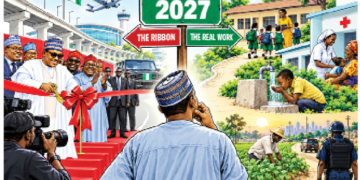
The PwC report also illuminates a deeper political economy challenge. Policymakers and the media often emphasise GDP growth while overlooking household realities. This creates a perception gap between official narratives and lived experiences. Citizens observe rising prices and stagnant wages, yet public discourse frequently presents growth as unambiguous progress. Social media reactions to the report illustrate this divide: some dismissed the projections as alarmist, others defended headline GDP figures as proof of recovery, while a smaller, evidence-focused group highlighted the stark disconnect between averages and distribution.
This perception gap has implications for policy legitimacy. Reforms that impose costs on households without delivering visible benefits undermine public trust and social cohesion. Persistent poverty threatens not only social stability but also the sustainability of reform. PwC’s report, by focusing on poverty, forces policymakers and the public to confront the question that often goes unasked: who benefits from growth?
Prosperity That Must Be Shared
The headlines drew attention because poverty is not an abstraction; it is lived reality. PwC’s projections confirm what millions of Nigerians already feel: growth alone does not lift households out of deprivation. The report, grounded in data and methodologically robust, emphasises that real progress is measured not by GDP figures but by the ability of citizens to secure food, income, and basic services. For too many, daily life is dominated by rising prices and limited opportunities, even as aggregate output expands.
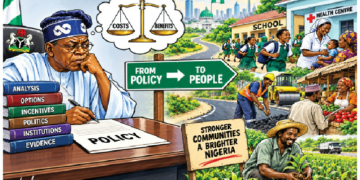
Nigeria now faces a choice. Policymakers may continue to celebrate growth as an abstract success, relying on averages and headline figures, or they can translate evidence into action that strengthens livelihoods. Investments in employment, social protection, rural productivity, and human capital can ensure that growth reaches those most in need.
The teacher in Ibadan, the trader in Kano, and the young graduate in Lagos illustrate that prosperity without inclusion is hollow. The PwC economic outlook has provided the evidence and quantified the risks. The task now is clear: transform abstract growth into shared opportunity, reduce vulnerability, and build a foundation for sustainable, inclusive development across the nation.
We’ve got the edge. Get real-time reports, breaking scoops, and exclusive angles delivered straight to your phone. Don’t settle for stale news. Join LEADERSHIP NEWS on WhatsApp for 24/7 updates →
Join Our WhatsApp Channel