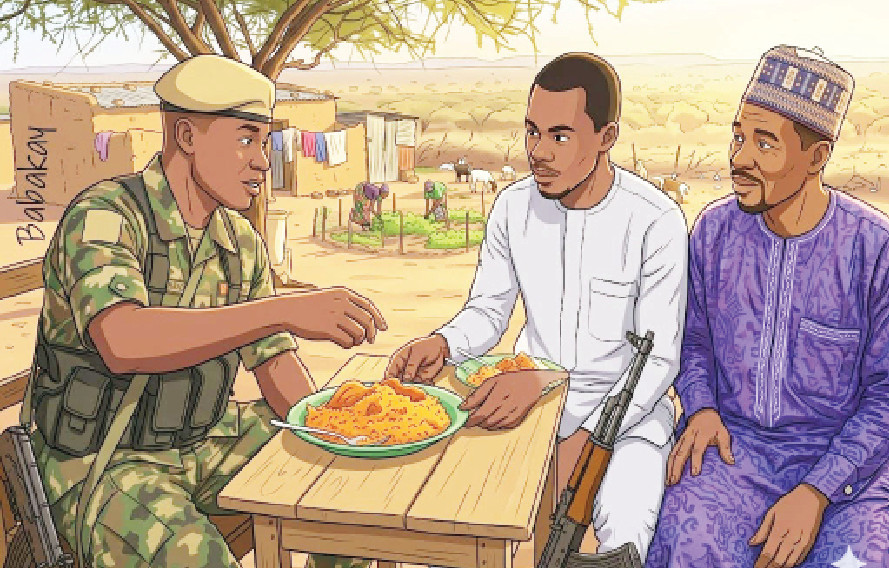
Jollof rice is a popular delicacy in Nigeria and other parts of Africa. It can be argued that it is the most consumed meal in most homes. It doesn’t discriminate between the rich and the poor. There is hardly a public function that doesn’t have it in the menu. I compare jollof rice to conventional wars. The military is trained to fight wars. The regime is to identify security threats, enemy location, and engage accordingly. But in recent times, the more readily available meal is different from jollof rice. It is a meal consisting of unpredictability, rapid mutation, and identity crisis. Sometimes, it appears an unpleasant meal. It is not. But the ingredients are different from what is used in preparing jollof rice.
The province of chance
Asymmetric warfare doesn’t have a clear definition. What we have as definitions are postulations. The common denominator in all the available definitions is the phrase “unconventional.” It is like reading a book upside down. When a book is read upside down, it takes longer to make sense. This is what the activities of insurgents, bandits and kidnappers do to our security agencies. For example, in a conventional war, the identity of the enemy is known and easy to target. But in asymmetric war, the identity of the enemy is unknown, and for the trigger to be pulled, several factors come into play. Looking at the picture of Abu-Bilal al-Minuki, the slain ISIS second-in command, who would bet that he was a terrorist?
In the words of Carl von Clausewitz, a Prussian military general in the 19th-century, “it is difficult to make accurate decisions when you are operating in the middle of a conflict.” He based his argument on the “Province of Chance” in his famous work “On War” (Vom Kriege), which explains that “no matter how perfect a plan is on paper, unexpected variables can alter a war trajectory.” What are these unexpected variables? They are the unknown factors that reveal themselves only in the heat of the moment. This is the regime in the North-East, and it is a game of chance. Nothing is predictable. And adaptability is necessary for survival.
The military in the North-East
Adaptability is a critical factor in asymmetric warfare. Since 2010, there have been several military operations in the North-East, and they were an expression of the realities of the times. For example, Operation Restore Order was established to restore order in the North-East in 2011 because at the time, the activities of Boko Haram members were viewed as a public unrest. Operation Boyona (Borno, Yobe and Adamawa) was launched in May 2013, when it was realised that the security challenge was beyond a public unrest as the insurgents became daring and established territories outside Borno State. This was the period a state of emergency was declared by the Goodluck Jonathan administration across Borno, Yobe, and Adamawa states to address the rising insecurity in the North-East.
Operation Zaman Lafiya (Peaceful Living) replaced Operation Boyona, and the idea was to consolidate on the gains recorded by the earlier operation to entrench peaceful coexistence among the people. As a step further, the Nigerian Army established the 7 Division with headquarters in Maiduguri to institutionalise its operations in the North-East. In 2015, the Boko Haram threats mutated to a regional war as the group began to receive external support for its operations. This was the year the Boko Haram leader, Abubakar Shekau, pledged allegiance to the Islamic State of Iraq and Syria (ISIS). Consequently, the military launched Operation Lafiya Dole (Peace by Force). It was an aggressive military operation occasioned by heavy deployment of military war assets that led to the reclamation of over 20 local government areas hitherto under the control of Boko Haram in the North-East.
In 2016, the military gained ascendancy over the insurgents with the capture of Camp Zero, the operational headquarters of Boko Haram in Sambisa Forest, through a special operation codenamed Operation Deep Punch I and II that took the battle into the inner chambers of the desert to dislodge the insurgents and flush them from their enclaves in the North-East. There was also Operation Crack Down to liberate hundreds of civilian abductees, including the Chibok schoolgirls. The current military operation in the North-East is Operation Hadin Kai (Collaboration), which is a blend of kinetic and non-kinetic strategies.
Fogs of war
If asymmetric warfare were as simple as preparing “jollof rice,” the Boko Haram insurgency would have been history. But unfortunately, it is not. The complication is that the war is against a people whose identity is confusing. There is no marker that differentiates the good guy and the bad guys. This skill is not taught; it is learnt from field experience. Boko Haram/ISWAP members do not have a distinct identity. The only time that they could be rationally identified is when they are in possession of weapons of war. For example, a non-state actor can elect to drop his arms somewhere and walk freely among the people and sometimes past military formations without being suspected. It is a case of an unknown enemy lurking around without detection. This is why sometimes it is possible for military bases to come under surprise attacks.
The provisions of the Law of Armed Conflict (LOAC) are complicated in Asymmetric war. It emphasises Distinction, Proportionality and Necessity. Military forces must distinguish between a civilian and a combatant, and should not take offensive action such as would cause harm to unarmed civilians or civilian objects, and every use of force must be justified. In my opinion, these provisions are practicable in conventional wars, but very difficult in asymmetric wars without the support of the people. This is where the role of the people comes in handy. A French Military Theorist, David Galula, in his work, “Counterinsurgency Warfare: Theory and Practice” posited that “insurgencies should not be viewed as a standard military problem to be crushed by superior firepower, but as primarily a political struggle centered entirely on the population.” He argued that in asymmetric warfare, the support of the population is paramount because the “population is the ultimate prize”.
A good example could be gleaned from the US-Afghan war which lasted for close to 20 years, and was estimated to have cost the Americans $2.261 trillion. At the initial stages, Afghans welcomed the international intervention, but as time progressed there were complications because military operations also affected unarmed civilians mostly in rural areas. What is not in the public space is that the Americans lost the support of the people, one reason why the war stretched.
After 13 years of combat operations, the Americans realised that it was beyond “jollof rice.” The operational focus changed from Operation Enduring Freedom, an aggressive war campaign to dismantle Al-Qaeda and remove the Taliban regime from power, to Operation Freedom Sentinel to train, advise, and assist Afghan security forces. This is a practical definition of asymmetric war, where wisdom, and not military strength is an asset.
– Ocheja, PhD, an alumnus of the Nigerian Defence Academy, is a military historian and creative writer. He is the author of “Two Advisers and One President”, (2026).
We’ve got the edge. Get real-time reports, breaking scoops, and exclusive angles delivered straight to your phone. Don’t settle for stale news. Join LEADERSHIP NEWS on WhatsApp for 24/7 updates →
Join Our WhatsApp Channel