President Bola Tinubu’s declaration that bandits, kidnappers, violent cults and armed gangs will henceforth be treated as terrorists marks a significant shift in Nigeria’s security posture.
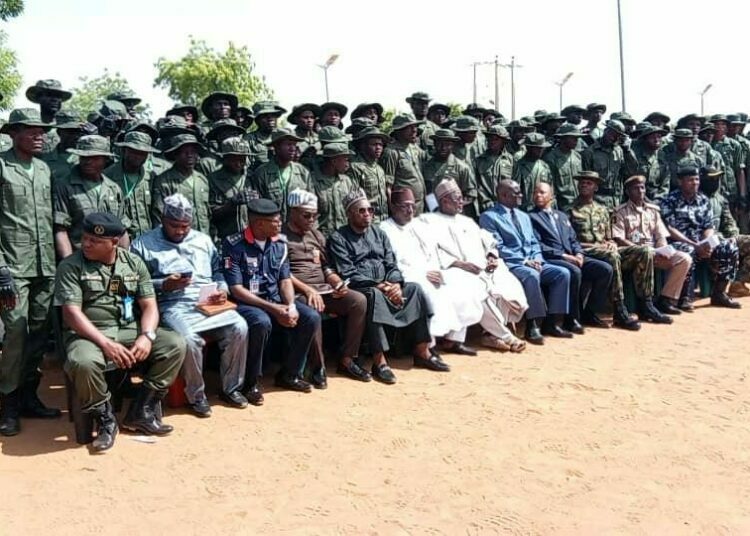
The announcement, made during the presentation of the 2026 Appropriation Bill, comes with the deployment of over 7,000 Forest Guards across seven pilot states—Borno, Sokoto, Yobe, Adamawa, Niger, Kwara, and Kebbi.
The question on everyone’s mind is straightforward: will this new approach succeed where previous strategies have failed?
The reclassification of kidnappers and bandits as terrorists is not merely semantic. It fundamentally changes the legal and operational framework under which security forces engage these criminals.
Minister of Information Mohammed Idris put it bluntly: “If you terrorise our people, whether you are a group or you are an individual, you are a terrorist and will be classified as such. There is no name hiding under this again.” This declaration eliminates the grey areas that have long allowed criminal networks to operate with relative impunity in Nigeria’s vast ungoverned spaces.
The Forest Guards Initiative represents a tactical recognition of what security analysts have argued for years—that conventional military approaches alone cannot secure Nigeria’s extensive forest belts.
These 7,000 newly graduated guards are indigenous to their local government areas, providing them with intimate knowledge of the terrain, community networks, and criminal patterns that external forces often lack.
National Security Adviser Nuhu Ribadu described them as “first responders” expected to dominate forest ecosystems, gather intelligence, and support ongoing security operations.
The strategic logic is sound. Nigeria’s forests have become sanctuaries for criminal enterprises precisely because they remain ungoverned. Bandit camps, kidnap dens, and illegal mining operations thrive in these spaces where state presence is minimal or nonexistent. By deploying locally recruited personnel with terrain familiarity and community trust, the government aims to deny criminals their most valuable asset—sanctuary.
Yet Nigeria has heard harsh security rhetoric before. Multiple administrations have declared war on banditry, promised to crush insurgents, and announced new security architectures. The results have been mixed at best. What makes this initiative different?
Three elements stand out: the reclassification of criminals as terrorists (which expands prosecution powers), the emphasis on local knowledge through indigenous recruitment, and the interagency coordination framework involving the Department of State Services (DSS), Defence Headquarters, Nigerian Army, Navy, Police, and NSCDC.
However, several concerns temper optimism. First, the Forest Guards are being deployed into environments where heavily armed bandits have operated freely for years, building networks, accumulating weapons, and establishing territorial control.
Will 7,000 guards—spread across seven states with vast forest territories—constitute sufficient force density to challenge entrenched criminal networks? The numbers raise questions about coverage and sustainability.
Second, while indigenous recruitment solves the terrain familiarity problem, it also creates vulnerability to local power dynamics, ethnic loyalties, and potential infiltration. Criminal networks have shown remarkable adaptability in corrupting security personnel, exploiting family ties, and leveraging community connections.
The guards will need robust oversight mechanisms and rapid rotation protocols to prevent compromise.
Third, the initiative’s success depends heavily on the interagency coordination that Ribadu emphasised. Nigeria’s security architecture has historically struggled with institutional rivalries, information hoarding, and operational silos. The DSS, military branches, police, and NSCDC have different mandates, hierarchies, and institutional cultures. Achieving seamless command and control across these agencies while integrating a new force of locally recruited guards presents enormous coordination challenges.
The broader counterterrorism framework announced by Tinubu raises additional questions. Treating bandits as terrorists expands prosecution powers but also risks conflating different security challenges. Boko Haram pursues ideological objectives through territorial control and governance. Bandits are primarily economic actors motivated by ransom payments and cattle theft. ISWAP seeks to establish an Islamic caliphate. Kidnappers operate for profit. Lumping these diverse threats under a single “terrorist” designation may simplify messaging but could complicate operational responses that require tailored approaches.
The president’s vow to “show no mercy to terrorists and violent criminals” signals a hardline posture. While understandable given public frustration with insecurity, such declarations must be balanced against due process and human rights considerations.
Ultimately, the Forest Guards Initiative will succeed or fail based on execution rather than conception. The strategy of deploying indigenous personnel with local knowledge addresses a genuine operational gap. The reclassification of criminals as terrorists provides expanded legal tools. The emphasis on interagency coordination tackles a persistent weakness in Nigeria’s security architecture. But strategies fail in implementation.
President Tinubu has reset the framework. Now comes the more complex work of delivering results. Nigerians have heard enough about new security architectures and counterterrorism doctrines. They want to travel highways without fearing abduction, farm their lands without bandit attacks, and sleep without wondering if gunmen will raid their villages. The Forest Guards Initiative deserves support and time to demonstrate effectiveness. However, it also deserves rigorous scrutiny, transparent accountability, and an honest assessment of its outcomes.
The era of ambiguous nomenclature may be over, as Minister Idris declared. However, the era of ambiguous results must also come to an end. Show Nigerians safer forests, secure highways, and protected communities. That is the only metric that matters.
We’ve got the edge. Get real-time reports, breaking scoops, and exclusive angles delivered straight to your phone. Don’t settle for stale news. Join LEADERSHIP NEWS on WhatsApp for 24/7 updates →
Join Our WhatsApp Channel