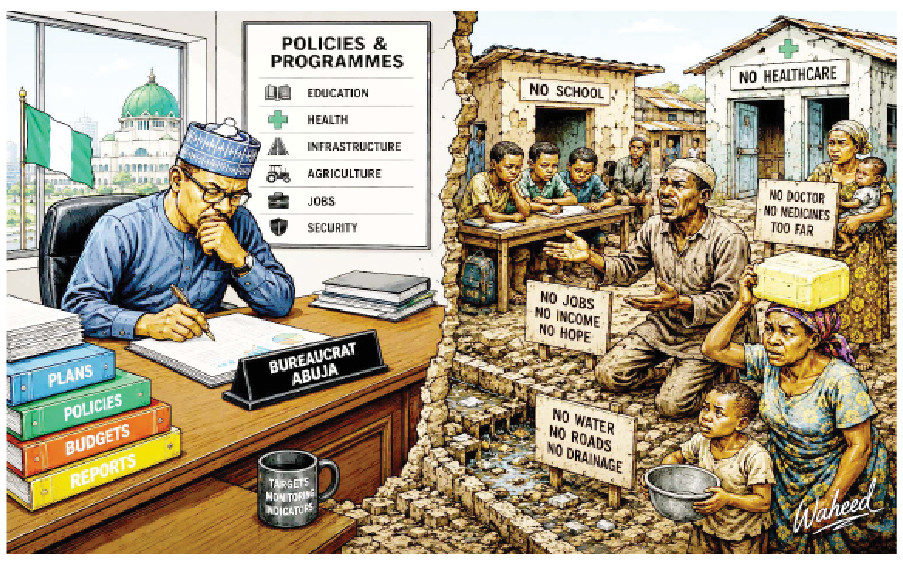
Nigeria’s policy conversation has long been conducted at the wrong altitude. We speak of federal programmes, presidential initiatives and national plans as though Abuja is the decisive theatre of development. Yet citizens encounter public policy elsewhere: in the classroom, primary health centre, rural road, market, motor park, drainage channel and local government office. The question is whether institutions closest to citizens know what problem they are solving, whose reality counts, what evidence supports their diagnosis, and how success will be recognised.
This matters because Nigeria’s federalism has produced a paradox. Service delivery is substantially decentralised, yet policy authority, fiscal resources, standards, data and political attention remain heavily concentrated elsewhere. The World Bank notes that states are at the forefront of primary education and primary and secondary healthcare, while subnational governments account for a substantial share of public spending. Nigeria’s federal structure can bring government closer to citizens, but it can also produce weak coordination, fiscal dependence and uneven service delivery. Decentralisation has therefore created proximity without necessarily creating capability. A governor may possess political authority without reliable information about the ward where a programme is supposed to work. A local government may possess responsibilities without the machinery to fulfil them.
Reading the Evidence
The consequences are visible in the lives of children. UNICEF’s 2024 assessment records 10.2 million primary-school-age children and 8.1 million junior-secondary-school-age children out of school. Among children aged seven to fourteen, 73 percent struggle to understand simple sentences and 75 percent cannot solve basic mathematics problems. Nearly seven in ten Nigerian children live in multidimensional poverty. These are not merely national statistics. They are accumulations of local conditions.
A child is not out of school in the abstract. The child is outside a particular classroom, in a particular settlement, within a particular local government, facing a particular combination of poverty, distance, insecurity, household labour demands, social expectations and weak educational provision. A woman does not experience poor primary healthcare as a national statistic. She encounters a closed facility, an absent health worker, an empty medicine shelf, an unaffordable referral journey or a health centre too distant to reach. This distinction between the national description of a problem and its lived reality should transform how state and local government policymakers think. Aggregate indicators tell us where the fire is. They do not necessarily tell us why it started, who is trapped inside, or what kind of intervention will put it out.
Beyond Visible Projects
The recurring mistake is to confuse visible government activity with the condition government intends to change. A state can report that it has built hundreds of classrooms while learning remains poor. It can commission boreholes while communities continue buying water. It can launch agricultural schemes while farmers remain constrained by insecurity, weak extension, poor roads, storage gaps and uncertain markets. It can announce ease-of-doing-business reforms while enterprises still navigate multiple agencies and informal charges.
The harder question is: what is the problem? Not the symptom, slogan or preferred project, but the problem. In a community with low school attendance, distance may be decisive. Elsewhere, poverty, insecurity, seasonal migration, disability, child labour or poor teaching may matter more. Each diagnosis points toward a different intervention. If children attend but do not learn, building more classrooms may have little effect. If insecurity is binding, conventional expansion may be unsafe. If household poverty is decisive, school feeding or targeted transfers may outperform construction. Good policy therefore begins by carefully understanding the causal structure beneath the visible symptom. This is where disciplined inquiry becomes more valuable than political instinct.
States and Local Governments Areas as Laboratories
States and local governments should be treated not merely as recipients, but as places where policy assumptions are tested against reality. Nigeria’s diversity makes this especially important. States differ in ecology, demography, economic structure, security conditions, urbanisation, political settlements and administrative capacity. Local governments differ even more sharply. A policy that works in Lagos may fail in Yobe. A model suited to a dense commercial city may be inappropriate for a dispersed agrarian community. An intervention that succeeds where insecurity is limited may collapse as displacement continue to shape household decisions.
This diversity is usually described as a governance problem. It can also be an extraordinary policy asset. Nigeria has enough variation to learn what works under different conditions, provided governments collect comparable evidence and are willing to adapt. The question should therefore shift from “Which programme should we copy?” to “Which mechanism made that programme work, and does that mechanism exist here?” That is a more demanding question because it forces policymakers to distinguish between a policy’s visible form and its underlying logic. A successful rural transport intervention, for example, may owe its results less to road construction itself than to maintenance arrangements, market connectivity, local enforcement and predictable financing.
Knowledge Before Prescription
Public policy is therefore best understood as an argument about reality that must continually confront evidence. Policymakers must distinguish what they know from what they assume, what citizens report from what administrative records suggest, and what a programme produces from what it actually changes. Government does not possess a monopoly on knowledge. Farmers understand market constraints that officials may overlook. Teachers know why attendance registers can conceal classroom realities. Community health workers know which households never reach facilities. Traders understand the costs created by fragmented regulation.
This matters in primary healthcare, where a state may measure success by facilities renovated, workers recruited or equipment purchased. Citizens experience healthcare differently, through availability, distance, reliability, affordability and trust. The World Bank’s review of basic education and primary healthcare in Nigeria identifies financing, governance and human-resource constraints as central barriers to service delivery. More inputs may therefore be necessary without being sufficient. The relevant unit of analysis should often be the service encounter itself: can a woman obtain care when she arrives? Can a child acquire foundational literacy? Can a farmer move produce at a viable cost? These questions bring policy back to lived reality.
From Knowing to Governing
The same logic explains why local government matters even when its institutions are weak. Weakness is not an argument for ignoring the local level. It is an argument for understanding it. Local officials and communities often know which settlements flood first, which schools have chronic teacher shortages, which roads become impassable during the rains, which markets generate waste, and which communities are underserved by health facilities. What is frequently missing is the institutional machinery for collecting, validating, using and acting upon that knowledge.
Nigeria therefore needs a different subnational policy culture, beginning with discipline. Before asking how much a programme will cost, policymakers should ask what behaviour or condition it is expected to change. Before counting projects, they should define the outcome. Before blaming citizens for noncompliance, they should ask whether compliance has been made feasible. Before declaring success, they should ask what would have happened without the intervention. This is the beginning of government that learns, not merely spends. The next stage is more difficult: converting understanding into choices that survive political pressure, administrative weakness and implementation realities. That requires a deeper examination of incentives, institutions, power and the people who actually execute policy.
We’ve got the edge. Get real-time reports, breaking scoops, and exclusive angles delivered straight to your phone. Don’t settle for stale news. Join LEADERSHIP NEWS on WhatsApp for 24/7 updates →
Join Our WhatsApp Channel