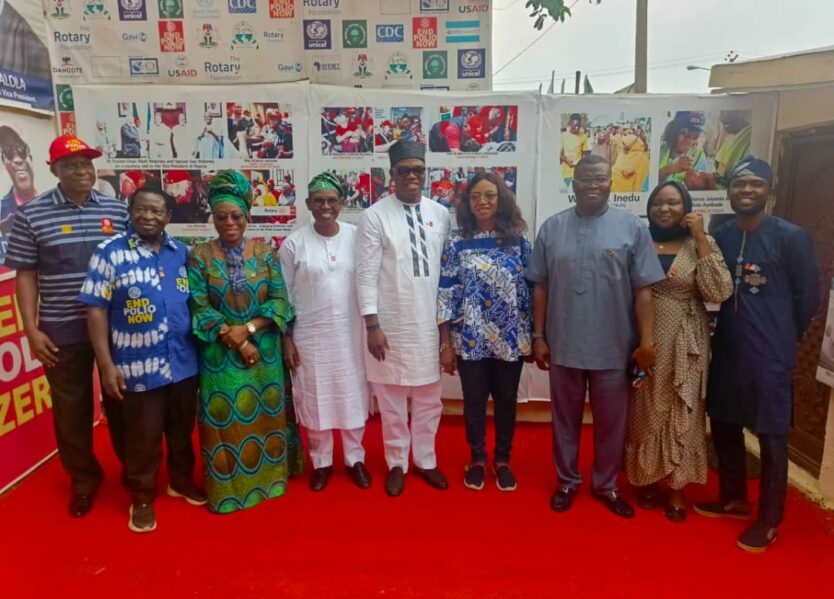
Rotary International president-elect, Olayinka Akeem Babalola, has vowed to leverage his historic position to strengthen global immunisation efforts and forge new partnerships, driving measurable change in Nigeria and Africa.
Babalola, elected by the organisation’s Board of Directors to serve as president for the 2026/2027 term, is the second African to lead the 119-year-old humanitarian body since its founding in 1905.
The president who made this known while speaking with journalists in Abuja to address his agenda, said,
“This is a privilege to lead a global movement dedicated to creating lasting change. It is an exciting development for Nigeria, Africa, and the entire Rotary world.”
He said that his presidency, which begins in July 2026, will focus on reinforcing Rotary’s core missions: maternal and child health, disease prevention, education, and economic development.
However, the president issued an urgent call to action on immunisation, warning that progress against polio remains fragile.
While reaffirming Rotary’s four-decade commitment to eradicating polio, Babalola highlighted the dramatic reduction in cases from over 1,000 children daily in 1985 to fewer than 50 annually today, now endemic only in Afghanistan and Pakistan.
He cautioned that Nigeria’ certified wild poliovirus-free status is under threat from variant strains.
“Polio is not circulating in Nigeria as an endemic disease. That was stopped. But some issues have emerged,” he said.
He pinpointed dangerously low routine immunization coverage in some states—as low as 13 percent against a required 80 percent for herd immunity, as the primary cause.
“Many of the cases you are now seeing as a variant of polio are mostly present in those parts of the country where the routine immunization coverage is very low,” he said.
Babalola emphasised that Rotary is working closely with the government to close these critical gaps, that they will not rest until no child is at risk.
Beyond polio, he outlined significant investments in combating other diseases, citing a landmark $9.8 million project in Kebbi and Akwa Ibom states to fight malaria, pneumonia, and diarrhea, building on a successful $4 million pilot in Zambia that nearly halved malaria deaths.
“That is the kind of measurable impact Rotary is scaling across Nigeria and Africa,” he said.
While acknowledging that Nigeria stands to benefit from having one of its own at the helm, Babalola was quick to note that Rotary’s rigorously structured system allocates resources based on need and established procedures, not favoritism.
He revealed that the Rotary Foundation has already invested $33.5 million in Nigeria over the last three years, with an average annual donation of around $3 million.
“Will there be increased grants? The possibility is there. But that will only happen if our Rotarians step up and do more for their communities. And I think they will do more,” he said.
Babalola further called for more Nigerians to join local Rotary clubs and for strengthened global partnerships.
He framed his upcoming presidency as a pivotal opportunity for African-led solutions on the world stage.
“Wherever Rotary goes, good things follow. We need more people, more clubs, and more partnerships to create lasting change.
“This is Africa’s moment to lead. We will show the world that solutions can come from here,” he said.
He encouraged citizens to engage directly with their communities through Rotary, assuring, “You tell them, look, this is an issue in this area. Can we do something about it? If there’s a need in that community, your Rotary club will take care of it.”
We’ve got the edge. Get real-time reports, breaking scoops, and exclusive angles delivered straight to your phone. Don’t settle for stale news. Join LEADERSHIP NEWS on WhatsApp for 24/7 updates →
Join Our WhatsApp Channel