
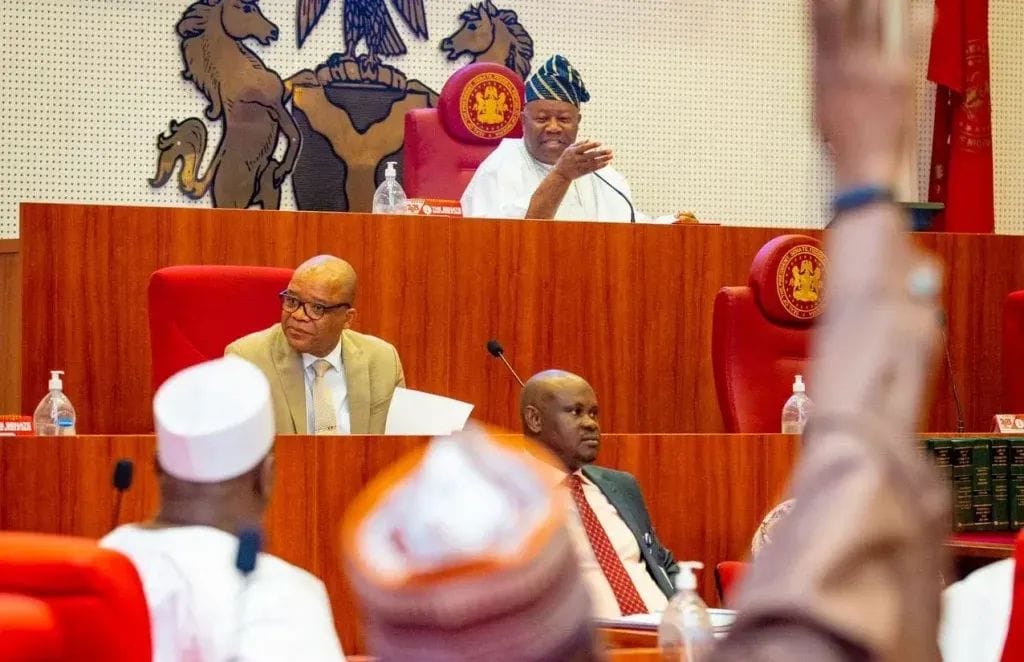
The Senate, through its Committee on Finance, on Thursday, directed the Federal Government to revert to the old payment system for contractors, citing growing unpaid obligations under the current centralised payment structure.
The committee noted that the present system has left many contractors unpaid for projects executed in 2024, as well as those nearing completion in 2025.
It also called for the replacement of the envelope budgeting system with a priority- or performance-based model, arguing that the incremental allocation approach had failed to deliver strategic outcomes.
Additionally, the Senate Committee resolved to write President Bola Tinubu, recommending the removal of the Registrar-General of the Corporate Affairs Commission (CAC), Hussaini Ishaq Magaji, SAN, for his persistent refusal to appear before the legislative panel.
The resolutions were taken during an interactive session with the Federal Government’s economic management team, led by the Minister of Finance and Coordinating Minister of the Economy, Wale Edun, on Thursdayl
Others in attendance included the Minister of Budget and National Planning, Abubakar Bagudu; the Accountant-General of the Federation, Dr. Shamseldeen Babatunde Ogunjimi; and the Chairman of the Nigeria Revenue Service (NRS), Zacch Adedeji.
In his opening remarks, the Chairman of the Committee, Senator Sani Musa (Niger East), told the economic team that feedback from Ministries, Departments, and Agencies (MDAs) during ongoing budget defence sessions indicated that the impact of economic reforms had not yet reached ordinary Nigerians.
“Based on submissions from heads of various agencies, the envelope system of budgeting has failed and needs to be replaced by a priority-based model,” Senator Musa said.
He added, “The incremental allocation model has outlived its usefulness. It promotes routine expenditure expansion rather than strategic prioritisation. Similarly, the centralised payment system, which has left many contractors unpaid for executed projects, should be replaced with the old system that allows MDAs to pay the contractors they awarded jobs to.”
Senator Musa also stressed the importance of restoring strict adherence to the annual budget cycle to ensure measurable outcomes.
“If, by December, we cannot assess ourselves realistically, then the system is failing. We must return to a disciplined budget cycle where one fiscal year ends before another begins,” he said.
Other committee members supported the chairman, urging the economic team to improve budget implementation, ensure timely release of capital funds, and prioritise prompt payment to contractors.
Responding, Minister of Finance Edun assured lawmakers that the outlook for 2026 remained positive, particularly regarding the proposed N58.472 trillion budget.
He clarified that Nigeria’s current N152 trillion debt profile was not solely the result of new borrowings.
“Currently, government debt in naira terms is N152 trillion. About N30 trillion came from Ways and Means inherited by this government, while N9 trillion resulted from exchange rate adjustments,” he explained. “Virtually half of that debt is made up of adjustments. It is not additional borrowing. Additional borrowing since 2023 is in the N20 trillion range.”
The minister further noted that moving forward, prioritisation would begin with MDAs identifying growth-enhancing projects.
These would be reviewed by the Economic Management Team before final approval by the President, particularly for capital projects.
Earlier in the session, the committee formally resolved to recommend the sack of the CAC Registrar-General, citing his alleged persistent refusal to honour invitations, describing it as disregard for legislative oversight.
We’ve got the edge. Get real-time reports, breaking scoops, and exclusive angles delivered straight to your phone. Don’t settle for stale news. Join LEADERSHIP NEWS on WhatsApp for 24/7 updates →
Join Our WhatsApp Channel