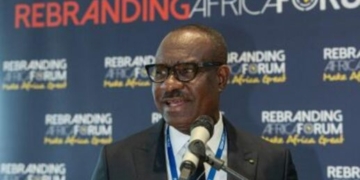

The Association of Small Business Owners of Nigeria (ASBON) has cautioned that the federal government’s proposed $21.7 billion external borrowing could worsen Nigeria’s debt sustainability concerns unless the funds are tied to projects that generate measurable economic returns, jobs and higher revenue.
ASBON president, Dr Femi Egbesola, said borrowing is not inherently wrong, but Nigeria’s weak revenue base relative to its obligations makes debt sustainability increasingly worrying.
“External borrowing is justifiable when it finances productive infrastructure that generates economic growth and revenue,” he said.
“The critical question is whether the returns will exceed the cost of borrowing.”
President Bola Tinubu asked the National Assembly to approve a 2026–2027 supplementary external borrowing plan of $20.52 billion and €1.045 billion—about $21.7 billion—for projects including power, transportation, healthcare, education, agriculture, water supply, security, employment generation and financial-management reforms.
The Senate has referred the request to its Committee on Local and Foreign Debts for scrutiny, and final approval had not been granted as of Tuesday.
Egbesola said the proposed loans, if fully disbursed, could add roughly N30 trillion to Nigeria’s debt stock at an exchange rate of N1,400 per dollar. Nigeria’s total public debt already stood at N166.79 trillion as of June 30, 2026, according to the Debt Management Office, up N7.44 trillion from N159.35 trillion at the end of March.
The ASBON president argued that the debt-service-to-revenue ratio is a more urgent indicator than debt-to-GDP because it reveals how much government income is consumed by debt repayment rather than healthcare, education and infrastructure.
“Debt-to-GDP alone can give a misleading sense of comfort,” he said. He added that the actual impact of the new loans on debt-to-GDP and debt-service ratios would depend on disbursement timing, loan terms, economic growth and revenue performance.
Nigeria’s public debt includes N91.59 trillion in domestic debt and N75.20 trillion in external debt as of June 2026, underscoring the scale of obligations facing the government.
Egbesola warned that additional foreign-currency borrowing would increase Nigeria’s exposure to dollar and euro movements. A weaker naira, he said, would raise the naira cost of servicing external debts and intensify pressure on foreign-exchange demand.
He noted that the risk is lower where borrowed funds finance projects that earn foreign exchange or strengthen domestic productive capacity, rather than recurrent spending or low-return ventures.
To reduce reliance on new debt, Egbesola urged the government to prioritise revenue expansion through improved tax compliance, reduced leakages, a broader tax base and cuts in wasteful expenditure.
“Where borrowing remains necessary, Nigeria should prioritise concessional, long-tenor loans for productive projects and carefully assess domestic borrowing to avoid crowding out private businesses,” he said. “Borrowing must translate into measurable economic returns, jobs and stronger revenue, not simply bigger debt obligations.”
The warning comes as scrutiny of the loan request intensifies, with critics questioning the clarity of project-level returns and the government’s capacity to service maturing obligations.
We’ve got the edge. Get real-time reports, breaking scoops, and exclusive angles delivered straight to your phone. Don’t settle for stale news. Join LEADERSHIP NEWS on WhatsApp for 24/7 updates →
Join Our WhatsApp Channel