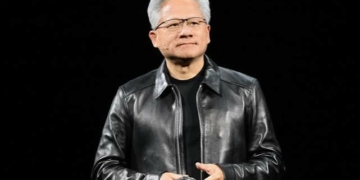
Nvidia, the world’s largest artificial intelligence chipmaker, suffered a sharp stock market decline on Monday, with its market valuation falling by nearly $400 billion at the height of trading following allegations that its Chief Executive Officer, Jensen Huang, was targeted in a Chinese espionage operation.
The sell-off came after the company’s board announced an independent investigation into reports linking Huang to Alice Huang, a Chinese business executive suspected by United States intelligence agencies of gathering information for Beijing.
Nvidia shares fell as much as 8.8 per cent in early trading on Monday, wiping nearly $400 billion off its market capitalisation and raising fresh concerns about corporate governance, national security and the growing geopolitical tensions surrounding the global semiconductor industry.
The company’s shares subsequently recovered some of their losses but closed down approximately 4.3 per cent, erasing more than $192 billion from its market value, according to market reports.
The development represents a major setback for Nvidia, whose valuation had reached approximately $4.5 trillion, making it one of the world’s most valuable publicly traded companies and a central player in the global artificial intelligence revolution.
The controversy intensified after reports by The New York Times and other international media indicated that US intelligence officials believed Alice Huang had been recruited by China’s Ministry of State Security to obtain information from the Nvidia chief.
Alice Huang reportedly had business connections within the artificial intelligence and semiconductor ecosystem and was associated with Megaspeed, a Singapore-based artificial intelligence computing company that had commercial dealings with Nvidia.
According to reports, American intelligence officials suspected that she was gathering information for Beijing, although the precise nature of the alleged intelligence operation and whether any sensitive information was obtained remain unclear.
Nvidia had previously dismissed suggestions of improper dealings, describing Jensen Huang’s interactions with the woman as normal engagements associated with his responsibilities and dealings with customers.
However, the allegations assumed greater significance after the Nvidia chief acknowledged having an extramarital affair and apologised to his family and employees.
In a message to staff, Huang admitted that he had fallen short of his responsibilities and pledged to cooperate fully with the investigation.
The company’s board subsequently announced that a committee of independent directors, assisted by external legal counsel, would examine all available information surrounding the allegations.
Despite the seriousness of the reports, Nvidia said it had no reason to believe that national security or company secrets had been compromised.
The investigation is expected to establish the extent of Huang’s relationship with Alice Huang, whether the relationship created potential security vulnerabilities and whether any confidential corporate or technological information was exposed.
The allegations have also drawn attention to Nvidia’s strategic importance in the US-China technology rivalry, particularly as advanced semiconductors have become critical to artificial intelligence development, military applications and national security.
Nvidia’s graphics processing units (GPUs) are widely used to train and operate advanced AI systems, including large language models, data centre applications, autonomous technologies and high-performance computing infrastructure.
Consequently, concerns about possible access to sensitive information within the company could extend beyond its corporate operations to Washington’s broader efforts to restrict China’s access to advanced American semiconductor technology.
The controversy is particularly sensitive because Huang has repeatedly advocated a less restrictive approach to selling Nvidia chips to China, arguing that maintaining access to the Chinese market is important for American technological competitiveness.
The US government has also reportedly investigated Megaspeed over concerns about possible diversion of Nvidia chips to China, further complicating the company’s position in the ongoing technology dispute between Washington and Beijing.
Meanwhile, US President Donald Trump defended Huang, describing him as an honourable person and expressing confidence in his contribution to American technological leadership.
According to reports, China has rejected the espionage allegations as unsubstantiated, describing them as smears against the country.
The controversy has also attracted the attention of US lawmakers. The chairman of the House Select Committee on China, John Moolenaar, has called on Huang to address national security concerns before Congress, particularly regarding China’s access to sensitive technology and information.
Meanwhile, the development is raising questions about the extent to which Nvidia’s corporate fortunes are tied to its chief executive, who has led the company since co-founding it in 1993.
Huang has become the public face of the global AI boom, steering Nvidia’s transformation from a graphics processing company into a dominant supplier of the computing infrastructure powering artificial intelligence.
The latest market reaction also comes amid growing investor scrutiny of technology companies’ massive spending on AI infrastructure and concerns about the sustainability of the sector’s rapid growth.
For Nvidia, the outcome of the investigation could have implications for investor confidence, its relationship with US policymakers and its position in the increasingly competitive global semiconductor market.
We’ve got the edge. Get real-time reports, breaking scoops, and exclusive angles delivered straight to your phone. Don’t settle for stale news. Join LEADERSHIP NEWS on WhatsApp for 24/7 updates →
Join Our WhatsApp Channel