
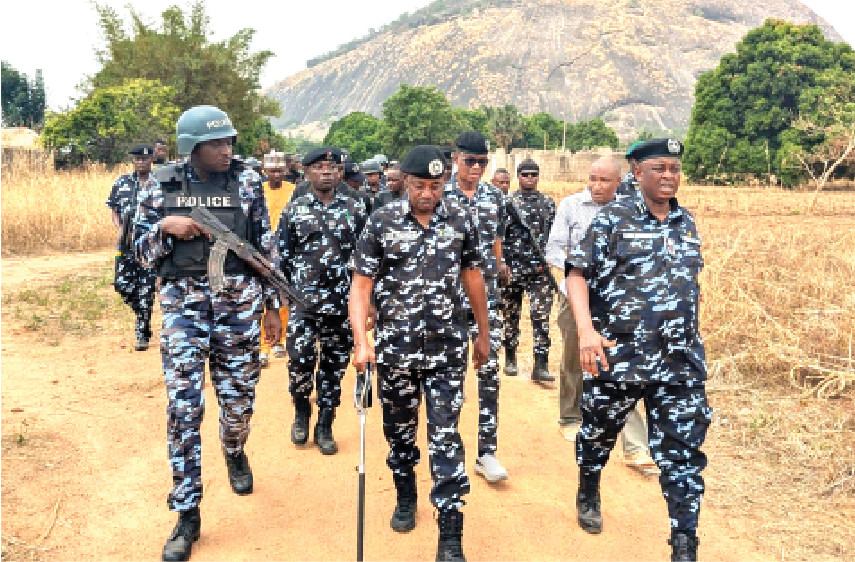
The Chief of Staff to the President, Femi Gbajabiamila, said something on Thursday that deserves more attention than it got. After a consultative meeting at the Presidential Villa, he told State House Correspondents that the constitutional amendment framework for state police is nearing completion.
According to him, deliberations have been ongoing for about four months following a directive by President Bola Tinubu, and the amendment, in his words, “will come shortly.” I want to believe him. More than that, I want this one to actually happen because if there is a single structural reform that Nigeria needs more urgently than any other right now, state police is it. Not the removal of fuel subsidy. Not the floating of the naira. Those were necessary, and I have acknowledged them on this page. But none of those reforms put boots on the ground in Zamfara or reduced the body count in Plateau.
I have been advocating for state police on this page for years. Long before it became a fashionable talking point at Abuja consultative meetings, this column argued that you cannot fight a localised, community-level security crisis with a centralised, Abuja-controlled police force. The evidence has been building for a decade, and the picture is damning. The north west is being held hostage by bandits. The north central is bleeding from herder-farmer violence that has razed entire villages. The southeast has endured years of sit-at-home orders enforced through fear and assassination.
Kidnapping on major highways has become so routine that Nigerians have developed a kind of grim fatalism about it: you set out, you pray, you arrive, and you thank God. And through all of this, the Nigeria Police Force, one institution, spread impossibly thin across 923,768 square kilometres, chronically underfunded, under-equipped, and too often under the political influence of whoever is in Aso Rock, has been expected to be the answer. It was never going to be sufficient.
To be sure, the arguments against state police are not trivial, and they deserve a fair hearing before we dismiss them. The most common objection is that state police will become a tool of oppression in the hands of governors. Governors would also use state police forces to settle scores, rig elections, and silence opposition. This is a legitimate concern. We have seen how SARS became an instrument of extortion and brutality under federal command. The fear is that state governors, several of whom already behave like medieval lords over their domains, would be worse. I understand that fear completely. I do not dismiss it.
But here is the counterargument that rarely gets made with sufficient force: the Nigeria Police Force, as currently constituted under federal control, has already catastrophically failed to protect lives. The question is no longer whether state police carry risks; everything in Nigerian governance carries risks. The question is whether the known, daily, documented catastrophe of the status quo is preferable to the manageable, preventable risks of decentralised policing. And when you frame it that way, honestly, the answer becomes obvious.
We are not choosing between a perfect system and a risky one. We are choosing between a system that is killing people right now and a system that, with proper safeguards, has a real chance of saving them. The perfect must not be allowed to become the enemy of the urgently necessary.
Those safeguards matter enormously, and Gbajabiamila was right to stress that this cannot be done with a snap of the fingers. The enabling legislation that follows the constitutional amendment must be airtight on several points. State governors must not have unilateral operational command of the state police. There must be an independent oversight mechanism, a state police service commission with genuine powers to hire, discipline, and remove officers free from gubernatorial interference. There must be clear federal intervention protocols for when a state government turns the police against its own citizens. And officers must have legally protected whistleblower channels so that unlawful orders can be reported without career consequences. These are not optional additions to the framework. They are the difference between state police as a genuine reform and state police as a new instrument of oppression dressed up in civilian clothing.
Mind you, the composition of that State House meeting tells its own story. Deputy Senate President Barau Jibrin was there. Deputy Speaker Benjamin Kalu was there. The Attorney-General of the Federation, Lateef Fagbemi, was there. The Inspector-General of Police, Tunji Disu, was there. When you have the legislature, the executive, and law enforcement leadership in the same room, all apparently aligned in the same direction, the political will exists in a way it has not always before. That is nothing. Nigeria has had countless committees and white papers on police reform that went nowhere because the political class had no appetite for genuine decentralisation of power. The appetite now appears different. We should acknowledge that without being naive about it.
God forbid we go through another round of “broad national consensus” that produces nothing but more meetings. Nigerians have sat through enough of those. We had a National Conference in 2014 that recommended state police, among other structural reforms. That report is gathering dust somewhere in a government basement right now. We have had police reform panels, presidential committees, and legislative hearings, all reaching broadly similar conclusions, only to be shelved when the political moment passed or the next election approached.
Gbajabiamila himself acknowledged that the debate is no longer about whether to establish state police, but about how to do so. That is significant progress. But Nigerians have learned, sometimes bitterly, that progress in Abuja corridors does not automatically translate into progress in Zamfara villages or Plateau communities. The constitutional amendment must move through the National Assembly without the usual time-wasting theatrics. The two-thirds majority required for constitutional change must be secured cleanly, and the state assemblies must ratify without the delays that have killed previous amendment efforts. None of that is automatic. All of it requires the same urgency from Mr President that he brought to the economic reforms of his first twelve months.
I also want to say something about the communities that have been most devastated by the security crisis, because they tend to disappear from these Abuja conversations very quickly. The farmers in Benue have abandoned their ancestral lands. The schoolchildren in Zamfara whose parents pulled them out of classrooms because of the abduction felt more likely than graduation. The traders in Owerri who cannot move goods freely. These are the people for whom state police is not a governance theory or a constitutional debating point. It is a survival question.
A local police officer who speaks Tiv, who knows the terrain of Benue’s Middle Belt, who grew up in the community he is policing and has a personal stake in its peace, is categorically better placed to provide security than a constable posted from Lagos who cannot identify a local informant from a bandit collaborator and who counts down the days to his transfer. Local knowledge is a security asset. The federal policing model wastes it entirely, every single day.
No reform in Nigerian history has been more consistently delayed, debated, and deferred than police decentralisation. The 2014 National Conference recommended it. Multiple police reform committees recommended it before and after. The #EndSARS protests of 2020, which shook this country to its foundations and brought international attention to our policing crisis, were, at their core, a demand for a police force accountable to the people it served rather than to a remote federal authority.
State police is the structural response to that legitimate demand. If this administration delivers it properly, with the necessary safeguards, not as a half-measure that grants governors operational control without accountability, it will rank among the most consequential governance achievements of the Fourth Republic.
The amendment is coming. The meeting has been held. The political alignment is there. What remains is execution, and in Nigeria, execution is always where good intentions go to die. President Tinubu must drive this personally, with the same tenacity he brought to the economic reforms that defined his first year.
The National Assembly must resist the temptation to drag its feet until the 2027 election cycle makes the whole thing politically complicated again. And civil society, the media, and ordinary Nigerians must hold everyone accountable to the timeline Gbajabiamila has now publicly committed to. No more deferrals. No more consultative meetings that produce only plans for further consultative meetings.
The bandits are not waiting. The kidnappers are not waiting. The communities being terrorised every week cannot afford to wait either.
We’ve got the edge. Get real-time reports, breaking scoops, and exclusive angles delivered straight to your phone. Don’t settle for stale news. Join LEADERSHIP NEWS on WhatsApp for 24/7 updates →
Join Our WhatsApp Channel