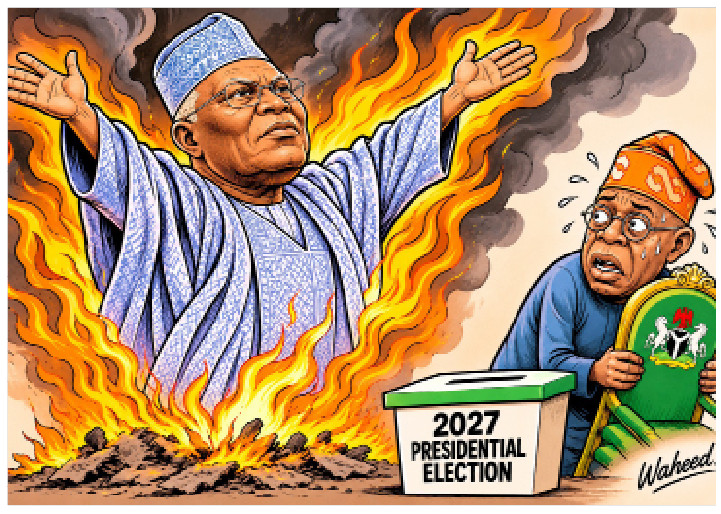
Former Vice-President Atiku Abubakar is still on the ballot, contrary to the supposed nullification of all of his party’s (ADC’s) 470 candidates in the 2027 elections by Justice Peter Lifu.
For almost 24 hours, his candidature seemed to have died; then, like the sphinx, it resurrected from the ashes of the nationwide controversy that greeted Justice Lifu’s judgement through the definitive pronouncement of retired veteran journalist and INEC’s Commissioner in charge of information, voter education and stakeholder engagement, Mohammed Kudu Haruna.
Not unexpectedly, conspiracy theorists took over the airwaves. They said the development was orchestrated by the ruling APC to prevent Atiku from trouncing President Tinubu at the polls. APC denies the charge and suggests that Atiku and his party are delusional.
Independent observers are asking, is there an Atiku factor in the forthcoming presidential elections?
Heavyweight
Anyone who denies Atiku’s political weight in contemporary Nigerian politics does not deserve to be taken seriously. A man who scored 6,984,520 against President Tinubu’s 8,794,726 cannot be considered a paperweight at all. With less than two million more votes in 2023, he could have dragged the contest to a runoff despite his trailing Tinubu in scoring 25% across two-thirds of Nigeria’s 36 states.
You don’t have to like Atiku to concede that he is tough meat. You won’t find me contesting for President at the age of 80, though.
But some people were already calculating what could have been. If Atiku were technically disqualified from contesting the 2027 presidential election by the courts—whether through party leadership nullifications affecting his nomination ticket or constitutional eligibility rulings—there would have been political, electoral, and regional repercussions.
Atiku is indubitably a central gravitational force for opposition politics. His disqualification would have accelerated conversations around a unified opposition ticket under alternative figures such as Peter Obi, Rabiu Kwankwaso, or emerging northern leaders.
Without his name on the ballot, Atiku’s massive northern base would either have been split among other northern opposition figures, defected to local state-level structures, or resorted to apathy.
Were Atiku to exit the race, the ruling All Progressives Congress (APC) and President Bola Tinubu would face a significantly fractured opposition field. Historically, a divided opposition in Nigeria works in favour of the incumbent party by diluting the anti-incumbency vote across multiple candidates.
The hope among APC faithful would be to capture orphaned northern voters whose heavyweight candidate is no longer on the ballot. Anyone who has monitored how the ruling party opened its arms to opposition governors to the extent that the fractious opposition parties were reduced to screaming about an impending one-party state would know that a presidential contest without Atiku would throw open the political bazaar in the north. And there are no prizes for who the highest bidder would be.
APC, Beware!
However, the ruling party is best advised to be careful of what it wishes for. Already, opposition parties and civil society groups were saying that Justice Lifu must have been acting on a script authored by the APC. While there is no direct evidence to substantiate that allegation, a technical disqualification of Atiku could inflame public cynicism regarding judicial independence in election-related matters.
Without doubt, the removal of Atiku Abubakar from the 2027 presidential contest along with other candidates of ADC on account of a leadership tussle within the party will spell doom for the political organisation and its members.
But, wait. The way karmic forces coalesced in the 2026 US midterm elections was parabolic for many discerning people all over the world. Many who cast their ballot for the Democratic Party said they were actually voting against Mr Trump and his policies, which have had a cumulative effect of picking their pockets.
There are over 54 million registered voters in the North. If Atiku Abubakar is removed from the ballot, the North will experience a seismic shift.
The Northwest, with over 25 million votes, is the largest single electoral bloc. Rabiu Kwankwaso & NNPP did well there the last time. APC is also a strong force in the area. If there is no major northern candidate of the stature of Atiku in opposition, Rabiu Kwankwaso becomes the most prominent northerner on the ballot. Let no one be surprised if disillusioned northwest voters committed to ethno-religious sentiments rally around Kwankwaso.
That is not to say that APC wouldn’t have any cards to play in the circumstances. The ruling party would actively leverage incumbent APC governors in Sokoto, Kebbi, Jigawa, Kaduna, and Katsina to capture orphaned votes.
However, economic dissatisfaction across the region means these votes would not automatically transfer to the ruling party without significant local patronage and concessions.
In the Northeast, Atiku’s absence leaves a void that no single national candidate can inherit. In 2023, Atiku scored approximately 51.7% (about 1.7 million votes) of the total votes cast in the zone. He won five out of the zone’s six states (Adamawa, Bauchi, Gombe, Taraba, and Yobe). He trailed only in Borno, Vice-President Shettima’s home state.
Some pundits say that if Atiku was not on the ballot, opposition votes could scatter toward an alternative opposition coalition (such as an Obi/Kwankwaso team), or the situation might induce lethargy.
Consolidation
By the same logic, Borno and Yobe would likely consolidate further under the APC, as Shettima would be the sole remaining high-profile standard-bearer from the sub-region on a major ticket.
Unlike the core Far-North, voters in states like Benue, Plateau, Nasarawa, Kogi, and Niger often vote on security concerns, religious balance, and local politics rather than so-called northern solidarity.
Voters in the Middle Belt who backed Atiku in the past because he was the face of opposition might shift toward Peter Obi or smaller entities like SDP. In spite of the security challenges and unwholesome economic situation, however, governors of APC-controlled states may pull all stops to ensure that they deliver their areas to President Tinubu and the APC.
Voter apathy is one of the other strategic outcomes that may attend the disqualification of Atiku. If northern voters feel disenfranchised by legal disqualifications of leading figures, overall voter turnout in traditional high-volume voting corridors could drop significantly.
Some northern political elites and traditional stakeholders read their own tarot differently. They would rather have a southern president through 2031 to maintain informal rotation of power between the North and the South. The only proviso is that the southern caucus assures them of a smooth transfer of power back to the North in 2031.
Even with legal harnesses threatening to rein in Atiku and his presidential dream, it appears that the ship of his candidacy has set sail, and there is no stopping it until it berths on January 16, 2027.
And the common man who has suddenly become the beautiful bride in the ongoing political bazaar does not care whether it is the eagle or the kite that perches at the victory post on January 16. All he wants is a better tomorrow. And that can’t be too much to ask.
We’ve got the edge. Get real-time reports, breaking scoops, and exclusive angles delivered straight to your phone. Don’t settle for stale news. Join LEADERSHIP NEWS on WhatsApp for 24/7 updates →
Join Our WhatsApp Channel