
The crisis over the payment of the Ticket Sales Charge (TSC) in Nigeria’s aviation industry is set to receive fresh attention as aviation unions and airline operators are expected to meet with the Minister of Aviation and Aerospace Development and the director general of the Department of State Services (DSS).
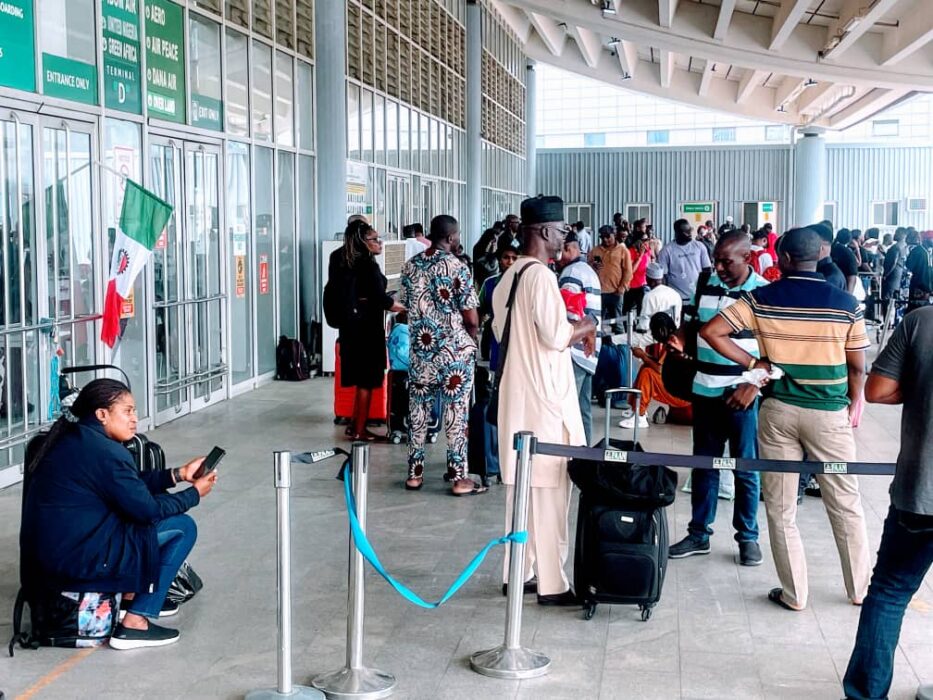
LEADERSHIP reports that the industrial action by members of the Nigeria Labour Congress (NLC), Air Transport Services Senior Staff Association of Nigeria (ATSSSAN) and Trade Union Congress (TUC) resulted in the barricading of entrances to departure terminals at the Murtala Muhammed Airport Terminal 1, comprising the Alpha and Zulu terminals, Terminal 2 in Lagos, and the Nnamdi Azikiwe International Airport Terminal in Abuja.
The blockade prevented scheduled flights from departing Lagos and Abuja, leaving passengers stranded and disrupting travel plans across airline networks.
The meeting is coming amid a deepening dispute between aviation unions and airline operators over TSC payments and the welfare of workers in the sector.
Speaking on the development, in an exclusive chat with LEADERSHIP, the general secretary of the Air Transport Services Senior Staff Association of Nigeria (ATSSSAN), Frances Akinjole, said the unions had been invited to Abuja for the meeting.
“I said we are invited to Abuja. We are going to Abuja tomorrow,” Akinjole said.
According to him, the meeting is expected to be attended by the minister, heads of aviation agencies and the director-general of the DSS.
He explained that the unions had earlier been invited to a meeting in Abuja last Friday, but the engagement could not proceed as planned after the Airlines Operators of Nigeria (AON) allegedly declined to sit with the unions.
“Now, everybody was seated. And they sent a letter that they could never sit with the union. That was the reason for this action,” he said.
Akinjole said the unions could equally have refused to attend the forthcoming meeting in protest, but chose to participate in the interest of resolving the dispute.
“If we had wanted to do, we too would have insisted now that we are not attending that meeting tomorrow,” he stated.
He confirmed that the unions would attend the meeting alongside representatives of the aviation agencies and other stakeholders.
According to him, the development that led to the current industrial action followed the failure of the airline operators to participate in the earlier meeting.
“That was the meeting that was summoned last Friday. We were there in Abuja now, waiting for AON. Only for a letter to be brought from them that AON said they can’t sit with the union,” Akinjole said.
He questioned the basis for the airlines’ opposition to engaging the unions, particularly as workers were being encouraged to belong to associations.
“Are they not a union? Are they not an association? You have your own association. And you are preventing your workforce from joining an association,” he queried.
Akinjole also dismissed suggestions that the unions were being selective in their actions, insisting that the struggle would be addressed in phases.
“It is in phases. The struggle is in phases. So, nobody should tell us where to start from,” he said.
Explaining why the action initially focused on Air Peace, the ATSSSAN general secretary said the airline had been particularly vocal in the media about the unions’ inability to take action.
“It started from Air Peace but, the first question is, which among the airlines was going to the press all the time, saying that we couldn’t do anything? You understand what I’m saying? Was it not Air Peace?” he asked.
“So, why are they not surprised that we started with them?”
He further alleged that Air Peace had one of the largest outstanding TSC obligations and argued that payment of the funds would help address the welfare challenges confronting workers in aviation agencies.
“Then, the second question is, who is owing the TSC the most? If only Air Peace had released the fund, that would go a long way in solving the aviation agency’s staff welfare problem,” Akinjole said.
He linked the inability of aviation agencies to fully implement workers’ conditions of service to funding challenges arising from unpaid TSC revenue.
“We have conditions of service that are unimplementable. Why are they not being able to be implemented? Was it not because of the deliberate act of those we told in the morning?” he queried.
When asked whether the union had effectively taken on the role of a debt collector by pursuing the TSC obligations of airlines, Akinjole responded in the affirmative.
“Yes. Yes. I have just told you something now. Why is our condition of service not being implemented? Because of TSC,” he said.
He, however, clarified that the welfare crisis was not solely attributable to TSC, noting that inadequate funding was also a major factor.
“No, not only TSC. Because of lack of money. And if we know where the money is, we have responsibility,” he stated.
The ATSSSAN official’s comments come amid heightened tensions between aviation unions and airline operators over revenue remittances, workers’ welfare and the implementation of conditions of service.
The unions are expected to use the meeting with the minister, aviation agency heads and the DSS to press their concerns and seek a resolution to the dispute.
Akinjole also spoke strongly about the need to confront what he described as impunity within the sector, questioning whether individuals who believe they are untouchable should be allowed to operate without regard for established rules.
“Who do you think will have the guts to go and take over the runway?” he asked.
When the issue of individuals who allegedly consider themselves untouchable was raised, he said: “That believes that nothing could happen to him. That he’s untouchable.”
We’ve got the edge. Get real-time reports, breaking scoops, and exclusive angles delivered straight to your phone. Don’t settle for stale news. Join LEADERSHIP NEWS on WhatsApp for 24/7 updates →
Join Our WhatsApp Channel