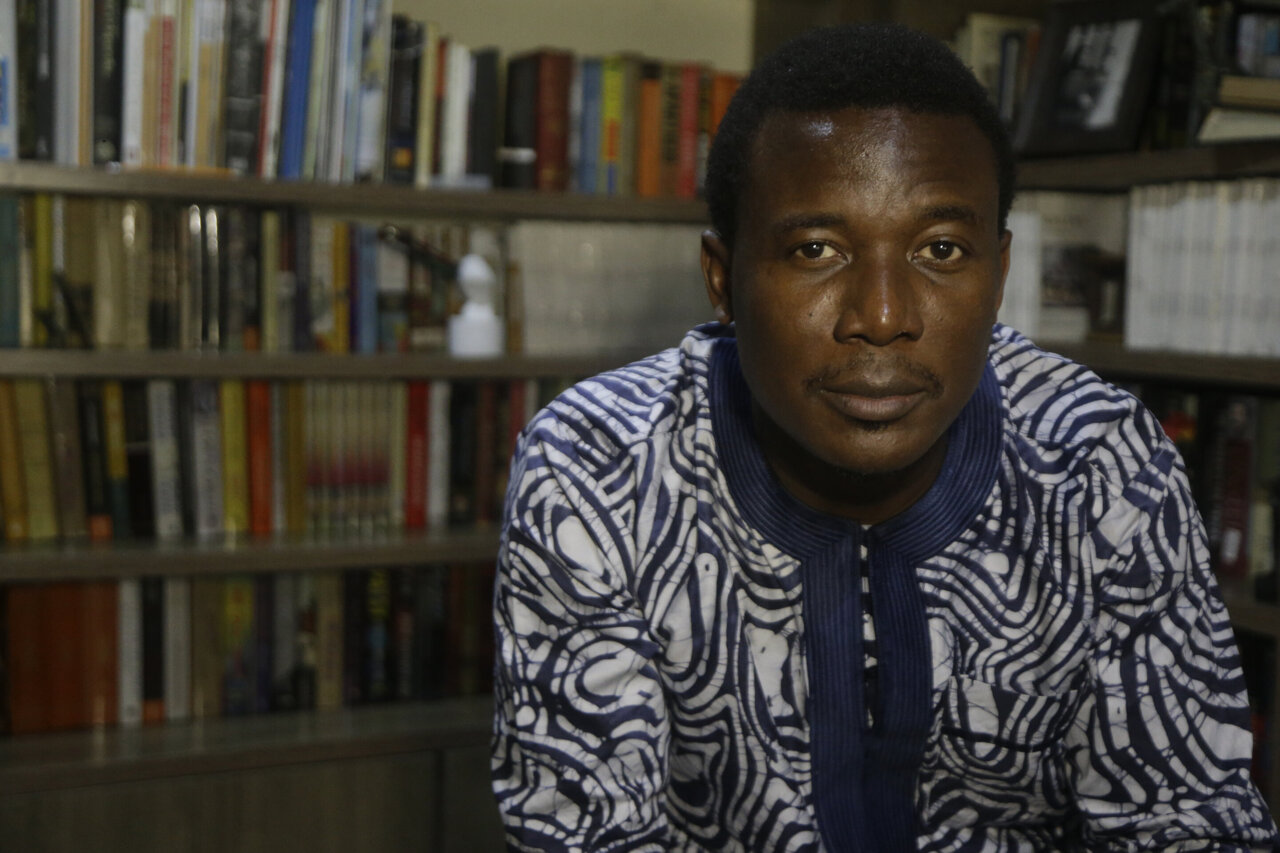
Among the challenges encountered by Tubosun while translating Murakami’s Confessions of a Shinagawa Monkey (Ijewo Inaki Shinagawa Kan) were writing in an accessible language; capturing the essence of the original work in Yoruba language, in addition to, a few lexicon decisions.
According to Tubosun, early Yoruba writers tilted towards the officious in writing and diction. The challenge was how to translate the text in a manner that isn’t too elevated to read, rather easy and accessible for all Yoruba readers. Next, he aimed at capturing the essence of the story, as the English translator did. Finally, he tackled decisions to either tonal mark and keep some Japanese words in the text, or simply translate them to Yoruba. He chose to translate them to Yoruba.
“There are some words I retained, like the use of English words that mentioned names of musicians. I decided to keep that because it is a real person. These challenges were creative experiments for me, which I view as opportunities.”
Although Tubosun knew of Murakami, he had never read anything of his until 2019, when he was browsing through a bookshop in a Turkish airport to kill time. He picked up What I Think About When I Think About Running, and was captivated by the writer’s ability to engage readers on such a boring subject. Afterwards, he looked out for the author’s work purchasing copies of his other works. Midflight to a residential programme in Spain he purchased Murakami’s First Person Singular and Confessions of a Shinagawa Monkey. He was floored.
“I picked up First Person Singular because it sounded like a grammatical text and as a linguist that was interesting to me. It turned out to be a collection of short stories of different human interaction. It was of complex stories written in simple language, which I finished at the airport. But when I got to Confessions of a Shinagawa Monkey, I thought “this is interesting and usual in so many ways.” Hence, he put aside the short stories by Nigerian authors he had planned to translate at the residency to translate Confessions of a Shinagawa Monkey.
Excited about the project, Murakami’s agent gave their consent with the condition that the translated work will be online, free of use, for a period of thirty days. Tubosun is in talks with Nigerian publishers to publish an illustrated copy Ijewo Inaki Shinagawa Kan. This milestone, he hopes will inspire others to translate more Nigerian and foreign authors texts into African languages.
“Many Nigerian writers works are published in English only, which is kind of crazy. Chimamanda Adichie, Helon Habila and many others, have their works translated to many languages but they don’t have them translated in their own indigenous languages. Part of my task is to make sure it changes going forward. We can expand their readership and empower our own languages to survive into the next generation.”
Although there has been some progress in language technology over time, that saw the development of online African language dictionaries such as the Igbo Dictionary; technology help guides in Yoruba language explaining YouTube, coding etc.; increased Masters and Ph.D. studies in African language technology, and big techs hiring linguists, Kola said much work need to be done. African languages translation is yet to reach its full potential. Translation of African languages texts into English language and other languages into African languages are a few to none. Many literary grants or scholarships like PEN are English-translation based. This scenario, he blames on African language societies such as the National Academy of Letters, The Linguistics Academy of Nigeria, and the Ministry of Culture whose mission it is to promote indigenous languages.
“I have not seen anyone say, “I am going to put down money for people to translate to indigenous languages.” Every year NLNG awards only English writers. It is important that they create such channels for African language translation.”
Meanwhile, Tubosun is not sitting on his hands. He is currently working on Yoruba Voices, a grant project collating 50 hours of prerecorded Yoruba audio for use on technological devices; a Yoruba dictionary and a collection of translated short stories by Nigerian (English) writers. At Olongo Africa, he and his colleagues aim to centralize translation by incentivizing people to translate African language texts to English language for publication on the platform. With these, he hopes more people will pay attention to writing and translating into African languages.
“If you think of literature written in early 40s and 1900s, they were written in indigenous languages. There were newspapers published in Nigeria in the 30s and 20s that were bilingual, where you open one page it’s in English, then another it’s in Yoruba. And there was nothing untoward about it. Today, you think of a newspaper, you only think of English.
Those things changed, and something needs to change now that will change the attitude of people to this. It is not going to take one year or two years.
It is the sustained effort that matters, such that when the new generation of Nigerians arise when they hear the word literature; they will think oh! It could be Igbo, it could be Hausa, it could be Yoruba; it could be anything as long as it is written down.”
We’ve got the edge. Get real-time reports, breaking scoops, and exclusive angles delivered straight to your phone. Don’t settle for stale news. Join LEADERSHIP NEWS on WhatsApp for 24/7 updates →
Join Our WhatsApp Channel