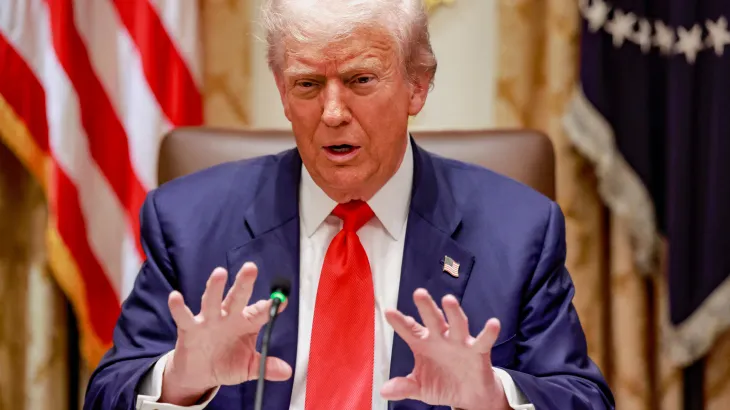
United States President, Donald Trump, has agreed to a two-week ceasefire with Iran, stepping back from earlier threats of military escalation, following what he described as “productive” engagements with regional leaders and a proposal from Tehran.
Trump said the ceasefire was conditional on Iran’s immediate reopening of the Strait of Hormuz, a critical global maritime transit route for oil.
“Based on conversations with Prime Minister Shehbaz Sharif and Field Marshal Asim Munir of Pakistan, and wherein they requested that I hold off the destructive force being sent tonight to Iran, and subject to the Islamic Republic of Iran agreeing to the COMPLETE, IMMEDIATE, and SAFE OPENING of the Strait of Hormuz, I agree to suspend the bombing and attack of Iran for a period of two weeks. This will be a double sided CEASEFIRE!,” Trump posted on Truth Social.
He added that the decision followed the achievement of key military objectives and progress toward a broader agreement.
“The reason for doing so is that we have already met and exceeded all Military objectives, and are very far along with a definitive Agreement concerning Longterm PEACE with Iran, and PEACE in the Middle East,” Trump said.
According to the US president, Washington has received a 10-point proposal from Iran, which he described as “a workable basis” for negotiations.
“We received a 10 point proposal from Iran, and believe it is a workable basis on which to negotiate. Almost all of the various points of past contention have been agreed to between the United States and Iran, but a two week period will allow the Agreement to be finalized and consummated,” he stated.
Iranian officials also confirmed the development, signalling readiness to de-escalate if hostilities cease.
Iran’s Foreign Minister, Abbas Araghchi, said in a statement that Tehran would halt defensive operations if attacks stopped.
“If attacks against Iran are halted, our Powerful Armed Forces will cease their defensive operations,” Araghchi said, adding that Iran would coordinate safe passage through the Strait of Hormuz during the ceasefire.
He noted that the United States had accepted “the general framework” of Iran’s 10-point proposal as a basis for further talks, while Tehran was also reviewing a separate 15-point proposal from Washington.
Meanwhile, Iran’s Supreme National Security Council described the ceasefire as a strategic victory, stating that most of its war objectives had been achieved.
The council also outlined elements of Tehran’s proposal, including regulated passage through the Strait of Hormuz, cessation of attacks on Iran and its regional allies, withdrawal of US forces from the region, compensation to Iran, lifting of sanctions, unfreezing of assets, and a binding United Nations (UN) resolution to formalise any peace agreement.
“Our hands remain upon the trigger, and should the slightest error be committed by the enemy, it shall be met with full force,” the council warned.
Talks were expected to take place in Islamabad, with Pakistan playing a mediating role in the crisis.
Reacting to the development, Israeli Prime Minister, Benjamin Netanyahu, expressed support for the ceasefire but clarified that it did not extend to Israeli operations in Lebanon.
Netanyahu’s office said Israel backed Trump’s decision to suspend strikes against Iran, provided Tehran reopens the Strait of Hormuz and halts attacks on Israel, but noted that the agreement did not cover Israeli operations against Hezbollah.
We’ve got the edge. Get real-time reports, breaking scoops, and exclusive angles delivered straight to your phone. Don’t settle for stale news. Join LEADERSHIP NEWS on WhatsApp for 24/7 updates →
Join Our WhatsApp Channel