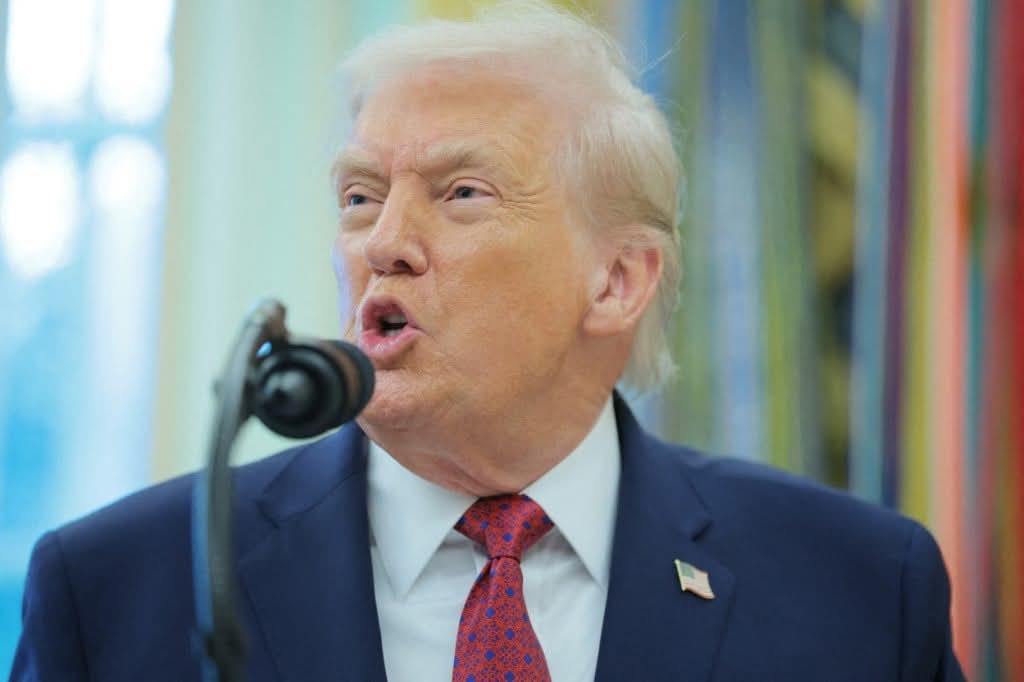
President Donald Trump said on Tuesday that he did not want to extend a rapidly expiring ceasefire in the U.S.-Israeli war on Iran and that the U.S. military was “raring to go” if negotiations were not successful.
He spoke shortly after the U.S. military announced it had boarded a huge Iranian oil tanker at sea in international waters, the first such move against Iran’s crude exports. That could make it more difficult to revive peace talks with Iran, which has said it will not negotiate while Washington enforces a blockade of its ports.
Washington has expressed confidence that last-ditch talks with Iran will go ahead in Pakistan, and a senior Iranian official said Tehran was considering joining. But with the final hours of a two-week truce ticking by, there was little time left.
Asked about the possibility of extending the truce, Trump told CNBC, “I don’t want to do that. We don’t have that much time.
“I expect to be bombing because I think that’s a better attitude to go in with,” he added. “But we’re ready to go. I mean, the military is raring to go.”
Iranian government spokesperson Fatemeh Mohajerani said, “We do not want to be attacked again, but if such attacks occur, we will definitely respond more firmly than before,” according to the state news agency IRNA.
The U.S. military said it had boarded the Tifani tanker linked to Iran “without incident.” The vessel last reported its position on Tuesday morning as near Sri Lanka in the Indian Ocean, according to MarineTraffic tracking data. It was close to fully loaded with 2 million barrels of crude and had signalled Singapore as its destination.
“As we have made clear, we will pursue global maritime enforcement efforts to disrupt illicit networks and interdict sanctioned vessels providing material support to Iran — anywhere they operate,” U.S. Central Command said.
On social media, Trump said Iran had carried out numerous violations of the ceasefire, without giving further details. He told CNBC that the blockade had been a success and the U.S. was in a strong position to end up with a “great deal.”
There was no immediate comment from Iran on the boarding. Iranian sources told Reuters Tehran had still not taken a final decision about whether to attend the next round of talks in Islamabad.
Iran has largely blocked off the Strait of Hormuz that controls access to the Gulf to all ships but its own. It had announced last week that it would reopen the strait, but reversed that decision on Saturday after Trump refused to lift his blockade of Iranian ports.
Oil prices eased around $0.30 and stocks bounced back in Asia on expectations that peace talks will resume, with European shares also up. Oil had jumped around 6% on Monday on doubts about the talks.
Trump wants an agreement that would prevent further oil price rises and stock market shocks, but has insisted Iran cannot have the means to develop a nuclear weapon. He wants Iran to give up its stockpile of highly enriched uranium, which can, if further enriched, be used for a nuclear warhead.
Tehran hopes to exploit its control of the strait to strike a deal that averts a restart of the war and lifts sanctions, while retaining more of its nuclear programme, which it says, is for peaceful purposes.
Trump initially announced the ceasefire would last two weeks from the evening of Tuesday, April 7 in Washington, though he has lately suggested it runs until the evening of Wednesday, April 22, effectively an extra 24 hours. A Pakistani source involved in the talks also said it would expire at 8 p.m. Eastern Time on Wednesday, which is 3:30 a.m. Thursday in Iran.
Thousands have been killed by U.S.-Israeli strikes on Iran and a parallel Israeli bombing campaign and invasion of Lebanon. The war has caused a historic shock to global energy supplies, and fears that the global economy could be pushed to the brink of recession.
France said the surge in energy prices and bond yields triggered by the war would cost the government 4 billion to 6 billion euros ($4.7 billion to $7.0 billion), requiring it to put the same amount of spending on hold.
Pakistan has been preparing to host the talks despite the uncertainty. Nearly 20,000 security personnel have been deployed across Islamabad, officials said.
We’ve got the edge. Get real-time reports, breaking scoops, and exclusive angles delivered straight to your phone. Don’t settle for stale news. Join LEADERSHIP NEWS on WhatsApp for 24/7 updates →
Join Our WhatsApp Channel