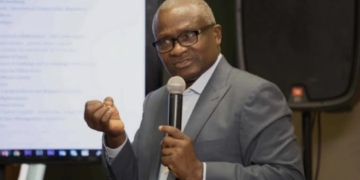

The federal government has committed about $54 million to secure tuberculosis medicines and prevent nationwide stock-outs, as part of efforts to keep TB response stable despite shrinking donor funding.
The Director of Public Health, Federal Ministry of Health and Social Welfare, Dr Charles Nzelu, disclosed this on Tuesday during a Pre-World TB Day press briefing in Abuja.
He said the long-term investment is part of the government’s strategy to strengthen drug availability and ensure uninterrupted treatment for thousands of Nigerians affected by TB.
“We are talking about, in the long term, spending $54 million. If you convert it to naira, then you will know the scale of the commitment. This is to ensure Nigeria does not experience any stock-out of TB medicines,” he said.
Dr Nzelu explained that the move became necessary after forecasts showed that some TB medications currently supported by external donors, including the Global Fund, might run out in the coming months. He noted that although the Global Fund’s support for AIDS, Tuberculosis and Malaria (ATM) expanded last year, it does not cover all the commodities Nigeria needs.
“There are medications that the Global Fund is not providing for the country. From our projections, funding gaps may emerge soon. That is why we have already set machinery in motion to procure TB commodities using part of the $200 million sector-wide allocation announced by the government last year,” he said.
Beyond drug security, Dr Nzelu announced the nationwide rollout of the Pluslife Mini Dock, a new near-point-of-care diagnostic platform that will enable faster testing in remote communities. Nigeria is deploying over 1,000 units of molecular diagnostic equipment.
He said the ministry is also enhancing its electronic TB reporting systems to improve real-time data flow, supply chain management and transparency.
The director reiterated that TB diagnosis and treatment remain completely free in all government-approved facilities. “No Nigerian should pay for TB services. If you have been coughing for two weeks or more, get tested. TB is curable, and the medicines are available,” he said.
In her remarks, the Board Chair of Stop TB Partnership Nigeria, Dr Queen Ogbuji-Ladipo, said the government’s renewed investment is critical as donor support becomes increasingly constrained.
She stressed that the 2026 theme, “Yes! We Can End TB – Led by the Federal Ministry of Health, Powered by the Communities,” underscores the need for stronger leadership and community ownership
While acknowledging progress in TB detection and community engagement, she warned that Nigeria still carries a heavy burden. “Ending TB requires sustained financing, private sector participation, and innovative funding approaches. Donor support alone cannot carry the burden,” she said.
WHO Representative in Nigeria, Dr Pavel Ursu, described TB as one of the world’s most lethal infectious diseases, killing over 3,300 people every day despite being preventable and curable.
“In 2024 alone, an estimated 1.23 million people lost their lives to TB, and 10.7 million people fell ill. These numbers are not just statistics, they are mothers, fathers, children, friends and colleagues whose lives were cut short by a disease we already know how to prevent, diagnose and cure,” he said.
Dr Ursu said Nigeria continues to carry one of the heaviest TB burdens in the world, with an estimated 510,000 cases occurring annually, including 61,000 children and young adolescents.
Despite this, he noted encouraging progress. Nigeria reported 405,324 TB cases in 2024, a significant rise from 106,533 cases in 2018. In the first three quarters of 2025 alone, the country reported 335,003 cases, with projections showing that 80 per cent of all estimated cases may be detected and notified when full-year data is released.
But the gains are threatened by a large pool of 175,000 undetected TB cases that continue to fuel community transmission. “One undiagnosed infectious TB case can spread the disease to 12–15 people in a year,” he warned.
Dr Ursu stressed that declining international funding makes domestic resource mobilisation more urgent than ever. “It is important to commit domestic resources towards TB activities now that traditional donor funds are dwindling. Too many patients suffer financially, 71 per cent of TB-affected households in Nigeria experience catastrophic costs,” he said.
We’ve got the edge. Get real-time reports, breaking scoops, and exclusive angles delivered straight to your phone. Don’t settle for stale news. Join LEADERSHIP NEWS on WhatsApp for 24/7 updates →
Join Our WhatsApp Channel