
- Pass rate rises from 13% in 2021 to over 26%
- Increase driven by digital learning exposure – Experts
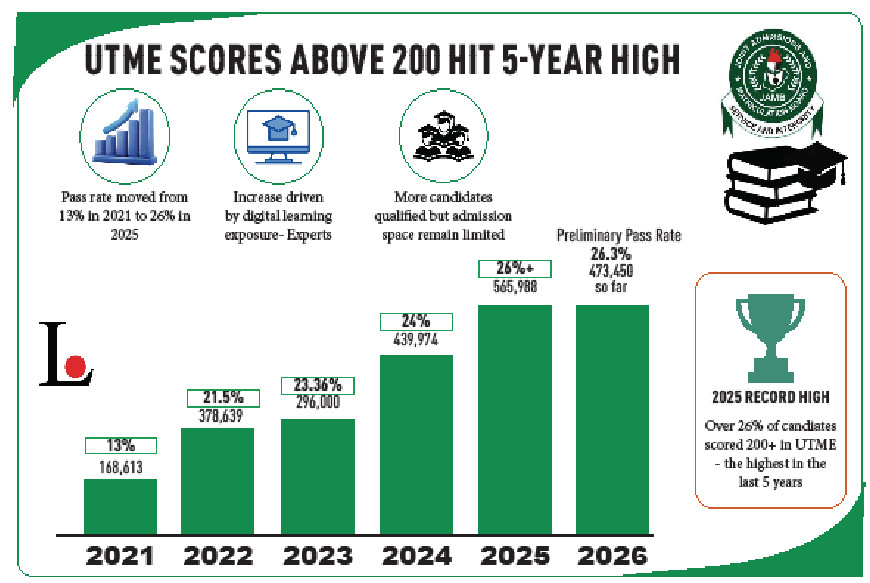
The performance of candidates in the Unified Tertiary Matriculation Examination (UTME) has shown a steady but uneven improvement over the past five years, with the proportion of candidates scoring 200 and above rising from about 13 per cent in 2021 to over 26 per cent in 2025.
The development shows a gradual strengthening of examination outcomes, even as admission spaces in tertiary institutions remain under increasing pressure.
A review of official examination data obtained from the Joint Admissions and Matriculation Board (JAMB) indicates an upward movement in the number of high-scoring candidates, though it has not been without fluctuations.
While more candidates have crossed the 200-mark benchmark during the period, the rising performance figures are unfolding against the backdrop of tightening admission capacity at Nigerian tertiary institutions.
Although candidates are meeting the benchmark scores required for admission consideration, universities, polytechnics, and colleges of education are still unable to absorb the expanding pool of all the qualified applicants.
LEADERSHIP Sunday reports that the gradual rise in UTME performance shows that in 2021, out of 1,312,992 candidates who sat for the UTME, about 168,613 scored 200 and above, translating to a pass rate of approximately 13 per cent using 200 as the benchmark.
That year marked one of the lowest performance thresholds in the five years under review.
The following year, 2022, there was a significant improvement. Out of 1,761,338 candidates, 378,639 scored 200 and above, pushing the pass rate to about 21.5 per cent.
The increase was widely seen as a rebound in candidate performance and adaptation to the computer-based testing system.
In 2023, the upward trajectory continued at a slower pace. About 23.36 per cent of candidates crossed the 200-pass mark, representing roughly 296,000 candidates out of about 1.27 million whose results were processed.
However, in 2024, the pattern showed a slight disruption. Although the absolute number of high scorers increased, the proportion grew only marginally.
Of the 1,842,464 candidates whose results were released, 439,974 scored 200 marks or higher, representing about 24 per cent.
By 2025, the UTME recorded its strongest performance within the five-year window. About 565,988 candidates scored 200 marks or higher out of 1,931,467, pushing the estimated pass rate to over 26 per cent. The development marked a notable peak in candidate performance over the period under review.
For 2026, JAMB has so far released the results of over 1.8 million candidates, with 473,450 reported to have scored 200 marks and above among those who uploaded their O-Level results. This represents an over 26.3 per cent pass rate.
However, JAMB has yet to publish a final national breakdown showing the complete proportion of candidates who crossed the 200-pass mark, making a definitive pass rate unavailable at this stage.
Despite the upward trend, education experts have cautioned that it should not be interpreted as a straightforward improvement in academic standards.
Instead, they said multiple factors may be influencing performance patterns across the years.
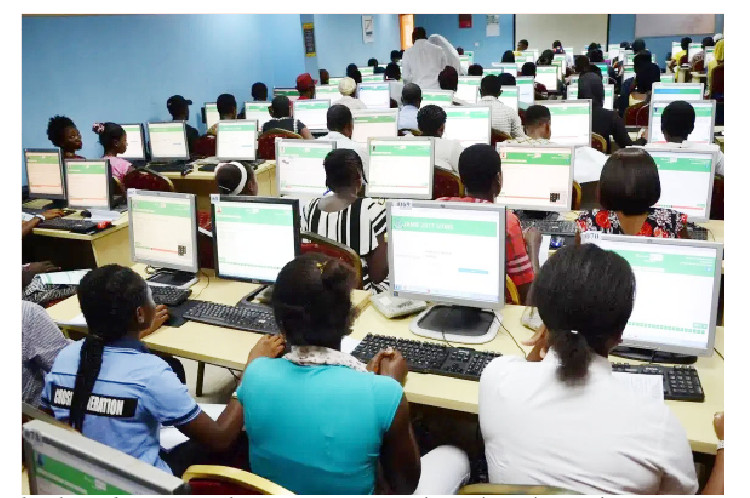
They said the increasing adoption of Computer-Based Testing (CBT), wider access to digital learning tools, and greater familiarity with UTME formats are key drivers of improved scores.
They, however, warned that changes in exam structure, question difficulty, and candidate demographics may be contributing to fluctuations.
An Abuja-based data analyst, Mr Isaac Moji, said the steady rise in candidates scoring 200 or more suggests that students are becoming more comfortable with technology-driven examinations.
According to him, many candidates now prepare for the UTME using online mock tests, tutorial platforms, and social media study groups, unlike in previous years when preparation was largely limited to textbooks and physical coaching centres.
“The CBT system is no longer new to candidates. Many students now understand the exam structure better and prepare more strategically. That naturally improves performance statistics,” he said.
Moji, however, cautioned that the increase in scores should not be mistaken for a complete improvement in learning outcomes, noting that many students still struggle with critical thinking and written communication after gaining admission.
While UTME performance has improved, admission data shows a parallel story of rising demand and constrained capacity.
Admission to Nigerian tertiary institutions has increased gradually between 2021 and 2025, even as the number of applicants continues to grow sharply each year.
In 2021, about 1.38 million candidates applied for admission, with roughly 600,000 eventually securing placement into universities, polytechnics, and colleges of education, representing an estimated admission rate of 43 per cent.
In 2022, applications rose to about 1.8 million candidates. JAMB confirmed that 557,626 candidates had secured admission, although the figure was later projected to rise close to 700,000 before the end of the exercise. This translated into an admission rate ranging from 31 to 39 per cent.
By 2023, admissions improved further, with more than 800,000 candidates reportedly gaining admission out of about 1.8 million applicants, pushing the admission rate to roughly 44 per cent.
The upward movement continued in 2024 as applications climbed to nearly 1.98 million, while 856,263 candidates gained admission, representing about 43 per cent of applicants.
In 2025, Nigeria recorded its highest admission volume in recent years, with more than 2.03 million candidates applying for admission and 1,009,044 eventually admitted. This pushed the admission rate close to 50 per cent, suggesting a gradual expansion in institutional capacity amid rising demand.
However, there is still a growing gap between improved UTME performance and limited admission spaces, which has raised concerns among education stakeholders, who say the system is gradually facing a structural rather than an academic challenge.
Mrs Grace Edeh, school administrator at Divine Grace, Lugbe, Abuja, said the comparison between pass rates and admission figures reveals a deeper systemic imbalance.
“What the figures show is that the real crisis is gradually shifting from poor examination performance to inadequate admission capacity. Every year, hundreds of thousands qualify for admission, but institutions cannot absorb all of them,” she said.
Edeh added that many tertiary institutions are often forced to lower admission thresholds for less competitive courses to fill quotas and maintain enrolment levels.
Digital learning and changing preparation patterns
Education consultant Mr Collins Aondo linked part of the improvement in UTME performance to increased awareness among parents and students about early preparation and digital learning tools.
“Parents now invest more in tutorial classes, CBT applications, and digital learning devices for their children. Even students in rural areas are gaining more exposure to online learning materials through smartphones,” he said.
However, he also raised concerns that intense competition for highly sought-after courses such as Medicine, Law, and Engineering is driving excessive coaching rather than deeper learning.
He also warned that while candidates scoring above 200 marks have increased, this does not necessarily reflect stronger foundational knowledge.
“The pressure to secure admission into highly competitive courses may be fuelling excessive examination coaching rather than genuine learning,” he said.
Despite the increase, JAMB provides a national framework for universities as minimum standards, with each institution ultimately deciding its own cut-off mark.
This year, 150 marks were set as the minimum standard for universities and 100 marks for polytechnics.
EXPLAINER
1. Rising Scores
UTME candidates scoring above 200 increased from 13 per cent in 2021 to over 26 per cent in 2025.
2. Digital Advantage
Experts linked improved performance to familiarity with CBT, online tutorials, mock examinations, smartphones, and social media study platforms.
3. Coaching Concerns
Stakeholders warned that higher scores may reflect intensive coaching strategies rather than genuine academic understanding among candidates.
4. Admission Pressure
Despite stronger UTME results, universities and other institutions still cannot accommodate the rising number of qualified applicants.
5. Structural Challenge
Education experts say Nigeria’s tertiary admission crisis now stems more from limited capacity than poor examination performance.
We’ve got the edge. Get real-time reports, breaking scoops, and exclusive angles delivered straight to your phone. Don’t settle for stale news. Join LEADERSHIP NEWS on WhatsApp for 24/7 updates →
Join Our WhatsApp Channel