
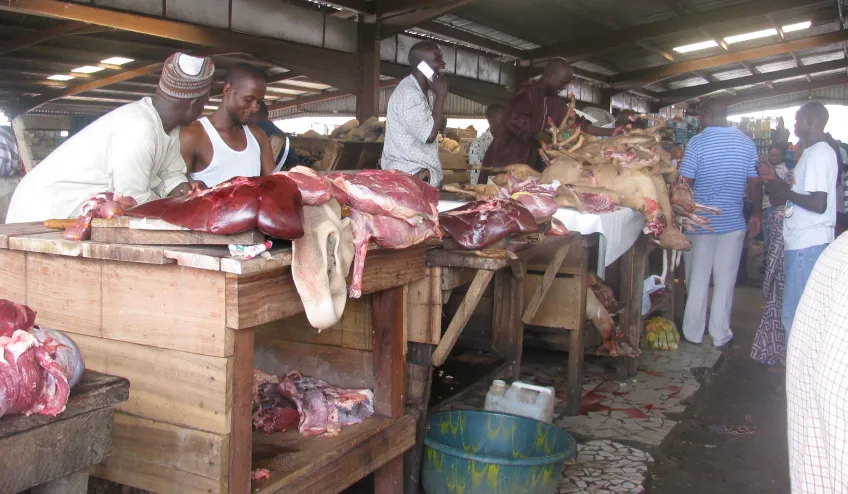
Weak veterinary services and rising transportation costs are driving up meat prices across parts of the country, tightening supply and worsening pressure on consumers already grappling with high food costs.
Findings by LEADERSHIP in the Federal Capital Territory (FCT) show that beef now sells for about N8,000 per kilogramme, up from between N6,000 and N7,000 recorded about two months ago.
Traders attribute the increase to a mix of rising logistics costs, livestock health challenges and broader supply chain pressures.
A meat seller in Lugbe, Sadiq, said that although prices have increased, sales have remained weak due to declining purchasing power.
“Beef was around N7,000 before, but now it is about N7,500. Goat meat has also gone up from about N6,500 to N7,000, but the market is not moving like before because people are not buying much,” he said.
He added that poor electricity supply is worsening losses for traders.
“Sometimes the meat even gets spoiled because there are no buyers and we don’t have steady light to preserve it,” he said.
The Secretary of the Lugbe Abattoir, Ahmed Rufai, confirmed the price increase, saying it has climbed to about N7,500 per kilogramme in recent weeks.
He linked the trend to rising transportation costs, noting that most livestock are sourced from northern Nigeria.
“We bring the animals from the North, and the cost of transportation has increased,” he said.
A butcher, Sani, said demand has dropped significantly despite rising prices.
“The market is not moving like before. Many customers cannot afford to buy meat again,” he said.
Also speaking, the Secretary of the Butchers Association in Kabusa Market, Musa Usman, said rising costs across the supply chain have worsened the situation.
“Animals are very costly now, and transportation is expensive. Even vaccines are costly, so we are selling beef for between N7,500 and N7,800 per kilogramme,” he said.
He added that scarcity of livestock is affecting supply.
“Animals are not enough in the market again. Many people have entered the business, and it is affecting supply,” he said.
Usman further noted that rising feed costs are compounding the problem.
“Feed that used to cost around N4,000 before is now selling for between N8,000 and N9,000,” he said.
A pig farmer in Makurdi, Benue State, Terkula Aduku, also lamented the rising cost of vaccines, saying it is affecting livestock production.
“The cost of vaccines is too high now, and it is affecting production. Many farmers are struggling to keep their animals healthy,” he said.
A resident, Ejiofor Emma, said rising meat prices have forced he to cut down on consumption.
“I can’t afford to buy meat like before, so I now buy smaller quantities or look for cheaper alternatives,” he said.
Meanwhile, the Federal Government has acknowledged gaps in veterinary service delivery, warning that weak implementation at the state and local government levels continues to undermine efforts to control livestock diseases.
Minister of Livestock Development, Idi Mukhtar Maiha, said the effectiveness of animal health interventions depends largely on grassroots execution.
“The true test of effectiveness lies not at the centre, but at the grassroots—among farmers, pastoralists, livestock markets and abattoirs,” he said.
Stakeholders warn that unless structural issues in animal health, logistics and production are addressed, rising meat prices could persist, further deepening food inflation and limiting access to protein for many households.
We’ve got the edge. Get real-time reports, breaking scoops, and exclusive angles delivered straight to your phone. Don’t settle for stale news. Join LEADERSHIP NEWS on WhatsApp for 24/7 updates →
Join Our WhatsApp Channel