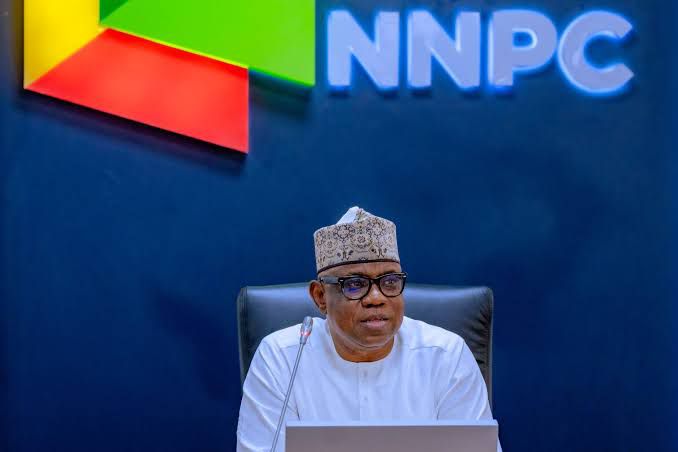
The Group Chief Executive Officer of the Nigerian National Petroleum Company Limited, Bayo Ojulari, stood before State House correspondents Tuesday afternoon with the kind of news most Nigerians have forgotten how to process: good news backed by actual money.
Shell’s global chairman not the Nigeria country manager, not some regional vice president, but the man who runs the entire Shell Group worldwide had just finished meeting President Bola Tinubu at the Presidential Villa. And he came to say thank you.
When was the last time the global CEO of a Fortune 50 company flew to Abuja to personally thank a Nigerian president? I’ll wait.
Ojulari explained the purpose plainly. “The idea was basically to come and thank Mr. President for the initiative on the executive orders that were released early last year to help attract investments.”
Now before the usual cynics start with the “so what, they’re thanking him for giving away our resources” routine, let’s deal with some uncomfortable facts about how global capital actually works in 2025.
“The competition for investment is global,” Ojulari said, and then he listed the countries eating Nigeria’s lunch while we’ve been busy arguing about zoning. “Most other African countries, Guyana, the Far East, they’re changing their policies, very dynamic, so that they can attract those investments.”
Very dynamic. Two words that have never described Nigerian policymaking. Until recently. Here’s what actually happened, stripped of spin: After the Petroleum Industry Act passed, NNPCL realized something the activist crowd still hasn’t figured out the PIA alone wasn’t enough. “Following the PIA, we realized that there were additional incentives that were necessary to attract investment,” Ojulari explained.
So President Tinubu issued executive orders with additional incentives. Not “we’re studying it.” Not “we’ve set up a committee.” He issued the orders.And Shell responded with their checkbook.
Let me break down what Shell has done since those executive orders dropped, because this is the part that should make every governor in Nigeria ask what the hell they’re doing wrong.
First, Shell completed the divestment of its onshore joint venture assets to Renaissance. Some people saw this as Shell running away. Ojulari saw it differently. “Completing that transaction showed to the world Mr. President’s commitment to the ability for investors to bring in investments and also, if they needed to exit, to exit, because the investment world is very dynamic.”
Think about that for a second. In Nigeria, we’ve historically treated foreign investors like Hotel California ,you can check in but you can never leave. Shell just proved you can exit cleanly, professionally, with government support. And paradoxically, that makes other investors more willing to come in. Because they know they’re not trapped.
After closing that exit, Shell took a $5 billion Final Investment Decision on Bonga North. Then another $2 billion investment decision on a shallow-water gas development project called HI.
“So overall, between the time that Mr. President has announced that incentive, just one company, Shell alone, has already invested over $7 billion,” Ojulari said. “So you can imagine what that means in terms of replication.”
And then Ojulari dropped the real headline. “Today Shell also made commitment to the President of pushing another $20 billion opportunities over the next couple of years.”
Do the math. That’s $27 billion total tied directly to policy reforms that most of the people screaming about “our oil, our resources” said would never work.
When Ojulari talks about the Bonga Southwest project part of that $20 billion pipeline he doesn’t speak like a bureaucrat. He speaks like someone who understands that big numbers mean nothing if people can’t connect them to their lives.
“Most of the time when we talk about these big numbers, I think we need to make it clear to ourselves, what does it mean?” he said. Then he got specific.
It means jobs. Real jobs. “Nigerians will have a lot of opportunities to participate,” he explained. “Most of our fabrication yards that have been closed out for many years since we didn’t have project, those fabrication yards will come to life. Most Nigerians have made huge investments in fabrication yards that have been idle for many years.”
Idle fabrication yards. Think about that. We built industrial capacity that’s been sitting empty because we couldn’t attract the projects to keep them running. And now those yards are about to wake up.
But here’s the part that separates short-term thinking from long-term wealth creation. “Apart from the project phase, for the next 20, 25 years, completing that project means you then have people employed for the next 20, 25, 30 years, for the life of that project,” Ojulari said. “And that’s why the operating expenditure come for those who have supplies; supply of materials, supply of manpower, supply of maintenance activities.”
Twenty to thirty years of employment. Not campaign promises. Not conditional employment that disappears when oil prices drop. Sustained industrial activity over decades because someone made a Final Investment Decision that survived scrutiny in boardrooms in Houston and The Hague.
Shell’s global chairman didn’t just come to discuss money. According to Ojulari, he came because of “the confidence that they have in the leadership that Mr. President has demonstrated, not just talked about, but in terms of what they can touch and feel around transparency and around commitment.”
Read that again. An international oil company executive praised a Nigerian president for transparency.
Not for potential. Not for vision. For transparency they can “touch and feel.”
When was the last time that happened?I’ve covered Nigerian politics long enough to know that “transparency” is usually code for “we haven’t figured out the bribe structure yet.” But Shell doesn’t invest $7 billion on vibes. They invest when the rules are clear, the timelines are predictable, and the government does what it says it will do.
Ojulari was clear about NNPCL’s role in all this. “On our part as NNPC, as the concession holder for the Nigerian PSC with the international investors like Shell, Chevron, ExxonMobil, Total, ours is to continue to work with them and also work with other parts of government to create solutions and proposals that the government can approve.”
But then he said something that should be carved into the entrance of every ministry in Abuja. “Our responsibility is to be the conscience of the government and the conscience of Nigerians in terms of ensuring that the assumptions that have been made, the promise that have been made, that they are correct and they are authentic.”
The conscience of government. Not a yes-man. Not a deal-closer at any cost. The entity that makes sure the promises are real and the numbers actually work.That’s the job description of a serious institution, not a political patronage machine.
Here’s where Nigeria usually fumbles. We attract the investment, we sign the deal, we make the announcement, and then we spend the next three years renegotiating, second-guessing, and letting every activist with a Twitter account turn it into a referendum on sovereignty.
Ojulari knows this. “Everybody is competing for global capital,” he said. Not some capital. Not patient capital. Global capital, which moves at the speed of email and has zero tolerance for drama.
Guyana didn’t become the fastest-growing economy in the world by arguing about whether ExxonMobil’s contract was fair. They executed the contract, collected the revenue, and built infrastructure. Meanwhile we’re still arguing about deals signed in the 1990s.
The Bonga Southwest project has a capital expenditure of close to $10 billion, Ojulari said, plus substantial operating expenses over the project’s lifetime. That’s the kind of money that builds an industrial ecosystem if we don’t blow it by doing what we always do.
What do we always do? We politicise everything. We question every decision. We treat every foreign investor like a colonial oppressor instead of a business partner who has options. And then we wonder why capital goes to Mozambique or Guyana or Ghana instead.
President Tinubu reportedly told Shell he expects Bonga Southwest to reach Final Investment Decision during his first term. Not “we’re working on it.” Not “we’re hopeful.” FID before May 2027.
That’s the kind of deadline that either builds credibility or destroys it. There’s no wiggle room. Either Shell writes the check or they don’t. Either Nigeria maintains the policy environment that makes that check rational or we don’t.
Ojulari and his team at NNPCL are working to make sure the government can approve proposals that make sense. “We hope to complete that, and hopefully we can get Mr. President’s support for the final investment decision in due course.”In due course. Not in due time. Not eventually. In due course, which in the context of a first-term deadline means the clock is ticking.
Look, I’m not interested in painting Tinubu as a messiah or Shell as a charity. This is business. Cold, calculating, shareholder-return-driven business.
But the fact that it’s working tells us something important: Nigeria’s problems are fixable. Not easy. Not overnight. But fixable.For years, we’ve been told our institutions are too broken, our corruption too deep, our bureaucracy too slow. And to be fair, all of that is true. But what Shell’s $27 billion commitment proves is that when leadership actually delivers on transparency, policy stability, and speed, capital responds.
Ojulari made the point clearly. “I think what this has shown is that we’re seeing more confidence in Nigeria’s economy from investors.”Not hope. Not optimism. Confidence. The kind you measure in billions of dollars deployed, not promised.
First question: If the federal government can create an investment climate that attracts $27 billion from one company in eighteen months, what’s the excuse of governors?
Every governor complaining about federal allocation should be asking why they can’t replicate this in their states. Mining, agriculture, manufacturing, tourism every sector has global capital looking for opportunities. What are you doing to compete for it? Or are you just waiting for the next FAAC payment so you can pay salaries and call it governance?
Second question: Can we sustain this, or will we do what we always do start renegotiating the minute things get difficult?
Because here’s the truth nobody wants to say out loud. Shell invested $7 billion and committed to $20 billion more not because they love Nigeria. They did it because for eighteen months, the investment climate has been predictable. The second it stops being predictable, that $20 billion evaporates faster than diesel subsidy.
We can keep arguing about whether the president should come from the north or south in 2027. We can keep debating restructuring like it’s a magic wand that solves everything. We can keep pretending that our problems are fundamentally different from every other country’s problems.Or we can look at what just happened and ask a simple question: If oil and gas policy can be fixed, what’s stopping us from fixing everything else?
The formula is right there. Clear policies. Credible incentives. Regulatory speed. A president willing to set hard deadlines and be judged by them.Shell didn’t invest $7 billion because Ojulari gave a good speech or because Tinubu is from Lagos. They invested because someone made a promise, kept it, and created an environment where billion-dollar decisions could be made without wondering if the rules would change in six months.
And now they’re betting another $20 billion that it wasn’t a fluke.The global chairman of Shell came to Abuja to say thank you. Not to complain. Not to threaten. Not to negotiate. To say thank you.
Maybe instead of asking what incentives we gave Shell, we should be asking what every other sector can learn from what just worked.
Because if we can get this right in oil and gas the sector we’ve mismanaged for 60 years.we can get it right anywhere.
The question is whether we’re serious enough to try.Or whether we’d rather go back to explaining why things can’t work while Guyana builds highways with ExxonMobil revenue and we’re still arguing about who should control what we haven’t even produced yet.
Ojulari just helped deliver $27 billion in commitments. The fabrication yards are about to wake up. Jobs are coming. Revenue is coming. Industrial capacity is coming back to life.Now the rest of Nigeria needs to ask itself one question: What’s our excuse?
We’ve got the edge. Get real-time reports, breaking scoops, and exclusive angles delivered straight to your phone. Don’t settle for stale news. Join LEADERSHIP NEWS on WhatsApp for 24/7 updates →
Join Our WhatsApp Channel