Over the weekend, while scrolling through Facebook’s increasingly crowded marketplace of political certainty and economic evangelism, I stumbled upon Tanimu Yakubu’s essay, “Deficits, Debt and Economic Literacy: A Response to Nigeria’s Fiscal Critics,” shared by presidential media aides. Coming from the Director-General of the Budget Office of the Federation, the essay naturally carried institutional weight. The essay arrived dressed in macroeconomic vocabulary, carrying Keynesian theory in one hand and debt-to-GDP ratios in the other, with the confidence that anyone unconvinced by current policy direction must simply be economically illiterate.
To be fair, parts of Yakubu’s intervention are entirely correct. Deficits are not inherently reckless. Fiscal expansion can stimulate aggregate demand during periods of structural weakness. From John Maynard Keynes to Joseph Stiglitz, modern macroeconomics recognizes the stabilizing role of public expenditure.
But economics is not theology. It is not enough to quote famous economists. Economic outcomes are shaped by institutions, governance quality, productive capacity, incentives, and context. And this is precisely where Yakubu’s argument becomes analytically fragile.
Theory and Terrain
One of the oldest mistakes in public policy is assuming that a theory which succeeds in one institutional environment will automatically produce identical outcomes elsewhere. A seed planted in fertile soil behaves differently when planted on exhausted land. The formula remains correct. The environment changes the harvest.
A Keynesian stimulus in Germany is not the same thing as a Keynesian stimulus in Nigeria because the transmission mechanisms differ fundamentally. Germany possesses industrial depth, reliable electricity, strong productivity, and institutional discipline. Nigeria operates within a porous economy characterized by weak manufacturing capacity, import dependency, fiscal leakages and policy inconsistency.
So when Yakubu argues that government spending becomes private sector income, he is technically correct. But economics is not merely about accounting identities. It is about what happens after the money moves.
And in Nigeria, money often moves without transformation.
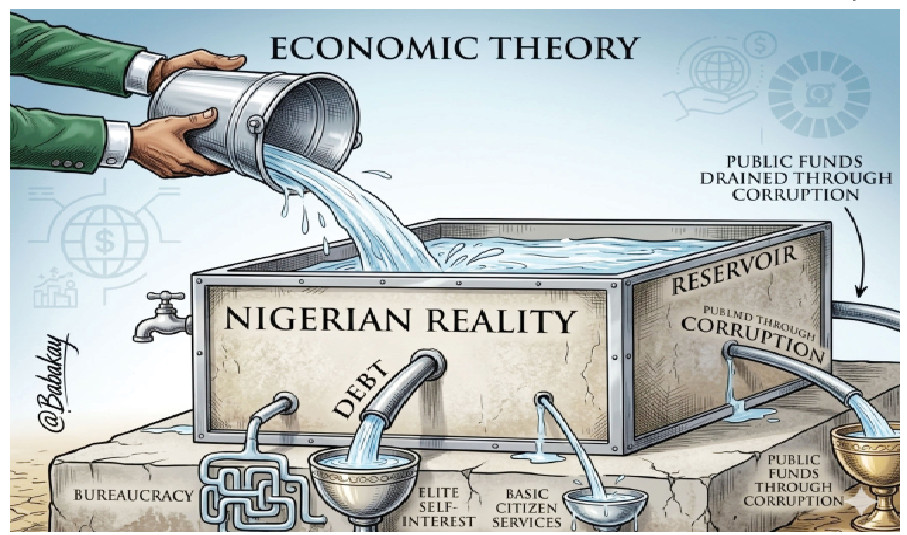
Budgets expand. Borrowing rises. Liquidity circulates. Yet industrial productivity remains weak, unemployment persists, and inflation continues punishing ordinary households. It resembles pouring water into a cracked reservoir and celebrating the sound of flowing water while ignoring the widening fractures underneath.
Debt and Distortion
Yakubu’s comparison between Nigeria’s debt profile and those of advanced economies reveals another weakness in Nigerian economic discourse: statistical abstraction detached from structural context.
Yes, Japan’s debt-to-GDP ratio is significantly higher than Nigeria’s. America’s is too. But debt sustainability is not determined by arithmetic alone. It depends on revenue strength, export sophistication, institutional trust, monetary credibility, and productive resilience.
Japan borrows largely in its own currency and possesses one of the most technologically advanced economies in the world. America issues the global reserve currency and remains central to international finance. Nigeria borrows within a fragile mono-export economy vulnerable to oil price volatility, exchange-rate instability, shallow industrialisation, and weak revenue mobilisation.
Comparing these economies through debt ratios alone is like comparing the body weight of an Olympic athlete and a hospital patient while ignoring cardiovascular health. The numbers may appear similar. The systems underneath are not comparable.
The real question is not whether Nigeria can borrow. The question is whether borrowed resources are being converted into productive assets capable of generating future repayment capacity. That question remains uncomfortable because Nigeria’s fiscal history contains too many abandoned projects, too many consumption-driven expenditures, and too few transformational outcomes proportional to the scale of borrowing.
Inherited Problems
Yakubu is correct that Nigeria’s structural dysfunction did not begin in 2023. Fuel subsidy distortions, exchange-rate arbitrage, oil dependency, fiscal opacity, and chronic underinvestment accumulated over decades.
But inherited dysfunction cannot become a permanent explanatory shelter. Every administration inherits problems. Leadership is measured not merely by diagnosing inherited crises but by intelligently sequencing corrective reforms.
Take fuel subsidy removal. Economically, subsidy removal was inevitable. The regime had become fiscally unsustainable and corruption-ridden. Most credible economists acknowledged this long before the current administration assumed office. But policy necessity does not eliminate the importance of sequencing.
Successful reform is not merely about courage. It is about preparation.
China’s reforms under Deng Xiaoping were carefully phased. South Korea coordinated industrial policy with export competitiveness and institutional discipline. India’s liberalisation occurred alongside stabilisation mechanisms and broader structural support. Nigeria removed subsidy within an environment already weakened by inflationary pressure, weak social safety nets, declining real wages, and fragile transportation systems.
The resulting hardship was therefore not entirely unavoidable. Much of it reflected sequencing failure.
One does not remove stabilizers from an aircraft mid-flight and then accuse passengers of economic illiteracy for panicking during turbulence.
State and Incentives
Another philosophical weakness in Yakubu’s essay is the assumption that state intervention is inherently rational while critics are supposedly trapped in market romanticism. But modern political economy moved beyond this binary decades ago.
Markets fail, yes.
Public choice economists such as James Buchanan demonstrated that governments are not neutral, omniscient planners operating above society. States are institutions shaped by incentives, bureaucratic inefficiencies, elite bargaining, patronage systems, and political calculations.
This matters enormously in Nigeria because the effectiveness of fiscal intervention depends not merely on the amount spent but on the governance architecture through which spending travels. If public expenditure leaks through corruption, inflated contracts, policy inconsistency, and weak accountability systems, then deficit financing becomes less developmental stimulus and more inflationary circulation.
Increasing water supply does not solve a plumbing problem when the pipes themselves are broken.
Nigeria’s challenge is therefore not simply insufficient spending. It is weak conversion of spending into measurable productivity and broad-based development.
The Human Variable
Perhaps the greatest limitation of technocratic economic debates in Nigeria is their tendency to reduce citizens into variables within equations. Inflation becomes “adjustment pressure.” Hardship becomes “transitional cost.” Currency depreciation becomes “market correction.”
But economics is not valuable because it balances models. It is valuable because it improves human welfare.
A trader in Kano does not experience “macroeconomic stabilisation.” He experiences rising transportation costs and shrinking profit margins. A manufacturer in Aba does not consume debt-to-GDP ratios. He consumes diesel price and collapsing consumer demand. An unemployed graduate in Lagos cannot pay rent with fiscal theory.
This is why contextual intelligence matters. Economics is not merely about what is theoretically correct. It is about what is institutionally feasible and socially sustainable.
Beyond Macroeconomic Poetry
Yakubu’s essay deserves engagement because it raises legitimate questions about deficits, fiscal intervention, and structural reform. But it also reveals two cognitive biases common among technocratic policymakers: authority bias and confirmation bias.
Authority bias appears in the assumption that invoking Keynes, Krugman, or Stiglitz automatically resolves contextual contradictions. Confirmation bias appears in the selective emphasis on evidence supporting deficit legitimacy while underplaying evidence of institutional inefficiency and weak developmental outcomes.
Yet economies are not persuaded by elegant prose. They respond to incentives, productivity, institutions, and outcomes.
The real debate in Nigeria is therefore not between economic literacy and illiteracy. It is between competing interpretations of whether the country’s fiscal architecture can realistically transform borrowing into development under existing institutional constraints.
That debate deserves humility rather than grandstanding, empirical honesty rather than selective comparisons, and contextual realism rather than macroeconomic poetry. Because ultimately, citizens do not live inside economic theories. They live inside the consequences of policy choices.
We’ve got the edge. Get real-time reports, breaking scoops, and exclusive angles delivered straight to your phone. Don’t settle for stale news. Join LEADERSHIP NEWS on WhatsApp for 24/7 updates →
Join Our WhatsApp Channel