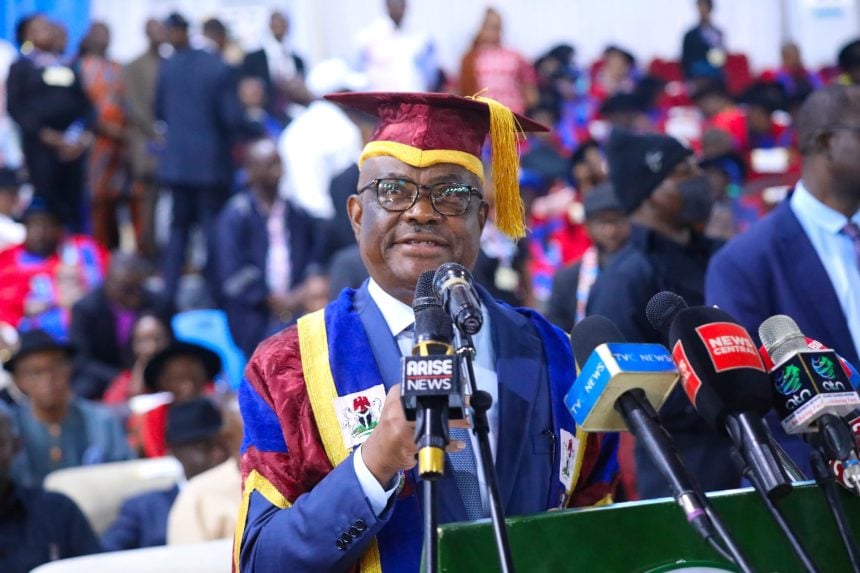
Minister of the Federal Capital Territory (FCT), Nyesom Wike, has said the future of Nigeria depends largely on the quality of leadership and the commitment of leaders to infrastructure development, adding that no nation can rise above the capacity, vision and resolve of those entrusted with governance.
He made the assertion yesterday while delivering the 36th Convocation Lecture of the University of Port Harcourt, titled “Leadership and Infrastructure Development in Nigeria: Lessons for Future Leaders.”
Addressing the vice-chancellor, Governing Council, Senate members, graduating students and distinguished guests, Wike described the University of Port Harcourt as a citadel of knowledge that had played a significant role in shaping Nigeria’s intellectual, political and developmental trajectory.
The former Rivers State governor, who described the occasion as a homecoming to his alma mater, said leadership remains the most critical factor in determining the success or failure of nations.
According to him, “No nation rises above the quality of its leadership, and no leadership proves itself more clearly than in the infrastructure it leaves behind.”
He argued that roads, schools, hospitals, water systems and power infrastructure remain the most visible evidence of effective governance, stressing that leadership should be measured not by speeches and promises but by tangible impact on citizens’ lives.
Speaking on what he termed Nigeria’s “development paradox,” Wike lamented that despite being richly endowed with vast natural and human resources, the country continues to struggle with poverty, unemployment, insecurity and infrastructural deficits.
He noted that at independence in 1960, Nigeria possessed all the ingredients necessary for greatness, including a vibrant population, abundant natural resources and a promising civil service, but failed to translate those advantages into sustainable development.
The minister said several scholars, including the late novelist Chinua Achebe, had consistently identified leadership failure as the root cause of Nigeria’s developmental challenges.
“Nigeria’s challenge is not primarily a lack of resources. It is a failure of leadership. Not leadership in title, but leadership in responsibility; not leadership in rhetoric, but leadership in results,” he stated.
Wike explained that leadership entails more than occupying public office, describing it as the capacity to influence, inspire and mobilize people and resources toward achieving shared goals.
He identified vision, courage, political will, discipline, accountability, integrity and service as essential qualities of effective leadership, stressing that leadership should be viewed as a responsibility rather than a privilege.
“Leadership is not a title bestowed; it is a burden assumed. It is not the comfort of office, but the weight of responsibility,” he said.
The FCT minister maintained that infrastructure remains the ultimate test of leadership because it represents governance translated into practical outcomes that improve the lives of citizens.
Drawing examples from global leaders such as Franklin D. Roosevelt of the United States, Lee Kuan Yew of Singapore, Deng Xiaoping of China, Paul Kagame of Rwanda and Jawaharlal Nehru of India, Wike argued that history remembers leaders not for their speeches but for the infrastructure and institutions they built.
He emphasised that roads, railways, schools, hospitals, power systems and digital infrastructure are critical drivers of economic growth, social inclusion and national cohesion.
According to him, “Infrastructure is the ultimate ledger of leadership. History does not remember intentions; it remembers results and legacies.”
The minister also reflected on Nigeria’s colonial experience, noting that while colonial infrastructure was primarily designed to facilitate economic exploitation, it nonetheless demonstrated the importance of infrastructure in achieving national objectives.
He argued that if colonial administrators could build railways, roads and ports to serve their interests, post-independence leaders should demonstrate even greater determination in constructing infrastructure to advance national development.
On the challenges facing infrastructure development in Nigeria, Wike identified corruption, policy discontinuity, weak institutions, political short-termism, poor maintenance culture and patronage as major impediments.
He said corruption diverts resources meant for public development into private hands, while successive governments often abandon projects initiated by their predecessors for political reasons.
The minister lamented that weak institutions, political interference and lack of accountability continue to undermine effective project implementation across the country.
“Development is not an event; it is a continuum. Nations that succeed do so because policies outlive administrations and projects transcend political cycles,” he said.
Turning to the administration of President Bola Tinubu, Wike commended the President for prioritising infrastructure as a strategic tool for national development.
He noted that although some ongoing projects were initiated by previous administrations, the Tinubu government had revitalized and expanded them within a coherent developmental framework.
The minister highlighted major infrastructure initiatives under the administration, including the Lagos-Calabar Coastal Highway, Sokoto-Badagry Super Highway, Abuja-Kaduna-Zaria-Kano Road, East-West Road, expansion of access roads to the Second Niger Bridge and the rehabilitation of the Port Harcourt-Maiduguri rail corridor.
He also cited efforts to improve electricity supply through the Presidential Power Initiative in partnership with Siemens, rural electrification programmes, the Presidential Compressed Natural Gas (CNG) Initiative, broadband expansion, airport modernization and the Renewed Hope Cities and Housing Programme.
According to Wike, President Tinubu demonstrated courage and political will by removing fuel subsidy, a decision he said created fiscal space for increased investment in infrastructure and development.
“What the present moment offers is a rare and defining possibility, a window in which purposeful leadership can begin, in earnest, to narrow the enduring gap between Nigeria’s vast potential and its historically uneven performance,” he stated.
The minister added that the current administration had shown commitment to building a functional, modern and integrated Nigeria through deliberate investment in infrastructure and institutional reforms.
Reflecting on his own experience in public service, Wike cited his tenure as Governor of Rivers State and his current role as Minister of the Federal Capital Territory as practical examples of how decisive leadership can transform communities through infrastructure development.
He recalled the construction of multiple flyovers, roads, schools and healthcare facilities across Rivers State, noting that the projects significantly improved mobility, education and healthcare delivery.
Wike said his administration in Rivers State became synonymous with project execution, earning him the nickname “Mr Project.”
“As many of you will recall, I came to be known as ‘Mr Project,’ a sobriquet born not of rhetoric, but of relentless execution,” he said.
In the FCT, he explained that efforts were underway to restore the Abuja Master Plan, improve road infrastructure, enforce development regulations and upgrade public facilities.
According to him, residents and visitors are already witnessing significant transformation in the nation’s capital through ongoing infrastructural renewal and urban development initiatives.
Offering lessons for future leaders, Wike urged the graduating students to embrace courage, integrity, discipline and service as guiding principles in leadership.
He stressed the importance of execution over rhetoric, continuity in governance, accountability and prioritization of public interest above personal gain.
“Do not tell us what you intend to do; show us what you have done. Do not promise transformation; deliver it. Do not manage decline; build progress,” he advised.
Wike concluded by reminding the graduates that leadership is a trust and that infrastructure remains the most enduring evidence of effective governance.
We’ve got the edge. Get real-time reports, breaking scoops, and exclusive angles delivered straight to your phone. Don’t settle for stale news. Join LEADERSHIP NEWS on WhatsApp for 24/7 updates →
Join Our WhatsApp Channel