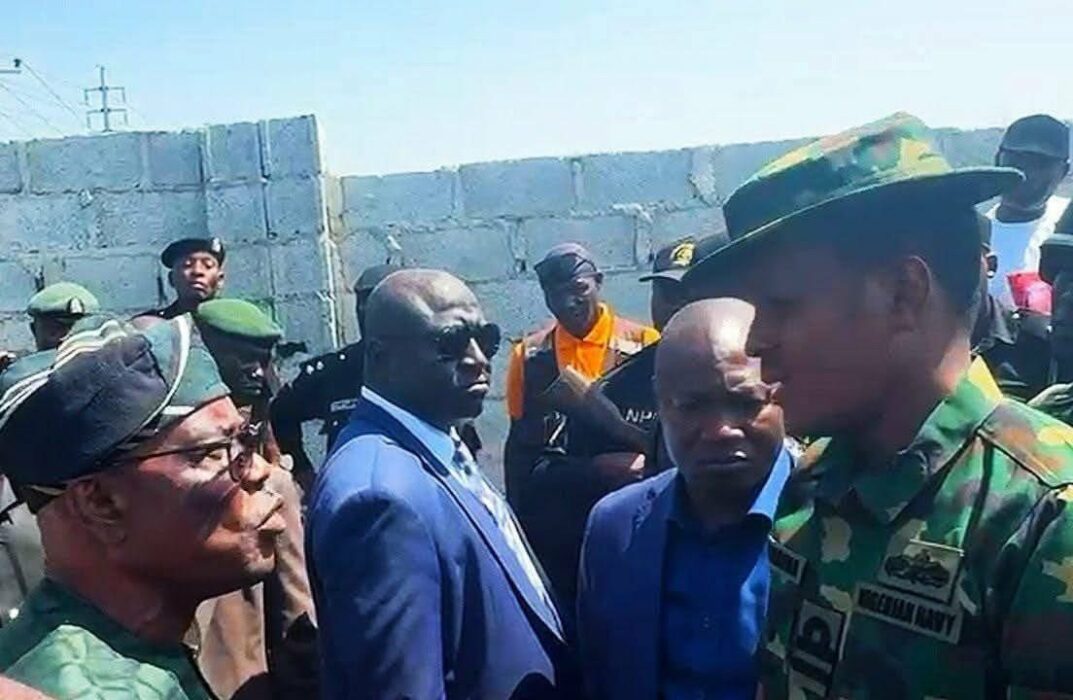
The clash between the Minister of the Federal Capital Territory (FCT), Nyesom Wike, who was on an official assignment, and a very junior naval officer, Lieutenant Ahmed Yerima, is unfortunate. Still, it highlights the lingering influence of military hegemony in the nation’s political life years after the reinstatement of democracy in the country.
In a democracy worthy of that designation, the military is expected to be subordinate to political civilian authority. That seems not to be fully ingrained in the psyche of Nigerian soldiers who still carry on as if the uniform is an instrument of willful insubordination. A section of that otherwise disciplined establishment still carries on as if they are above civilian political control.
The minister’s visit to investigate an alleged land grab by a senior military officer became an opportunity to showcase the military’s power and influence. The parcel of land in question was reported to be earmarked initially for park and recreation purposes, allocated to one Santos Estate Limited but which was allegedly converted and sold for residential use without proper approvals.
Wike, in his capacity as the FCT minister in charge of land matters in the city, is authorised to inspect any plot of land for any reason. But soldiers acting on orders obstructed him from performing his lawful duties of land administration in the federal capital. He could have handled the matter diplomatically.
At the head of the naval personnel manning the land was a Lieutenant Yerima, a very junior officer, who was ordered by his superiors to stand between the minister and the performance of his duty.
Wike, according to reports, was there to support the Department of Development Control officials who had earlier been obstructed by military personnel stationed at the site from performing their assigned lawful duty.
The trending video recording of the exchange between the minister and the junior officer is instructive—a perceptible disrespect for the military institution for political authority.
The first question that came to the discerning mind was whether Yerima would have had the temerity to stand in the way of General Theophilus Danjuma (rtd) as Minister of Defence, in a democratic dispensation, as he was, from exercising his duties based on an order from wherever, whoever and claim integrity?
Unfortunately, a former Chief of Army Staff, Lt. General T.Y. Buratai, did not see it in that light. He did not see anything wrong with that act of indiscipline on the part of that soldier. He, instead, described the minister’s conduct as a “clear and present danger to national security,” and went ahead to warn that publicly rebuking a uniformed officer weakens discipline.
Another Former Chief of Defence Staff, Gen. Lucky Irabor, added: “Whether it’s a young officer or a senior one, when you make disparaging remarks against them, you insult the state itself. The uniform is not about who is wearing it; it represents the authority of the state.”
Surprisingly, both of them see nothing wrong with soldiers being used to perform a domestic civilian duty, such as guarding a private property purportedly belonging to another high-ranking military official.
The point to be made is that it is an institutional abuse for soldiers paid by Nigerian taxpayers to be used in such a manner that actually reduces the aura that uniforms are expected to command under normal circumstances. The land in question does not belong to the military as an institution, and, to that extent, it is an abuse of military resources for those soldiers to be there in the first place.
This newspaper is persuaded to argue that the presence of those soldiers to prevent state officials from carrying out their functions is a sufficient reason to arouse Wike’s anger.
The minister should have been more restrained in his response as we believe that uniform or not, every human being deserves respect. And this view is not inconsistent with honouring our military for their very important role in our collective defence.
We are compelled to note that Nigeria is technically at war with terrorists. Recently, a very senior military officer, a Brigadier General, was slaughtered by terrorists on Nigerian soil. Others were killed in an ambush. Ordinarily, these ought to have been perceived by the military as an affront and reacted to as such. No. it is seen as part of an occupational hazard.
The nation is complaining that there are not enough soldiers to ward off the impudence of terrorists. Yet, the few available are used for personal duties by the high and mighty in the establishment. That is unacceptable.
We’ve got the edge. Get real-time reports, breaking scoops, and exclusive angles delivered straight to your phone. Don’t settle for stale news. Join LEADERSHIP NEWS on WhatsApp for 24/7 updates →
Join Our WhatsApp Channel