
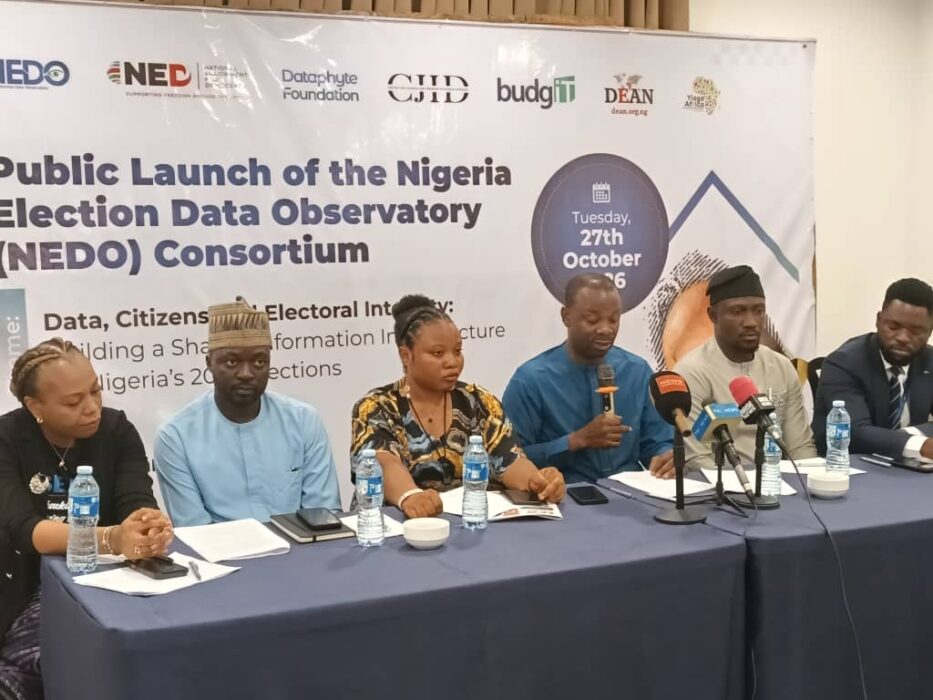
A consortium of five civil society organisations has launched the Nigeria Election Data Observatory (NEDO), a joint election monitoring and data-sharing initiative designed to strengthen independent verification of election results, track electoral incidents and improve public access to credible information ahead of the 2027 general elections.
The consortium, comprising Dataphyte Foundation, YIAGA Africa, BudgIT Foundation, the Centre for Journalism Innovation and Development (CJID), and Dean Initiative, said it plans to deploy more than 4,000 election observers through the networks of its member organisations for the 2027 polls.
The initiative will integrate information gathered by election observers, data from official results published by the Independent National Electoral Commission (INEC), research findings, and media reports into a common technological platform for analysis, verification, and public communication.
Oluseyi Olufemi of Dataphyte Foundation, who read the consortium’s statement at the launch, said the initiative was designed to address the fragmentation of election observation activities among civil society organisations and establish a coordinated system for examining electoral information.
He explained that although civil society groups had invested considerable resources in election observation, voter education, incident tracking, research and data analysis over the years, much of the information generated remained within separate institutional networks and data systems.
According to him, this arrangement has limited the ability of organisations to aggregate and compare evidence, verify reports across different sources and maximise the value of their investments in election monitoring.
The consortium said the experience of the 2023 general elections, particularly the controversies surrounding INEC’s Result Viewing Portal (IReV) and the transmission and public display of election results, reinforced the need for a coordinated, independent civic information system.
It argued that an integrated platform would enable civil society organisations to compare official election records with independent observations from polling units and other locations, identify discrepancies that require further investigation, and communicate findings supported by verifiable evidence.
A major component of NEDO is the deployment of technology to collect, process and analyse results published by INEC.
The consortium said it would incorporate automated data collection systems capable of retrieving information available from the electoral commission, alongside artificial intelligence optical character recognition (OCR) technology.
The OCR technology converts images of election result sheets obtained from IReV into machine-readable data that can be organised, analysed and shared with participating organisations.
The consortium said the system would support interactive election result platforms developed by its partners, including Dataphyte Foundation and BudgIT Foundation, while making electoral information more accessible for public scrutiny.
Through the arrangement, information collected by one participating organisation would be made available to other partners through application programming interfaces (APIs) and other data-sharing mechanisms.
The coalition cited public confidence in the electoral process as another reason to establish the observatory.
It cited YIAGA Africa’s September 2026 National Voting Intention Survey, which reportedly found that only 34 per cent of respondents expressed confidence in INEC’s ability to conduct credible elections.
The consortium said the finding highlighted the importance of independent election observation and access to credible information throughout the electoral cycle.
It also warned that the growing use of generative artificial intelligence, deepfakes, manipulated content, and misinformation had created additional challenges for the integrity of electoral information.
According to the coalition, citizens increasingly need reliable means of distinguishing authentic election information from false or misleading claims, particularly during periods when political tensions and competing accounts of electoral events may influence public perception.
It said NEDO would bring together independent observation networks, research institutions, data platforms and media organisations to improve the collection and verification of electoral evidence.
We’ve got the edge. Get real-time reports, breaking scoops, and exclusive angles delivered straight to your phone. Don’t settle for stale news. Join LEADERSHIP NEWS on WhatsApp for 24/7 updates →
Join Our WhatsApp Channel