BABAJI USMAN BABAJI writes about the Gombe snakebite crisis, which has exposed the agony of poverty and healthcare in the state.
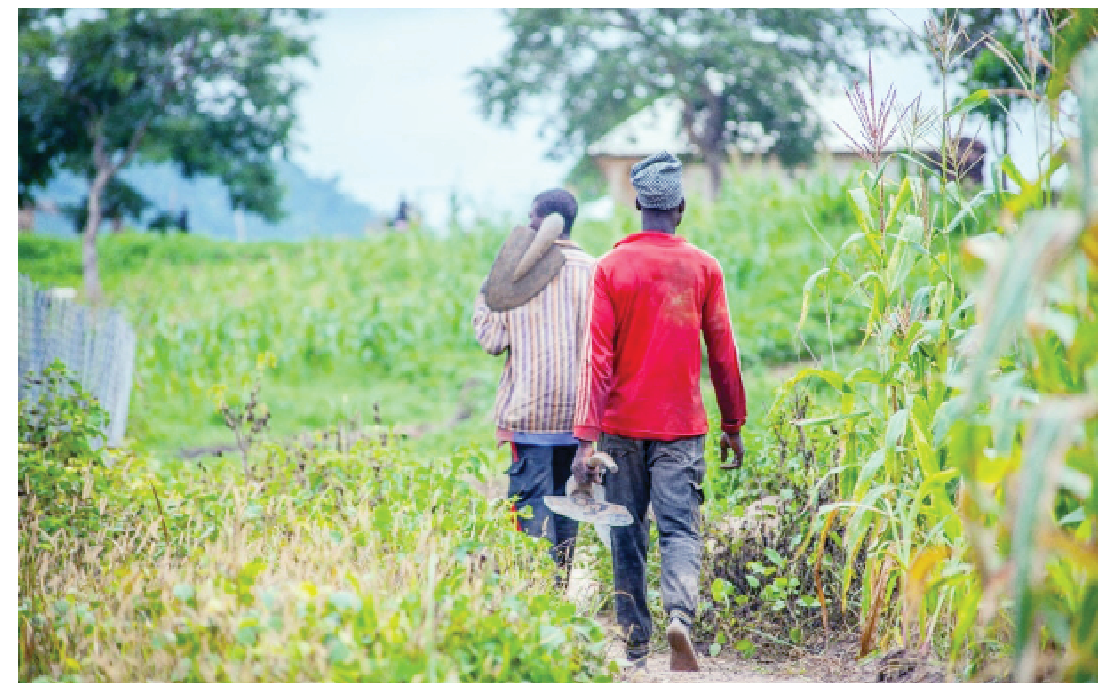
In the farmlands of Kaltungo, one of the rocky local governments of Gombe State, farmers and rural families have for decades lived alongside a silent but deadly threat: venomous snakes.
What once was a manageable hazard has ballooned into one of the region’s most overlooked public health emergencies — a reality now laid bare through the harrowing experiences of victims, caregivers, medical professionals, and officials.
While recent figures suggest a drop in reported snakebite cases, experts warn that the actual burden of the crisis remains obscured by shortages of treatments and escalating costs that push vulnerable communities to the brink of financial ruin.
“In 2022, we recorded more than 2,700 snakebite cases in this hospital; in 2023, around 2,500; in 2024, just over 2,100; and 1,591 so far in 2025,” Dr. Nuhu Bile, State Epidemiologist at the Gombe State Ministry of Health, disclosed this at a State Public Health Emergency Management Committee meeting held in December 2025.
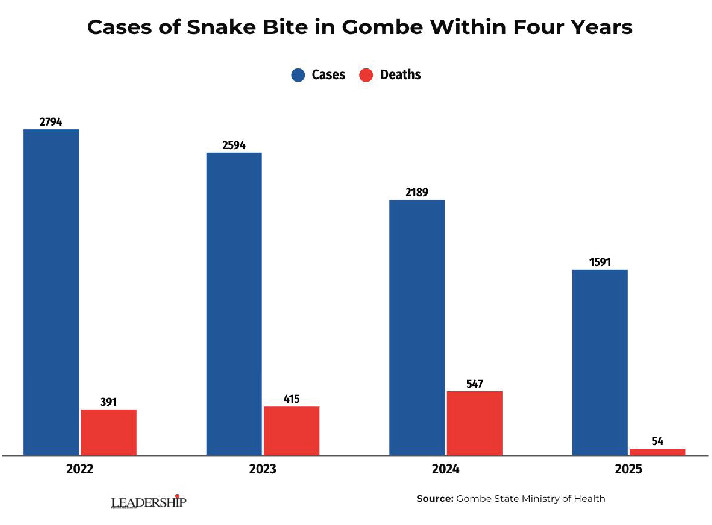
He explained that the centre recorded 2,794 cases in 2022 with 391 deaths, 2,594 cases in 2023 with 415 deaths, 2,189 cases in 2024 with 547 deaths, and 1,591 cases in 2025 with 54 deaths.
At first glance, the decline in these numbers could suggest progress. But Dr. Bile cautions that this apparent improvement masks the real crisis.
“The reduction is not because there are fewer snakes or that people have learned to avoid them. It’s because there is no free anti-venom available anymore, and many victims avoid the hospital unless their condition has worsened,” he stressed.
He said while the numbers may appear lower than in previous years, the cases are likely underreported due to victims choosing traditional healing routes or avoiding hospitals entirely when faced with unaffordable treatment.
When Survival Comes at a Price
For many in rural Gombe, the snakebite experience is not just a statistic — it’s a story of trauma, financial despair, and a fight for survival.
Ali Idris, a villager from Bojude, recounted how a single bite turned his life upside down.
“When I got to the hospital, they told me there was no anti-snake venom in stock. To survive, I had to buy two vials from outside at a total cost of N500,000,” he told News Agency of Nigeria in August 2025.
Idris, a subsistence farmer, said the ordeal was both physically painful and financially crippling.
Nearby, Abubakar Muhammed shared a similar struggle. After being bitten, he managed to secure just one vial of anti-venom — costing N250,000 — only after borrowing money from relatives.
“The economic situation is really hard. Some patients come with no money at all,” he explained.
These stories suggest that good care is not only scarce but prohibitively expensive; victims often delay seeking help or turn to traditional remedies that are ineffective against venomous bites.
From Fields to Hospital Beds
Snakebites in Gombe State occur predominantly among rural dwellers — farmers, herders, and children who live and work near rivers, bushes, and farmland where venomous snakes thrive.
Kaltungo’s unique topography of hills and vegetation creates an ideal habitat for species such as carpet vipers, a common culprit behind many bites.
For those bitten, every minute matters. In cases documented by media outlets, victims recount harrowing journeys — some walking or riding on motorcycles for hours — to reach a hospital equipped to administer anti-venom.
Delays can be fatal; in rural communities where transport and health infrastructure are limited, reaching appropriate care is often a race against time.
Medical Infrastructure Strained
The Kaltungo Snakebite Hospital has long been the epicentre of snakebite treatment in northern Nigeria.
The hospital serves patients in Gombe State and neighbouring states, and even across borders, where similar rural health gaps exist.
Despite its crucial role, the facility faces persistent challenges of anti-venom shortages. Without adequate stocks, many victims must source anti-venom themselves at prohibitive prices, increasing the likelihood of complications and death.
Delayed presentation is another challenge. Patients who first turn to traditional treatments often arrive at hospitals too late for optimal treatment.
Similarly, high demand for the resources makes it more complicated. The centre treats thousands of cases annually, with an overwhelming staff and resources.
For Dr. Nicholas Amani Hamman, Chief Medical Officer of the Snakebite Treatment and Research Centre in Kaltungo, thousands of cases pass through the facility’s doors each year.
Dr. Hamman said that anti-snake venom is scarce not just in Gombe, but across Nigeria and much of the world, adding that the lack of availability is partly because venomous snakebite predominantly affects the less privileged.
He noted that this scarcity extends into hospitals themselves, driving patients into the hands of private vendors.
The Cost of Delay
Another silent killer is late presentation. Dr Hamman said many patients wait days, sometimes weeks, before seeking hospital care.
By the time such patients arrive, complications such as severe tissue damage, infections, or organ failure may already have set in, reducing their chances of survival.
Late reporting is often linked to poverty, distance, and trust in traditional medicine. But doctors stress that cutting wounds, sucking venom, or applying herbs and chemicals can worsen injuries. The only proven treatment for venomous snakebite is timely administration of the correct antivenom in a hospital setting.
Beyond treatment, experts say prevention is critical. Simple environmental measures, such as clearing bushes, controlling rodents, sealing home entry points, and keeping surroundings tidy, can reduce snake presence. Wearing protective footwear on farms and using lights at night can also lower risk.
Still, prevention offers little comfort to families already affected.
For many, the emotional scars linger long after physical recovery. Some survivors lose limbs or strength, making it difficult to return to farming. Others carry debts that take years to repay.
The Helping Tips – Expert
Snakebite is a medical emergency, and experts agree that speed, calmness, and proper action can mean the difference between life and death.
Medical experts stressed that anyone bitten by a snake should seek medical help immediately, even if the bite seems minor or the snake is thought to be non-venomous.
They warn against cutting the wound, sucking out venom, applying tourniquets, ice, herbs, chemicals, alcohol, or stimulants, as they can worsen injury and increase the risk of death.
”Preventing snakebites starts with making homes and surroundings less attractive to snakes. Controlling rats and frogs around homes is critical, as snakes often follow their prey into compounds,” said Dr Rowoland Saseun.
Government Response
Acknowledging the urgency of the situation, the Federal Government moved to restructure the response.
In a plan agreed with the Gombe State Government, the Federal Government will take over the management of the centre, transform it into a national hub for treatment, research, training, and local anti-venom production.
According to Health Minister, Professor Muhammad Ali Pate, the takeover is intended to ensure the centre has the capacity to serve as a referral institution, not just for Gombe, but for the broader North-East region and beyond.
The long-term vision includes developing local capacities to produce anti-venom and reducing reliance on expensive imports.
This strategic shift is also part of a broader effort to strengthen rural health systems and improve access to essential medicines.
Yet experts caution that implementation — from funding to infrastructure and supply chain management — remains a formidable challenge.
Human Cost and Hope for Change
Behind the data and policy shifts are people whose lives have been affected.
Farmers who can no longer afford to work their land after losing limbs, families plunged into debt to pay for treatment, and communities that watch their loved ones suffer, all make up the human faces of the crisis.
There is a consensus among health professionals and advocates that expanding anti-venom availability and bringing treatment closer to rural communities could dramatically reduce deaths.
Local anti-venom production, better funding, and public awareness campaigns are seen as essential steps in addressing the crisis.
For Idris and Muhammed, there is cautious optimism; both believe government intervention could make future cases less financially and medically devastating.
While official statistics offer a snapshot of the trend, the real story is in the lived experiences of victims and their families, medical staff stretched thin, and communities caught between tradition and modern medicine.
Efforts to elevate the Kaltungo centre to national prominence and invest in local anti-venom production represent promising steps.
Yet without sustained political will, funding, and community engagement, the cycle of preventable suffering is likely to continue for rural villagers living in fear of the next bite.
We’ve got the edge. Get real-time reports, breaking scoops, and exclusive angles delivered straight to your phone. Don’t settle for stale news. Join LEADERSHIP NEWS on WhatsApp for 24/7 updates →
Join Our WhatsApp Channel