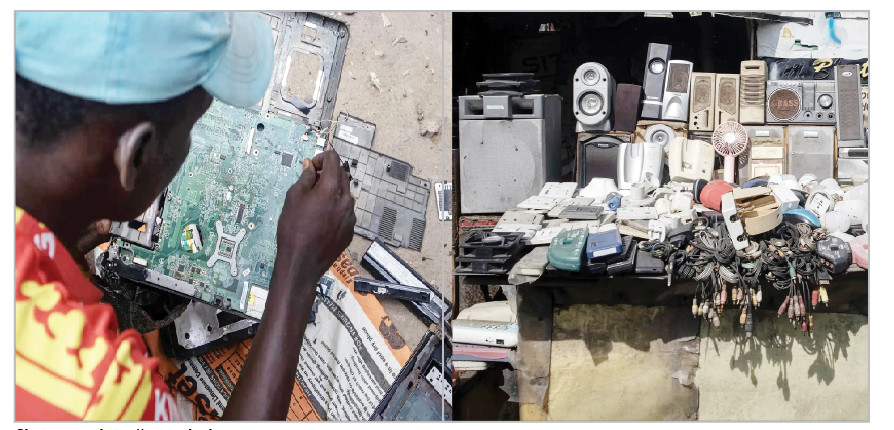
In the busy corridors of Ikeja Computer Village, beneath flyovers in Ojota, and behind spare-parts stalls in Alaba and other suburbs across the country, a quiet economy is quietly thriving.
Here, discarded phones, broken laptops, damaged chargers, and outdated gadgets are far from useless. In the hands of skilled young technicians, these items are dismantled, repaired, refurbished, and sometimes completely reborn.
These once considered useless, electronic scrap trading is now providing daily income for hundreds of residents who have discovered profit in what others throw away.
In fact, what many people throw away as electronic waste is becoming an unexpected source of income and opportunity for thousands of young Nigerians, turning piles of obsolete gadgets into a growing hub of innovation, survival, and employment.
LEADERSHIP Weekend gathered that the business operates through a network of scrap buyers, technicians and end-market aggregators who collect faulty gadgets ranging from cracked Android phones to water-damaged laptops and abandoned office equipment.
These devices often find a second life as spare parts, recyclable metals and reusable components. Some are refurbished and resold, while others are dismantled and processed for materials such as copper, aluminium and traces of gold used in manufacturing and recycling industries.
For many young people and adults facing limited employment opportunities, the e-waste trade has become a vital source of livelihood.
A phone technician and scrap dealer who identified himself simply as Denis, operating in Ibafo along the Lagos–Ibadan Expressway, said the venture started small but has gradually grown.
“I started with just N15,000. Now I buy broken phones in bulk from repairers. Some I resell as parts, while others go to recyclers. In a good week, I make between N60,000 and N80,000 as a part-time hustle,” he said.
According to Denis, the process is straightforward but requires strategy. Traders source faulty devices from phone repairers, offices upgrading their equipment, schools, security agencies and even households disposing of old gadgets.
The items are typically sorted into three categories such as, repairable devices, parts salvage and pure scrap.
“Repairable devices are refurbished and resold. Those beyond repair are dismantled for screens, batteries, keyboards, hard drives and circuit boards. The remaining shells, which contain copper, aluminium and small traces of gold, are sold to recycling agents who export them in bulk,” he explained.
At the popular Computer Village in Lagos, a broken smartphone can sell for between N500 and N3,000 depending on the model, while scrap laptops range from N2,000 to N7,000. When dismantled for parts, the value of these devices can sometimes double or triple.
For Fatima Azeez, the business provided a way out of unemployment.
“I go round repair shops asking for their dead devices. They are happy to sell because it clears their workspace. Sometimes I buy up to 100 phones in a week,” she said.
According to her, profit comes largely from volume.
“If I make N1,000 on one phone and sell 50, that’s N50,000. The work is dirty, but it pays.”
Some scrap buyers also use portable loudspeakers to announce their presence in neighbourhoods, encouraging residents to bring out unused gadgets for sale.
An in-depth look at the scrap chain shows that it supports a broader ecosystem involving transporters, sorters, dismantlers and exporters. In many cases, middlemen aggregate thousands of devices monthly before shipping them to processing firms in Asia and Europe for metal extraction.
Despite its economic potential, the sector remains largely informal and unregulated. Many traders handle batteries, circuit boards and other components without protective gear, exposing themselves to potentially toxic substances.
Yunus Abubakar, a scrap dealer and sorter, acknowledged the risks but said economic realities leave many with little choice.
“There’s risk involved, but hunger is worse. A man must work to eat and survive,” he said.
Abubakar added that proper training and government support could transform the trade into a more structured industry.
“If the government supports us with safety training and equipment, this can become a big industry,” he said.
Environmental experts have also warned that improper handling of electronic waste can pose serious ecological risks. Advocates say formalising the sector could help reduce pollution while creating thousands of jobs.
Lagos alone generates thousands of tonnes of electronic waste annually from businesses, telecom upgrades and imported second-hand gadgets.
For newcomers interested in the trade, experienced operators advise starting small, learning how to classify devices, building relationships with technicians and reinvesting profits.
“This business teaches patience and negotiation. What others throw away is our daily bread. Many people and families are surviving on it,” Denis said.
We’ve got the edge. Get real-time reports, breaking scoops, and exclusive angles delivered straight to your phone. Don’t settle for stale news. Join LEADERSHIP NEWS on WhatsApp for 24/7 updates →
Join Our WhatsApp Channel