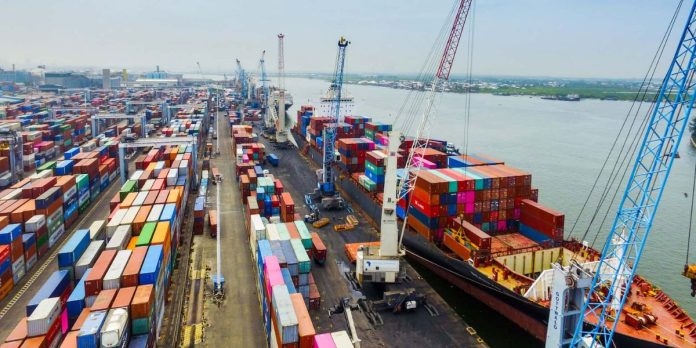
It sounded like a bad coincidence that while President Bola Ahmed Tinubu was in the United Kingdom mobilising resources to modernise the facilities at the Apapa and Tincan ports complexes in Lagos, freight forwarders were busy picketing shipping companies over recent increases in shipping charges.
We recall that during the just-concluded state visit to the United Kingdom by the President, the two countries entered into a £746 million ports infrastructure deal.
The port workers are demanding the immediate reversal of the hikes, threatening to disrupt operations.
As a newspaper, we understand the position of the clearing agents and freight forwarders who operate on razor-thin margins. For them, every naira added to freight costs translates into higher bills for importers, delayed clearances, and squeezed profits. And in an economy where over 80 per cent of goods are imported, these increases, when implemented, can pose a challenge.
The regulatory agency that oversees port operations, the Nigerian Shippers’ Council (NSC), has already intervened to avoid any tendency that could escalate the seemingly charged atmosphere. In its opinion, dialogue is the appropriate medium to resolve issues of that nature.
There are moves to persuade freight forwarders to engage in structured negotiations and to allow the government and stakeholders to resolve this matter amicably.
In its argument, escalation will compound the pain that may likely affect all parties in the dispute. Industry watchers are also of the opinion that the tariff hikes are a fallout from the raging United States of America/Israel-Iran war that has effectively closed the Strait of Hormuz.
That unfortunate development arose as Iran is making good its threats to attack tankers, deploy mines and drones against commercial shipping on the waterway.
Before the conflict, the Strait handled about 138 vessels daily and carried one-fifth of the world’s oil supply. Now, only 50 tankers have transited since the onset of the war.
The implication is that Insurance premiums for war-risk coverage have skyrocketed. Fuel costs have surged as oil prices hit $100 per barrel. Shipping lines worldwide have been forced to reroute vessels around Africa’s Cape of Good Hope. This adds thousands of nautical miles, extra fuel, and weeks of delay. From this perspective, it is to be expected that shipping tariffs would rise sharply, not just in Nigeria, but across the globe.
For Nigeria, an import-dependent economy already battling inflation, foreign exchange scarcity, and post-subsidy adjustment pains, the timing could not be more adverse. The shipping companies are merely reacting to a situation with an international dimension, with ripple effects in almost all advanced countries of the world, including even political ones. For instance, the United States and its allies bicker over efforts to reopen the waterway.
While this is going on, market forces, insurance underwriters, and the brutal arithmetic of longer voyages are responding to trends that act spontaneously.
The development at the ports has a corollary to the hike in pump prices of petrol and diesel in Nigeria’s market.
That same dynamic is playing out in the shipping sector. Freight rates have climbed because bunker fuel is dearer, war-risk add-ons are mandatory, and capacity is constrained. Shipping firms have defended the adjustments, citing rigorous cost calculations, inflation, and forex pressures.
The Shipping Association of Nigeria has emphasised that these hikes followed due process and stakeholder consultations. To demand an outright reversal is to ask companies to operate at a loss, an unsustainable position that would eventually lead to service withdrawals, vessel shortages, higher costs and adverse effect on the economy as a whole.
It is pertinent to observe that freight forwarders are critical stakeholders in the sector and must rise above anger-induced solutions.
Picketing and service withdrawals do not force shipping lines to absorb impossible costs; they only punish Nigerian importers, exporters, manufacturers, and ultimately the consuming public.
It is also noteworthy that every day of disruption at Apapa or Tin Can Island means that demurrage piles up, goods rot in containers, factories stay idle, and jobs hang in the balance.
In an economy where maritime trade accounts for over 90 per cent of cargo movement, self-inflicted wounds are luxuries that the nation cannot afford.
The National Association of Government Approved Freight Forwarders (NAGAFF) and other groups have expressed legitimate concerns about consultations and their impact. Nevertheless, those concerns deserve a hearing, but at the dialogue table, not through blockade.
We believe that the path forward is a structured, multi-stakeholder dialogue facilitated by the Nigerian Shippers’ Council, which has already positioned itself as a neutral arbiter.
Shipping companies must engage clearing agents transparently, explaining cost breakdowns and exploring phased adjustments or incentives for loyal clients. Forwarders, in turn, should present data-driven proposals, such as volume discounts, shared-risk mechanisms, or advocacy for government intervention.
And government must step up decisively. The Federal Ministry of Marine and Blue Economy, the Nigerian Ports Authority, and relevant agencies should accelerate efforts to mitigate the crisis. This could include negotiating with international lines for Nigeria-specific relief, fast-tracking incentives for alternative routing, exploring deeper collaboration with West African ports to build regional resilience, or even targeted fiscal measures to cushion importers’ unexpected costs during this global emergency.
President Bola Tinubu’s administration, which is committed to economic reform and port efficiency, as demonstrated during his just-concluded trip to the United Kingdom, ought to be well-advised to treat this as a national emergency.
Critics may argue that shipping companies are foreign entities profiting at Nigeria’s expense. While some lines are indeed international, the reality is symbiotic: they need Nigerian cargo as much as we need their vessels. Mutual interest demands partnership, not confrontation. Moreover, many Nigerian agents and forwarders have long-standing relationships with these lines.
Destroying trust through pickets will only push the shipping lines to reroute capacity to more stable jurisdictions, leaving our ports emptier.
Most freight forwarders are not mere agitators; they are professionals whose expertise is vital for trade facilitation. We call on them to demonstrate that professionalism by heeding calls for calm, proposing constructive solutions, and standing as partners in national resilience under the present circumstances.
Similarly, we appreciate that some freight forwarders are small- and medium-sized operators who have weathered multiple economic storms, including the naira devaluation, policy flip-flops, and infrastructure deficits. Their resilience is admirable. However, that resilience must now translate into strategic patience.
To the shipping companies, we urge transparency by publishing clear cost justifications, holding town-hall sessions with freight forwarders, and committing to no further unilateral hikes without consultation.
In the meantime, we commend the port economic regulator for stepping in and suspending the tariff increase indefinitely. We, therefore, urge all parties to follow due process in efforts to resolve any pending issues.
We’ve got the edge. Get real-time reports, breaking scoops, and exclusive angles delivered straight to your phone. Don’t settle for stale news. Join LEADERSHIP NEWS on WhatsApp for 24/7 updates →
Join Our WhatsApp Channel