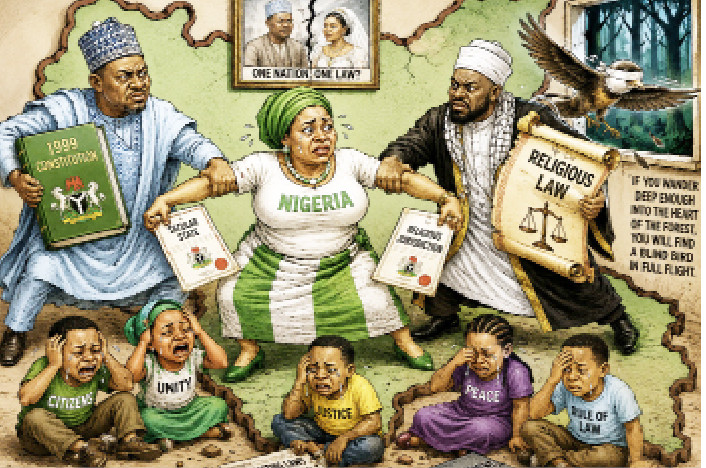
A nation governed by two sets of laws—a constitution and a religious law—is like a woman with two husbands. Can she satisfy them both?
Considering the ongoing clamour by some religious zealots for the expansion of the geographic scope of the implementation of Islamic jurisprudence in Nigeria, and in view of the massive pushback the campaign has encountered, the obvious answer to the above question is a firm ‘No’. Statecraft is not religion. The temporal and the supposedly divine have their uses, but not as contending rivals.
It is not normal for one woman to have two husbands. Some cultures, however, allow polygamy, where one man may marry multiple women. The same society sometimes closes its eyes when confronted with the unusual. There is a beautiful Yoruba proverb for such a situation: If you wander deep enough into the heart of the forest, you will find a blind bird in full flight.
The other side of polygamy, an ‘abomination’ called polyandry, shocked the whole world when it happened in Kenya in 2013.
Polyandry
In Kisauni, Mombasa, Kenya, Sylvester Mwendwa and Elijah Kimani discovered they had been dating the same woman, Joyce Wambui, for over four years. Instead of resorting to violence or forcing her to choose, they realised neither was willing to walk away from her. Joyce, a widow and mother of two, was also unwilling to choose between them.
To resolve the impasse, the two men drafted and signed a formal contract agreeing to share her as a wife. They agreed to take turns living in her house on alternating days and to share child-rearing duties for her existing children and any future children she might have. In addition, they agreed to respect each other, shun jealousy, and protect the family together.
Although it was witnessed and submitted to the authorities, the agreement immediately ran into legal and cultural hurdles because it turned the traditional dynamic of marriage between a man and a woman on its head.
A nation is like a bride married to a constitution. If a country insists on being ‘husbanded’ by two constitutions—one legal and the other religious—it runs the risk of being stranded on an island of confusion where it is neither a democratic entity nor a theocratic state. The argument for the separation of powers between religion and state has gone on long enough for people to realise by now that governance and religion don’t mix well. Like a woman wedded before the law, a state should have just one husband – the constitution.
For years, Nigeria has grappled with the insistence of Muslim activists for the inclusion of Islamic Sharia jurisprudence in the constitution. The more radical of such agitators even insist that the Sharia is higher than the constitution and that wherever there is a conflict between the Sharia and the constitution, the latter should take a back seat. As usual, the political elite have managed to continue deceiving themselves that they are running a secular state while in real life they are operating one country with two different laws.
Traoré
Like Rwanda, Burkina Faso recently opted out of that league when its revolutionary leader, Capt Ibrahim Traoré, himself a practising Muslim, decreed a firm policy on Sharia law, religious education, and national sovereignty. Traoré publicly declared that Sharia law will never be applied as the legal framework in Burkina Faso. He emphasised that the nation’s constitution stands supreme above any religious code and that every citizen has the equal right to practise any religion.
He criticised Burkinabè youth being sent abroad (specifically referencing Saudi Arabia and other Arab states) to study Sharia and Islamic jurisprudence rather than technical or vocational trades. He issued a directive to bring these students home so they can focus on skills needed for national development, arguing that religious studies do not provide young people with practical skills (such as technology, engineering, or trades) necessary to build the economy and defeat insurgency.
Traoré announced that the state would step in to oversee and fund religious education locally across all faiths (Muslim, Catholic, Protestant, and traditional beliefs) to prevent foreign influences from radicalising young citizens or promoting extremist ideologies.
The government has since enacted the Religious Freedoms Law, tightening oversight on religious associations, regulating places of worship, prohibiting public officials from engaging in religious proselytising while on duty, and introducing penalties for hate speech or incitement.
The Burkinabe leader views the foreign-backed promotion of Sharia as an entry point for radicalisation, arguing instead for a state where civic duty, technical skill, and religious freedom operate within a strictly secular republic.
One of the most striking ironies of our time is that a soldier who rifled his way to power has demonstrated a firmer grasp of developmental issues than so-called politicians. Witness the contention of leading Muslim politicians in Nigeria that their primary loyalty is to their religion and that the sovereignty of their country comes a distant second.
The metaphor of comparing Nigeria to a wedlock between one woman and two husbands is at the heart of legal pluralism—the dynamic where multiple legal systems operate within a single sovereign state. Whether a nation can “satisfy both” depends entirely on how the relationship between those two legal frameworks is defined.
Grundnorm
If cohesion is to be maintained in a nation-state, no religion should aspire to compete with the constitution enacted by “We, the people”. I believe in the freedom of religion, but I do not subscribe to adopting a religious legal system above the constitution, which ought to be the supreme law.
As we have seen in Nigeria and other countries where the constitution is sometimes subsumed under some religious jurisprudence, if religious law claims divine authority over all aspects of public life, and the constitution guarantees individual civil liberties that contradict those religious mandates, the state faces constant legal and societal friction. In practice, one system eventually bends or reframes its interpretation to coexist with the other—or political instability follows until a primary authority is established.
By all means, let every Muslim who wants to practice Sharia be allowed to do so. But let our constitution remain the grundnorm in letter and spirit.
The greatest challenge facing our people today is economic, not eschatological. The world is moving fast. Countries are throwing massive economic lifelines to their people to rescue them from poverty while we are quarrelling about the hereafter. Many African states are so disoriented that there is a real danger of their regressing back to servitude to the applause of erstwhile colonialists.
The task of reinventing Africa calls for the best of all our faculties, not the bending of the supreme instrument of nationhood to the sectional desires of some crusaders. We can see the futility of the claims that religion is a wonder tablet that fixes all ailments in the reduction of many communities in states already operating the Sharia system to ungoverned spaces.
If we don’t separate religion and state, our union will eventually unravel like that of Joyce Wambui and her two ‘husbands’, Sylvester Mwendwa and Elijah Kimani. As a result of the intense public criticism, social pressure, media fallout, and the insistence of legal experts that polyandry had no legal standing in Kenya, the trio could no longer remain together as one family as planned. What polyandry put together, society tore asunder.
We’ve got the edge. Get real-time reports, breaking scoops, and exclusive angles delivered straight to your phone. Don’t settle for stale news. Join LEADERSHIP NEWS on WhatsApp for 24/7 updates →
Join Our WhatsApp Channel