
FirstBank has stressed the need to promote ethical business practices among operators in Nigeria’s informal sector, saying integrity, transparency and responsible practices are critical to building sustainable enterprises and strengthening the economy.
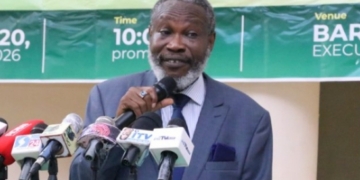
The bank’s Managing Director and Chief Executive Officer, FirstBank Group, Olusegun Alebiosu, stated this at the public lecture of the FirstBank Samuel Asabia Professorial Chair in Business Ethics, held at the University of Lagos.
Alebiosu, who spoke on the theme, “The Paradox of Business Ethics for Sustainable Enterprises in the Informal Sector of Nigeria’s Economy,” said the informal sector, despite its significant contribution to the economy, operates under conditions that make the adoption of ethical practices particularly challenging.
He said the sector provides livelihoods, employment and entrepreneurial opportunities for millions of Nigerians, including traders, artisans, farmers and small business owners, but many of them operate with limited access to finance, infrastructure, capacity and formal business structures.
According to him, the challenge is how to encourage ethical practices among businesses that are primarily focused on survival without making such practices an additional burden on their sustainability.
“This brings us to the paradox before us today: How do we promote ethical business practices among enterprises that are often focused primarily on survival, while ensuring that such practices do not become an additional burden to their sustainability?” he said.
Alebiosu noted that the informal sector contributes approximately 42.5 per cent to Nigeria’s Gross Domestic Product (GDP), adding that it remains the first and sometimes only source of income for many households.
He said unlike formal businesses that rely heavily on regulation and governance structures, informal businesses often depend on reputation and trust in their day to day operations. “It is a sector built less on regulation than on reputation, where a trader’s word to a customer, or an artisan’s fairness to a supplier, often matters as much as any contract,” he said.
The FirstBank chief executive said the bank does not regard ethics and sustainability as competing priorities, stressing that ethical business practices ultimately support long term sustainability. “At FirstBank, we believe that ethics and sustainability should not be viewed as competing priorities but rather that ethical business is sustainable business. Integrity builds trust. Transparency strengthens relationships. Responsible practices enhance resilience,” he said.
He added that businesses that earn the confidence of customers, employees, partners and financial institutions are better positioned to grow. Alebiosu said FirstBank’s commitment to responsible enterprise is reflected in its strategic focus on education and health, diversity and financial inclusion, as well as responsible lending, procurement and climate initiatives.
Also speaking, the Chairman, Board of Trustees, FirstBank Samuel Asabia Professorial Chair in Business Ethics, Prof Akin Osinbogun, said businesses should not be viewed solely as vehicles for making money, stressing the importance of providing quality services.
“In general, people think that business is just about making money, and many go into business just to make money. But I’ve since learned that business is actually more than making money. Business is about making a profit while providing service, and many people leave out that aspect of service, and not just service, quality service,” he said.
The Deputy Vice Chancellor, Academic and Research, University of Lagos, Prof Mathew Olusoji Ilori, who represented the Vice Chancellor, Prof Folasade Ogunsola, said the Chair represented more than an endowment, describing it as a potential centre of intellectual leadership where research could influence practice and policy.
He recalled that the collaboration between FirstBank and the University of Lagos gave birth to the Chair in 1994 in honour of Chief Dr Samuel Asabia, FirstBank’s first Nigerian Managing Director and Chief Executive Officer, who was remembered for his high ethical standards in business.
Ilori said the Chair’s revival following the reconstitution of its Board of Trustees in 2025 marked a decisive step towards fulfilling its mandate of teaching, postgraduate supervision, research, industry collaboration, public engagement and annual public lectures.
He added that the theme of the lecture was particularly relevant to Nigeria because small businesses and informal enterprises sustain millions of livelihoods while operating at the intersection of economic pressure, regulation, social expectations and ethical choices.
We’ve got the edge. Get real-time reports, breaking scoops, and exclusive angles delivered straight to your phone. Don’t settle for stale news. Join LEADERSHIP NEWS on WhatsApp for 24/7 updates →
Join Our WhatsApp Channel