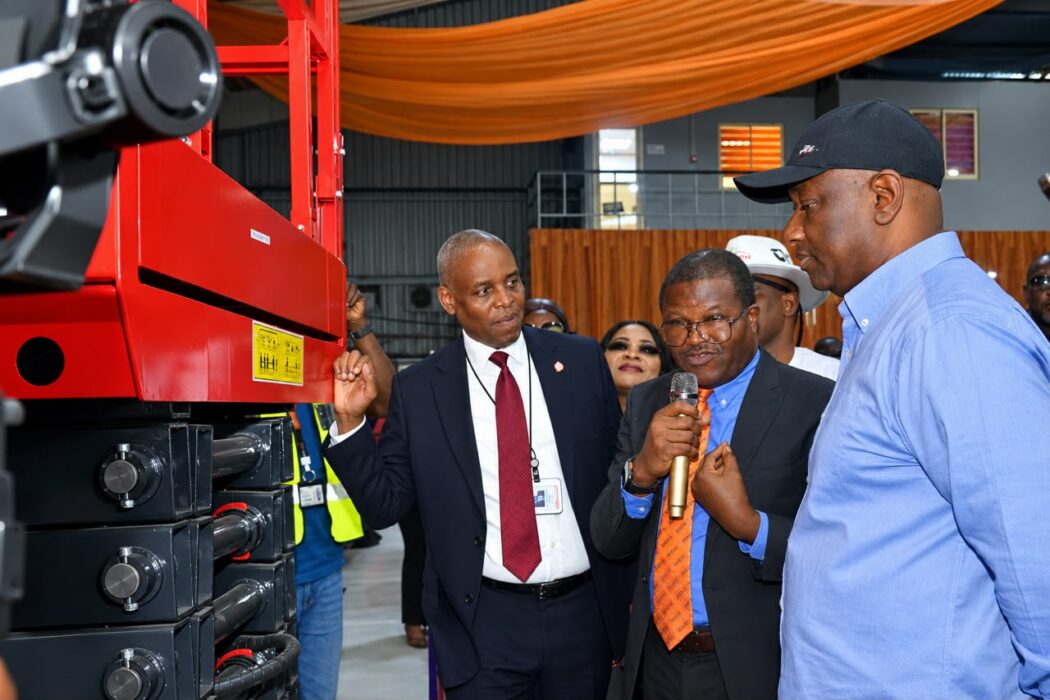
The Minister of Aviation and Aerospace Development, Festus Keyamo, has said that the removal of fuel and foreign exchange subsidies has enabled the Federal Government to mobilise $500 million for the reconstruction of Lagos Airport without borrowing.
The minister, who spoke at the 67th anniversary celebration of Aero Contractors, said the development marked a departure from decades of infrastructure financing constraints, during which much of the country’s oil earnings was spent on subsidies rather than development.
Nigeria’s Aviation Reforms Attract New Routes, Aircraft, Crash Airfares – Keyamo
N522m Arms Procurement Predates Keyamo’s Tenure — Minister’s Aide
Keyamo Seeks IATA Review Of Osubi Airport Code
Keyamo said the funds became available as government liquidity and foreign reserves improved following the subsidy reforms, allowing the administration to channel more resources into critical infrastructure.
“In less than two years, after we removed subsidies, from both money and fuel, in less than two years, the President raised $500 million to rebuild the Lagos Airport. Not money borrowed, but because our liquidity rose,” he said.
“In less than two years, after we removed subsidies, from both money and fuel, in less than two years, the President raised $500 million to rebuild the Lagos Airport,” Keyamo said.
“Not money borrowed, but because our liquidity rose. Our foreign reserve also rose from $3 billion to $56 billion now, and investors are rushing to the country because they now see the country as viable.”
The minister said the development represented a major shift from the financing constraints that had characterised infrastructure development in the country for decades.
According to him, Nigeria had struggled to finance major infrastructure projects because a large portion of its oil earnings was previously channelled into subsidising petroleum products and supporting the naira.
“We could not raise money to do anything in the last 50 years, because there was no money. The thing we managed to do was that we borrowed money from the Chinese, and we are paying back that money,” he said.
Keyamo said the country’s major airport infrastructure had suffered years of deterioration as government resources were constrained by subsidy commitments.
“Why was there no money? All the monies we were earning in this country, from oil, were going to subsidies. Very simple. Our major earnings from oil, when we made money, all the monies went to subsidising PMS and suppressing the Naira,” he said.
He explained that the four major airport terminals in Lagos, Abuja, Kano and Port Harcourt were largely developed through Chinese financing because the country lacked the financial capacity to independently fund such projects at the time.
“The four major airports sent out to build, started under Jonathan, or under Yar’Adua and the three under Buhari, which is the Chinese terminal now, in Lagos, in Abuja, in Kano and Port Harcourt were done by monies borrowed from the Chinese,” Keyamo said.
The minister said the government was now pursuing a broader programme of airport infrastructure development, with projects spanning major airports across the country.
“I only talked about the Lagos airport. Within that same approval, the total amount was 1 trillion. It was only $500 million; there are other approvals – total reconstruction of Kano runway, we are resurfacing Port Harcourt, we are about to start resurfacing Akure airport runway,” he said.
Keyamo said the infrastructure programme was also expected to generate employment, noting that the reconstruction of the Lagos airport was already providing jobs for thousands of Nigerians.
“Look at the number of people that would have been employed as we are building the Lagos Airport,” he said.
According to him, the China Civil Engineering Construction Corporation (CCECC), which is involved in the project, had engaged more than 2,000 Nigerians daily.
“CCECC has brought in more than 2,000 Nigerians every day now, who were previously unemployed, all local people,” he said.
The minister also disclosed that President Bola Tinubu had approved the return of CCECC to the Abuja airport second-runway project, which he said had suffered years of delay.
He recalled that the project had initially been estimated at about N45 billion but now costs nearly N400 billion, demonstrating the financial consequences of delaying infrastructure projects.
“15 years or nearly 20 years later, it’s now costing us nearly 400 billion. That is the danger in delaying the building of infrastructure because the prices will go up everyday,” Keyamo said.
He said the Federal Government was also planning an extension of the Lagos Red Line to improve rail connectivity to the airport.
“The President has approved and we have drawn the plan and are about to go to FEC, we want to start the Red Line now. It is from Ikeja bus stop run through GAT and MMA2, having a stop at Airport Base and continue to the new terminal, where it would stop underground,” he said.
Beyond infrastructure, Keyamo said the government was implementing policies aimed at strengthening domestic airlines by improving their access to aircraft and encouraging subnational governments to establish airlines.
“After that, we have also concentrated on policies, which is to empower airlines to have access to aircraft. Because of policies, we have subnationals now coming up with airlines: Enugu, Bayelsa, Sokoto and Edo is about to start something,” he said.
Keyamo said the infrastructure and policy measures formed part of the Federal Government’s broader strategy to strengthen the aviation industry and support economic growth.
“That is how the Renewed Hope agenda is affecting the aviation sector positively,” he said.
We’ve got the edge. Get real-time reports, breaking scoops, and exclusive angles delivered straight to your phone. Don’t settle for stale news. Join LEADERSHIP NEWS on WhatsApp for 24/7 updates →
Join Our WhatsApp Channel