At one time, a queue could stop a Nigerian in his tracks. At the airport, bus stop, bank, or government office, people waited their turn.
Not always happily, and certainly not because Nigerians had suddenly become saints, but because the War Against Indiscipline had made disorder a public concern. Today, the queue has become a contest of elbows, connections and shameless audacity. Whoever pushes hardest often gets served first. The rest are expected to accept humiliation as normal.
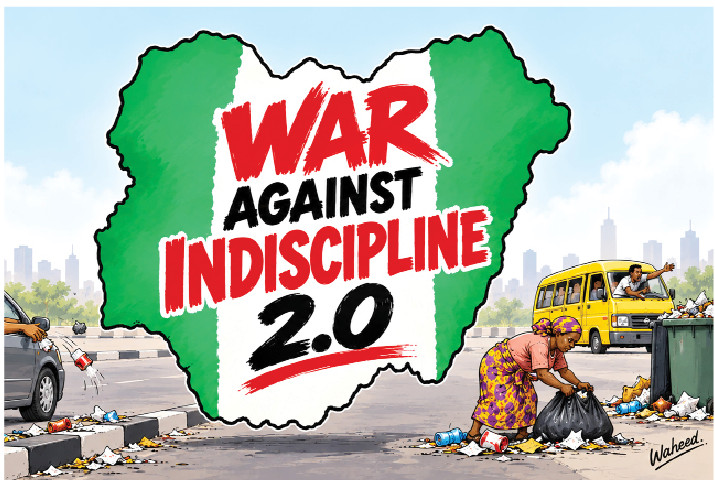
That small scene captures a much larger national problem. Across our cities and towns, indiscipline has become so familiar that we barely notice it. Drivers run red lights, drive against traffic and treat road signs as suggestions. Motorists block intersections because they cannot wait for the road ahead to clear. Commercial buses stop wherever a passenger waves. Motorcycles mount pavements. Pedestrians cross expressways recklessly, while some drivers respond to congestion with horns, insults and dangerous manoeuvres.
We litter streets from moving vehicles, dump refuse into drainage channels and then act surprised when floods invade homes and businesses. Traders occupy roads and walkways, forcing pedestrians into traffic. Street begging has expanded, while open defecation persists in communities where sanitation facilities are absent, broken or neglected. Public spaces are treated as nobody’s responsibility, and therefore as everybody’s dumping ground.
Remembering the War Against Indiscipline
In 1984, the military government of Major General Muhammadu Buhari introduced the War Against Indiscipline as a national campaign to restore order and promote civic responsibility. Its early, visible demand was simple: queue. Nigerians were expected to wait their turn at bus stops, post offices, banks, airports and other public places. The campaign expanded to work ethics, patriotism, environmental sanitation, protection of public property and other aspects of public conduct. Radio, television, public messaging and the WAI Brigade reinforced the message that nation-building began with everyday behaviour.
But nostalgia must not erase the flaws. WAI operated under military rule, and its enforcement sometimes involved humiliation, arbitrary punishment and abuses of power. A democratic Nigeria must not revive those excesses. Citizens have rights, officials must follow due process, and no campaign for public order should become a licence for brutality or the selective harassment of the poor.
However, we cannot deny the fact that we need some sort of reenactment of WAI to set things back on track and instil discipline.
Disorder Has Become Everybody’s Business
Look closely at our streets. A driver who drives against traffic may save five minutes, but forces dozens of others into danger and delay. Someone who throws a takeaway pack into a gutter may consider it insignificant, until the drain clogs and the neighbourhood floods. A trader who occupies a pavement may earn a living, but the pedestrian pushed into a moving lane pays the price. A person who jumps a queue is making a statement: my time matters more than yours.
The same contempt for shared rules appears in public offices, where visitors can be made to wait while officials arrive late or attend to favoured acquaintances. It appears in reckless parking, noise pollution, illegal dumping and the destruction of public facilities. It appears when people urinate or defecate in open spaces because there is no accessible toilet or because a facility exists but is filthy, locked or poorly maintained. We must distinguish deliberate disregard from failures of public provision, but neither can be ignored.
Street begging also demands a humane, practical response. Poverty, displacement, disability and insecurity push people onto the streets. Simply chasing beggars from one junction to another does not solve those problems. Governments need social protection, accessible services, child-protection measures and support for people who cannot provide for themselves. At the same time, dangerous obstruction of roads and public spaces must be addressed through lawful, coordinated action, not sporadic raids that merely move vulnerability elsewhere.
Indiscipline thrives when enforcement is unpredictable. The person fined for littering watches a politically connected offender dump a truckload of waste without consequence. The motorist stopped for a traffic violation sees another driver wave an official through a red light or against traffic with sirens. The ordinary citizen is told to obey, while the powerful appear exempt. Such double standards do more than weaken enforcement; they teach people that rules are for those without influence.
A New WAI, Without the Whip
Nigeria needs a renewed War Against Indiscipline, not a nostalgic imitation of military rule, but a sustained national compact for public order. The Federal Government, states and local governments should agree on a civic code covering traffic, sanitation, waste disposal, queuing, street trading, public toilets and the protection of walkways.
Enforcement must be consistent. Traffic offences should attract lawful, proportionate penalties; repeat offenders should face escalating consequences. Waste dumping should be met with reliable collection services, accessible disposal points and penalties that apply to households, businesses and large operators alike. Markets need designated trading areas and workable loading arrangements. Public toilets must be built, maintained and affordable, especially around markets, motor parks and busy transport corridors. It is unreasonable to demand sanitation where government has provided no realistic means to practise it.
A modern campaign should also make civic education continuous. Schools, religious institutions, community associations, transport unions, media organisations and employers can teach practical habits: queue patiently, keep public spaces clean, respect traffic lights, protect public property and challenge misconduct without violence. Communities could track cleared drainage channels, functioning public toilets, reduced illegal dumping and improved traffic compliance.
Technology can help through accessible channels for reporting hazards and tracking complaints, provided privacy is protected and reports are acted upon. But no app can replace a working sanitation department, a traffic officer who refuses a bribe or a local authority that collects refuse on schedule. Enforcement must be adequately funded, transparent and open to complaints. Officials who extort citizens or abuse their powers should face consequences too.
The Wake-Up Call
Nigeria’s problem is not that its people are incapable of discipline. We have seen order emerge when rules are clear, services work and compliance is expected of everyone. We queue when the system makes queueing possible. We keep places clean when waste is collected and littering carries consequences. We respect traffic rules when enforcement is present and no one is exempt.
The challenge is to make responsible behaviour ordinary rather than exceptional. We cannot keep demanding a better Nigeria while treating the street outside our homes as someone else’s problem. We cannot complain about government failure and then sabotage public life through selfishness, recklessness and contempt for our neighbours. Citizenship is not only the right to demand services; it is also the responsibility to protect the common good.
Nigeria does not need a new era of fear. It needs an era of consequence, fairness and civic pride. The driver who blocks an intersection, the trader who obstructs a walkway, the resident who dumps refuse in a drain and the official who demands obedience while breaking the law must all hear the same message: public space belongs to all of us, and none of us has the right to destroy it.
The time for excuses is over. A renewed WAI must begin with leadership, reach every neighbourhood and endure beyond a launch ceremony. It must make discipline visible, practical, fair and favourable. Our streets, our institutions and our collective future are telling us plainly: wake up, Nigeria.
This article is a public service announcement to end the chaos!
We’ve got the edge. Get real-time reports, breaking scoops, and exclusive angles delivered straight to your phone. Don’t settle for stale news. Join LEADERSHIP NEWS on WhatsApp for 24/7 updates →
Join Our WhatsApp Channel