Electricity distribution companies (DisCos) have questioned the conflicting explanations offered by the Nigerian National Petroleum Company Limited (NNPC) and the Nigerian Independent System Operator (NISO) over the nationwide power shortages.
The Minister of Power, Joseph Tegbe, has urged Nigerians to be patient, saying the full impact of the government’s power sector reforms would be felt in three to five years.
He said the problems could not be resolved overnight and that Nigerians should expect gradual improvements in electricity supply.
Power Outages: NNPC Refutes Claims of Gas Supply Constraints
The minister spoke in an interview with TVC News on Monday, the same day the Managing Director of the Association of Nigerian Electricity Distributors (ANED), Sunday Oduntan, apologised to Nigerians and criticised the blame game among sector operators during an appearance on Channels Television’s Sunrise Daily.
Conflicting Claims
Oduntan said NISO and NNPC had given different accounts of the factors responsible for the power shortages.
He said NISO had attributed the shortfall partly to low water levels and inadequate gas supply, while NNPC subsequently stated that its gas network had recorded no constraints affecting deliveries to power plants.
According to him, the NNPC statement omitted key information.
“From the NNPC statement, it is very clear that they came to tell us half-truths. What I would have expected NNPC to do is to go ahead and talk to us whether there are payment issues. We need to know whether gas was paid for and delivered, who did, who didn’t,” he said.
He identified the disagreements among gas suppliers, NNPC, the Transmission Company of Nigeria (TCN) and NISO as part of the problem, urging the Minister of Power to intervene.
“This back-and-forth blame game between gas suppliers, NNPC and, of course, TCN or NISO, I think the Minister of Power needs to take charge. There is a need for this leadership because, at the end of the day, they need to call them together,” he said.
DisCos, GenCos Return To Blame Game
Oduntan said the sector was reverting to the pattern witnessed between 2016 and 2019, when DisCos, TCN, generation companies (GenCos) and gas suppliers blamed one another for poor electricity supply.
“Part of what happened at that time was that people would blame the DisCos, DisCos would blame TCN, TCN would blame GenCos, GenCos would blame the gas suppliers, and gas suppliers would blame payment issues. We have returned to that, and I think there is a need to arrest that,” he said.
He also apologised to Nigerians over the prolonged outages.
“I’d like to first of all start by apologising to Nigerians. Apology is needed; it is essential because Nigerians have been taken through this problem over the past few weeks,” he said.
Minister Seeks Patience
Urging patience, Tegbe noted that he had been in office for only five months, adding that the challenges confronting the sector could not be resolved immediately.
“I took office in June and have only served as minister for five months, though it sometimes feels like five years. The truth is, there are challenges at every stage of the value chain,” he said.
He added that the sector needed more infrastructure and generation capacity, saying Nigerians should begin to feel the impact of government interventions within three to five years.
The minister also apologised to Nigerians over the outages, particularly in Lagos and other affected states. He said President Bola Tinubu shared the public’s concerns and that the government was doing everything possible to address the problem.
“Nigerians deserve to have electricity. It is not rocket science,” he said.
Gas Supply, Debts Affect Generation
On gas supply, Tegbe said Nigeria had sufficient gas for power generation but faced constraints along the supply chain.
“I can tell you categorically, we have gas. There is gas availability for us as a nation. It is a comparative advantage. However, within the gas supply chain, there are constraints,” he said.
He identified the inability of GenCos to pay for gas, partly because of debts owed to them, as a major constraint.
The minister said the Federal Government had reduced the outstanding debt to N3.3 trillion.
“In the last few months, we have paid down N1.23 trillion. We only have N2 trillion left,” he said, adding that the remaining N2 trillion would be paid next year.
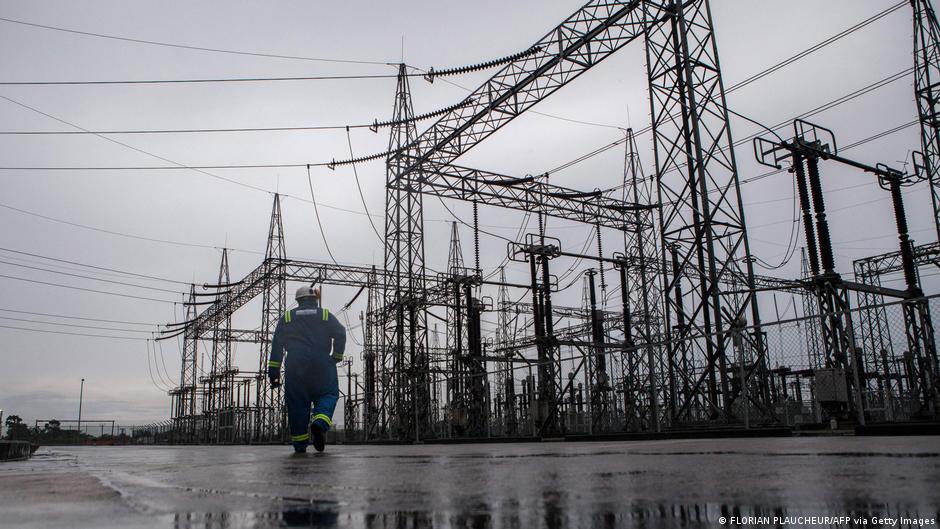
Tegbe said the recent disruption was not a national grid collapse but a decline in electricity supply. He attributed it to planned maintenance at the Egbin Power Plant and the vandalism of a 330-kilovolt transmission line serving Lagos.
He said the line supplied the Lagos complex with between 300 and 400 megawatts, while the disruption at Egbin reduced available generation by nearly 800 megawatts. The combined effect forced load shedding across Lagos, Ogun and parts of Kwara State.
According to him, Egbin’s ST1 turbine had returned to service, while he had been assured that the ST3 turbine would resume operation later on Monday, adding about 150 megawatts to supply in Lagos.
He said electricity supply to the Lagos complex stood at about 1,000 megawatts on Sunday night and Monday morning.
In a subsequent social media update, the minister said power had been restored to parts of Lagos, Ogun, Oyo and Kwara states, as well as the Federal Capital Territory, after the Benin-Egbin transmission line was repaired and returned to service.
Ageing Infrastructure, Vandalism Compound Challenges
Tegbe acknowledged that much of the country’s electricity infrastructure was ageing.
“Some of the equipment we have is 40 to 50 years old,” he said.
He said only three transmission lines supplying Lagos were operational, while a fourth, running from Oshogbo to Ikeja West through Oshodi, had been out of service for more than 18 months.
According to him, restoring the line would add about 400 megawatts to electricity supply in Lagos. He expressed confidence that it would be restored by the end of November.
He said about six towers along the route had been vandalised, while the swampy terrain was slowing repair work.
The minister said the government had established a task force to tackle vandalism, comprising the Ministry of Power, TCN, NISO, the Office of the National Security Adviser, Homeland Security and the Department of State Services.
He said many vandalised installations were located in areas also affected by kidnapping and banditry.
The government, he added, planned to deploy helicopters and drones to monitor critical installations. It also intended to seek amendments to the law because suspected vandals were tried in magistrate courts, a process he said could delay justice.
FG Targets Grid Expansion, Solar Mini-Grids
Tegbe said the government was strengthening the national grid to improve supply to major cities such as Lagos, while deploying solar mini-grids to remote communities where extending the grid would be too expensive.
He cited Talase in Gombe State, which he said had been without electricity for 17 years.
According to him, some communities already enjoy round-the-clock electricity from solar mini-grids with capacities of between 17 and 20 megawatts.
Public Anger Mounts Over Poor Supply
The persistent outages have attracted widespread public criticism.
Actress Kate Henshaw said Nigerians had effectively turned their homes into “mini-factories” because they were forced to generate their own electricity.
Content creator Cute Abiola also appealed to President Tinubu in a video, highlighting the heat and the lack of affordable alternatives to public electricity supply.
The shortages have also renewed questions about the Band A, B and C tariff structure, as Band A customers, who are entitled to at least 20 hours of electricity daily, complain that they are not receiving the promised supply.
High petrol and diesel prices have made generator use increasingly expensive, while solar and inverter systems remain beyond the reach of many households.
Some Nigerians and civil society groups have called for Tegbe’s resignation. Their demands followed his appeal for calm on Saturday and his promise that electricity supply would improve within 48 to 72 hours.
We’ve got the edge. Get real-time reports, breaking scoops, and exclusive angles delivered straight to your phone. Don’t settle for stale news. Join LEADERSHIP NEWS on WhatsApp for 24/7 updates →
Join Our WhatsApp Channel