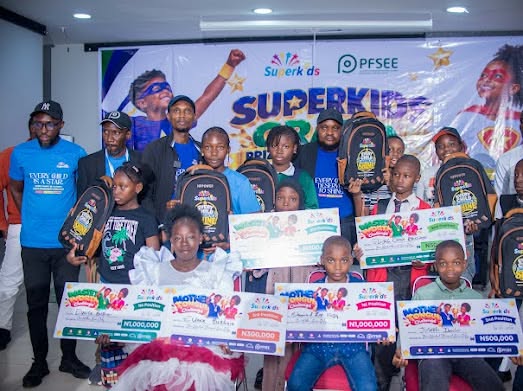
A young girl from Yobe State who discovered how to transform waste into useful materials and a boy from Kakanda-speaking community have each won ₦1 million in the maiden edition of the Shelta SuperKids Mother Tongue and Waste to Worth challenges.
The two children emerged as winners in the respective categories at the programme’s Cohort 1 prize-giving ceremony held at Novare Mall, Wuse Zone 5, Abuja, on October 28, 2026.
Eunice Bishara, from Yobe State, clinched the grand prize in the Waste to Worth challenge after six weeks of demonstrating how discarded materials could be converted into useful products.
Meanwhile, Muhammad Zaik Musa, an Abuja-based boy whose family is originally from Niger State and belongs to the Kakanda ethnic community, won the Mother Tongue challenge, bringing attention to a language spoken by a minority community in Nigeria.
The initiative, a free programme for children aged between six and 12, is powered by the Shelta Impact programme and seeks to encourage creativity, environmental awareness and the preservation of indigenous languages among young Nigerians.
According to the organisers, the first cohort offered prizes worth up to ₦8 million for participating children and their coaches.
Bishara emerged as the overall winner of the Waste to Worth challenge, receiving ₦1 million for her ability to turn waste materials into useful items.
Elijah Osose, from Abuja, finished as first runner-up and received ₦500,000, while Salma Ndatsu, also from Abuja, secured third place with ₦300,000.
Speaking at the ceremony, Bishara said the experience helped her discover abilities she had not previously recognised.
“The SuperKids challenge helped me discover my creative side and how much I can achieve,” she said.
Beyond her victory in the environmental challenge, Bishara also secured third place in the Mother Tongue category, earning an additional ₦300,000 and bringing her total prize money to ₦1.3 million.
In the Mother Tongue category, Muhammad Zaik Musa emerged champion, winning the ₦1 million grand prize.
Joseph Ibrahim, from Borno State, finished as first runner-up with ₦500,000, while Bishara took the second runner-up position with ₦300,000.
Muhammad’s victory placed the Kakanda language, spoken by a minority ethnic community, at the centre of a programme designed to reconnect Nigerian children with their cultural roots.
Expressing excitement over his achievement, Muhammad said the challenge had deepened his understanding of his heritage.
“I am excited and happy to win,” he said.
“This has helped me learn about my roots and learn new words, and it helped me discover myself.”
His father, Mr Zaik, also described the initiative as beneficial to the family, particularly because it encouraged parents and children to learn their indigenous language together.
“It strengthened our family bond as we worked on learning our language together, and it increased Muhammad’s interest in his mother tongue,” he said.
He urged the organisers to sustain the initiative, adding, “I want the programme to continue.”
The focus on indigenous languages comes amid concerns about the survival of Nigeria’s linguistic diversity.
Nigeria has approximately 520 living indigenous languages, with Ethnologue classifying 167 as endangered, highlighting the need for deliberate efforts to encourage younger generations to learn and use their ancestral languages.
Beyond celebrating the children, Shelta SuperKids also recognised the teachers and coaches who supported participants throughout the challenges.
The organisers said the programme was designed to strengthen teachers’ capacity, recognising their role in shaping children’s education and development.
In the Mother Tongue category, Zainab Hassan Sule, coach to the overall winner, received ₦500,000, while Emmanuel Yaya Gata, coach to the third-place winner, received ₦150,000.
For the Waste to Worth challenge, Gata received ₦500,000 for coaching the winning participant, while Okiemute Mercy Ezinne and Fauziyah Suleiman received ₦250,000 and ₦150,000, respectively, for coaching the first and second runners-up.
No coach prize was awarded for the Mother Tongue first runner-up because Joseph Ibrahim did not have a registered coach. According to the organisers, registering a coach is the responsibility of the participating child’s parent.
Gata, who coached Bishara in Yobe State, said the experience had inspired him to extend the programme’s impact beyond the competition.
“The SuperKids programme inspired me to create a community of children learning their mother tongue and eco champions converting waste to worth,” he said.
“I am happy because our language is our identity, and excited because the programme recognises the impact of teachers in society.”
Another winning coach, Mrs Okiemute Mercy Ezinne, emphasised the importance of identifying and nurturing children’s individual abilities.
“Every child has unique abilities and talents that must be discovered,” she said.
“This is one of the core aspects of education we must not neglect, and it highlights the impact and difference the SuperKids programme is making.”
The programme manager, Emmanuel Adeola, also stressed the need to recognise and empower teachers as part of efforts to improve the education sector.
“Teachers are the SI unit of the education sector,” he said.
“The nation will remain stagnant if teachers are not appreciated and empowered to impact the lives of children.”
Speaking on the motivation behind the initiative, Shelta Chief Executive Officer and programme convener, Austin Igwe, said the programme was established to reconnect children with their cultural identities while providing opportunities for them to develop their talents.
“Our goal is to bring our languages back into society, connect our children to their cultural identity, and discover, nurture and provide global platforms for them,” he said.
Igwe also disclosed that the next cohort would be expanded to accommodate more children and teachers, with additional learning opportunities.
“It will bring more opportunities for children and teachers, and it will include foreign languages and new programmes,” he said.
“We are also looking at collaborating with international embassies to drive impact.”
We’ve got the edge. Get real-time reports, breaking scoops, and exclusive angles delivered straight to your phone. Don’t settle for stale news. Join LEADERSHIP NEWS on WhatsApp for 24/7 updates →
Join Our WhatsApp Channel